Hunesion Shares N2SF Transition Strategy at AIDC Security Technology Workshop
TECHWORLD ·
✦ AI Summary
Hunesion said on the 8th that it shared its N2SF adoption case and adoption strategy at the "AIDC Security Technology Workshop."
At the event, public AIDC build and security strategies, AIDC security-focused technologies and supply chain security, and N2SF adoption strategies for national and public institutions were shared.
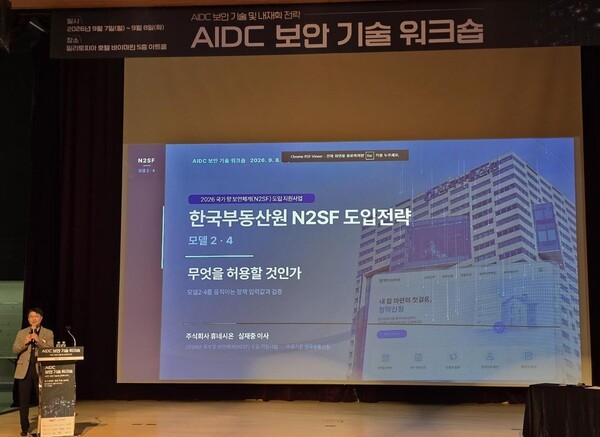
Hunesion presented the "N2SF Adoption Strategy for Korea Real Estate Board" and a strategy for implementing an information transfer system based on "i-oneNet CDS (i-oneNet CDS)."
Hunesion said on the 8th that it introduced its N2SF adoption case and shared its adoption strategy at the "AIDC Security Technology Workshop." The event, held over two days from the 7th to the 8th, brought together experts from industry, academia, research, and government and covered public AIDC build and security strategies, AIDC security-focused technologies and supply chain security, and N2SF adoption strategies for national and public institutions.
At the event, Hunesion gave a presentation on the theme of "N2SF Adoption Strategy for Korea Real Estate Board." The presentation covered practical deployment strategies for National Network Security Framework (N2SF) Models 2 and 4, as well as the direction for building the National Network Security Framework (N2SF) Models 2 and 4.
Hunesion introduced a case from its ongoing "2026 National Network Security Framework (N2SF) Adoption Support Project" for Korea Real Estate Board. It then presented a strategy for implementing an information transfer system based on "i-oneNet CDS (i-oneNet CDS)."
Hunesion explained that "i-oneNet CDS (i-oneNet CDS)" has a function that controls the release and import of work files. It also said safe information transfer is possible based on file type, information level, approval status, security inspection, and audit history.
Hunesion explained that the N2SF transition is not simply a matter of connecting the work network to external services. The basis for the N2SF transition is the "permission conditions" framework, and the criteria presented for defining the scope of permission included users, devices, services, information levels, and usage conditions. It said the key lies in defining the scope of permission in detail and technically implementing it.
Hunesion is the lead company for the project, and the demand institution is Korea Real Estate Board. Hunesion is overseeing the consortium for the Korea Real Estate Board demand institution and is responsible for integrated design, project management, and the establishment of a file transfer linkage system.
Through this project, Hunesion secured experience in designing and building N2SF Models 2 and 4. The company plans to actively use this experience in future N2SF transition projects for public institutions. It also plans to strengthen its capabilities in controlling and verifying data movement and to continue upgrading its information linkage security framework optimized for the N2SF environment, based on its technology and i-oneNet CDS, which are core technologies and products in the network linkage field it has accumulated over time.
Jung Dong-seop, CEO of Hunesion, said the company has accumulated hands-on building experience through the Korea Real Estate Board N2SF adoption support project and has proven network linkage technology, adding that it will use this to support the safe use of AI and external services by public institutions and contribute to building an N2SF environment.
Source: TECHWORLD · Kim Hye-jin
Original: https://www.epnc.co.kr/news/articleView.html?idxno=406696
References
This article was produced with the help of an automated content generation algorithm.
Source: TECHWORLD
View originalThis article was summarized and organized by BizCrush based on the original article from TECHWORLD. For exact quotations and full details, please refer to the original article.