ETRI and Korea Military Academy to Develop AI-Based Future Defense Technologies
TECHWORLD ·
✦ AI Summary
ETRI and the Korea Military Academy signed a memorandum of understanding (MOU) for research on AI-based future defense technologies and field demonstrations.
The core of the cooperation is "AI-In-Glass technology development for personal AI agents," which ETRI launched this year, a glasses-type wearable AI technology that understands surrounding conditions and provides the needed information in front of the user.
The two institutions plan to jointly research technologies that support soldiers' and commanders' decisions, establish military operational concepts, conduct demonstrations, and identify new national R&D projects.
The development of future defense technologies is now moving into full swing. AI is being pursued as a system that will serve as a soldier's eyes and ears, understanding surrounding conditions and providing the information needed in real time. The goal is to support soldiers in carrying out their missions and help commanders make decisions.
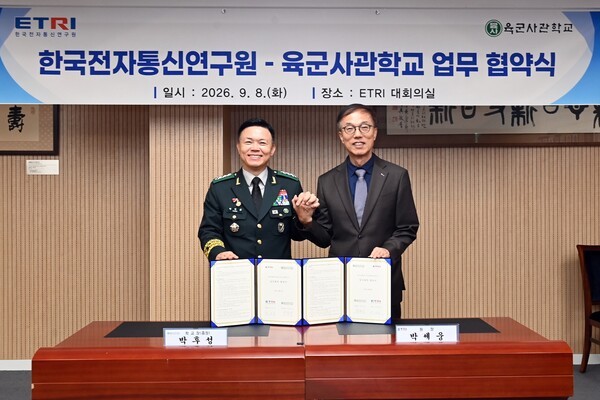
The Electronics and Telecommunications Research Institute (ETRI) and the Korea Military Academy signed a memorandum of understanding (MOU) for research on AI-based future defense technologies, the establishment of military operational concepts, and field demonstrations. The agreement was pursued based on ETRI's AI and information and communications technology (ICT) capabilities and the Korea Military Academy's expertise in military and tactical fields.
The two institutions set the agreement's goal as combining cutting-edge AI technology with military expertise to develop AI technology created in the laboratory into something that can be used in actual military missions. To that end, they plan to combine their respective AI and ICT capabilities and military and tactical expertise to turn technologies at the research stage into forms that can be applied to field missions.
The agreement also marked an opportunity to expand cooperation from individual research projects to a sustained institution-level research collaboration framework. Going forward, the two institutions plan to broaden the scope of cooperation to the soldier domain, small-unit command and control, defense networks, and manned-unmanned integrated systems, and to expand into the broader field of future defense AI technologies.
ETRI said the core of the cooperation is its strategic research project launched this year, "AI-In-Glass technology development for personal AI agents."
AI-In-Glass (In-Glass) is a technology that combines AI with glasses-type wearable devices. ETRI said the technology is intended to understand in real time the surrounding situation that the user sees and hears, and to provide the necessary information in front of the user's eyes to support situational assessment and decision-making.
ETRI said that if this technology is applied to the defense sector, soldiers will be able to quickly grasp surrounding conditions, risk factors, and operational information while carrying out missions, and receive necessary information in real time. It also said that by synthesizing and providing field information gathered by multiple soldiers to commanders, it can accelerate commanders' situational understanding and assist command decisions.
ETRI emphasized that this would act as a "personal AI assistant" that provides soldiers with timely information needed in the field without requiring them to constantly check a separate device, while also assisting commanders in making judgments.
Through the strategic research project, ETRI will jointly develop four core technologies. Core technology 1 is spatial intelligence for precise recognition of surrounding spaces and objects, and core technology 2 is a personal AI agent that provides user-tailored information based on the situation. Core technology 3 is a low-power, high-resolution display for clear information presentation, and core technology 4 is AR device and portable AI computing technology for realizing an actual glasses form factor.
ETRI's goal is to secure core foundational technologies for AI-In-Glass by combining AI software with display and device technologies. The two institutions aim to use this technology to help front-line battlefield soldiers grasp needed information more quickly and to support small-unit commanders in making effective judgments in limited time and information environments. They also aim to develop field-centered defense AI technologies.
ETRI said that technological excellence alone may make actual battlefield use difficult. It also explained that utilization would be limited if the technology does not align with the military command structure. It added that, in order for defense AI to be used as real military capability, not only advanced technology but also an understanding of the military operational environment and mission procedures is essential.
Accordingly, the two institutions plan to reflect military requirements from the early stages of research and development. They will also pursue technology development, the establishment of military operational concepts, and field demonstrations in parallel.
Under the agreement, ETRI will be responsible for developing core technologies based on its research capabilities in the AI and ICT fields, while the Korea Military Academy, as a military education institution that trains elite Army officers, will use its expertise in small-unit tactics and command procedures to take part in establishing military operational concepts and deriving user requirements. The Korea Military Academy will also support demonstration, testing, and evaluation of the developed technologies by using its training facilities and related resources.
Accordingly, the two institutions will jointly research technologies to support situational awareness and decision-making for future soldiers based on wearable AI such as AI glasses, human-AI collaboration technologies, command and control technologies including at the small-unit level, defense network technologies, and technologies to ensure the safety and reliability of AI use in the national security field.
The two institutions plan to continue cooperating to link joint research results to military education and training, as well as to actual military capabilities.
ETRI said that as AI use expands in the defense sector, ensuring accuracy, reliability, and security is important, and that it is necessary to prevent incorrect information or AI misjudgments from affecting mission performance. To this end, it will pursue research on technologies to verify AI judgment results and also pursue research on technologies that support safe final human decision-making.
ETRI and the Korea Military Academy are currently jointly carrying out 3 national R&D projects in the AI and defense fields, including this strategic research project. Through this agreement, the two institutions aim to develop project-level cooperation into a sustained institution-level research collaboration framework.
To that end, ETRI and the Korea Military Academy plan to jointly identify and plan new national R&D projects in the defense AI field. They also plan to promote research and academic exchanges, as well as cooperation to cultivate defense AI specialists.
The two institutions will pursue cooperation by combining ETRI's AI and ICT technologies with the Korea Military Academy's military expertise. Based on this, they intend to fully accelerate the securing of future defense technologies that can be used in actual military operational environments.
ETRI President Park Se-woong said that in future defense AI, understanding the actual military operational environment and carrying out field verification are important, in addition to developing advanced technologies. He added that by combining ETRI's AI and ICT technologies with the Korea Military Academy's military expertise, the institute will pursue the development of defense AI technologies that make a practical contribution to military mission performance and combat capabilities in areas such as future soldier support, command and control, and defense networks.
Korea Military Academy Superintendent Park Hu-seong said that advanced science and technology, including AI, are rapidly changing the shape of the future battlefield. In response, he said the academy will pursue the combination of its military expertise with ETRI's AI technology to support future soldiers in carrying out their missions and in making command decisions, and connect that effort to practical results that contribute to the future development of the Korean military's combat capabilities.
Source: TECHWORLD · Lee Gwang-jae
Original: https://www.epnc.co.kr/news/articleView.html?idxno=406651
References
This article was produced with the help of an automated content generation algorithm.
Source: TECHWORLD
View originalThis article was summarized and organized by BizCrush based on the original article from TECHWORLD. For exact quotations and full details, please refer to the original article.