Policy Proposal for AI National Assembly Audit Released... Calls for Tracking Who Benefits From Budget
AI TIMES ·
✦ AI Summary
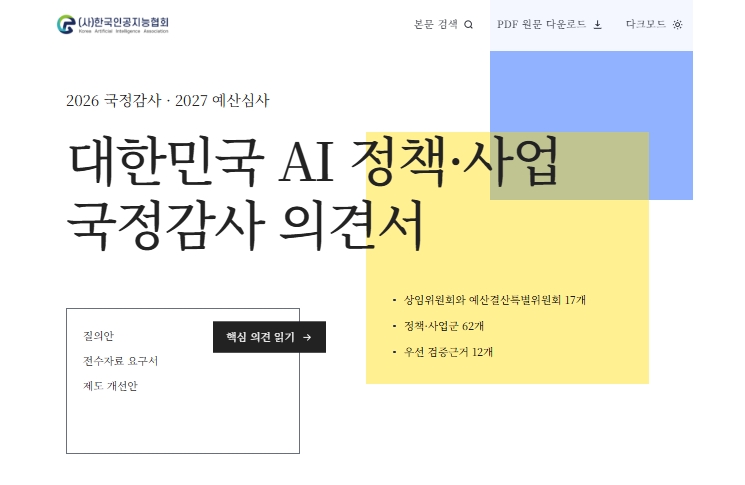
According to AI TIMES, the Korea Artificial Intelligence Association said it released an AI policy proposal for use at the October 6 Nationa…
According to AI TIMES, the Korea Artificial Intelligence Association said it released an AI policy proposal for use at the October 6 National Assembly audit and that a verification system is needed to reveal the final beneficiaries of AI funding. The proposal targets 17 standing committees and the Special Committee on Budget and Accounts, and it was compiled as reference material to help the National Assembly with follow-up scrutiny by organizing 62 policy and project categories. The association said public investment should be examined to determine whether it actually leads to corporate growth, stronger operational capabilities for recipient institutions, and career development for young people. In particular, it proposed distinguishing between budgets delivered to specialized institutions and the entities that actually received support in the field, so that budgets, contracts, and outcomes can be checked together. It also stressed that publicly supported infrastructure and models should clearly define usage conditions so that small companies can meaningfully access them. In addition, it said AX projects should be designed around on-site operations, and youth support should seamlessly connect pathways to employment, retraining, and entrepreneurship.
Perspective
This proposal is meaningful in that it shifts the debate away from how much of the AI budget was spent and toward who benefited and what changes it produced. In particular, if the ideas of tracking final beneficiaries, checking usage conditions, and designing around real-world operations become actual verification standards, responsibility for explaining outcomes may weigh more heavily than simply winning projects. For the industry, it signals that the barriers to public support and the way it is distributed will be examined again, and for policies supporting recipient institutions and young people, it suggests that standards emphasizing sustainability rather than one-off execution may grow stronger.
This perspective is BizCrush's own commentary and is not part of the reporting by AI TIMES.
This article was produced with the help of an automated content generation algorithm.
Source: AI TIMES
View originalThis article was summarized and organized by BizCrush based on the original article from AI TIMES. For exact quotations and full details, please refer to the original article.