[DigiKey TechForum] High-Efficiency Power Conversion Guide 1: Limits of 48V Step-Down Design and the Rise of Hybrid Converters
TECHWORLD ·
✦ AI Summary
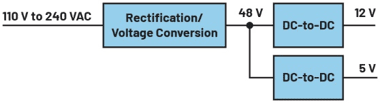
Conventional buck regulators lose efficiency when converting a 48V input to low output voltages such as 12V and 5V.
Transformer-based architectures can adjust the duty cycle through the turns ratio, but they also incur additional transformer losses.
A hybrid converter is a two-stage structure that combines a charge pump and a buck regulator, first lowering the input voltage by about 1/2 before converting it to the final output in the downstream buck stage.
High-Efficiency Power Conversion Guide 1 covers the limits of 48V step-down design and the emergence of hybrid converters. Conventional buck regulators have difficulty delivering low output voltages from a 48V input. In particular, as conventional buck regulators convert a 48V intermediate-voltage rail to even lower output voltages, efficiency declines.
When converting 48V to 5V, the required duty cycle is about 9.6%. In such a low-duty-cycle range, conversion efficiency may deteriorate. Power loss may also increase in the same range.
A transformer-based architecture is presented as an alternative. Examples include push-pull and forward converters. Transformer-based architectures can adjust the duty cycle by using the turns ratio.
Using the turns ratio can improve conversion efficiency. However, additional transformer losses occur, limiting the extent of the efficiency gains. In other words, even if transformer-based structures offer room for improvement in terms of duty cycle, they also bring loss issues.
Accordingly, in applications where galvanic isolation is not required, a design that does not use a transformer is recommended. Even if transformer-based structures have advantages, transformer losses themselves must also be taken into account.
When a conventional buck converter converts a 48V intermediate-voltage rail to low voltages such as 12V and 5V, efficiency declines. In applications that prioritize efficiency and power density, the possibility of alternatives to conventional topologies is raised.
A related topic is the high-efficiency implementation of hybrid converters compared with conventional buck regulators. As an alternative for improving efficiency, hybrid converters are proposed.
A hybrid converter is a topology that combines a charge pump and a buck regulator. Its structure consists of a charge pump combined with a step-down buck regulator.
This hybrid converter uses a total of 4 switches. Among them, the charge pump operates by reducing the supply voltage by 1/2.
The lower 2 switches operate together with an inductor. This stage is built on the supply voltage already reduced by half.
The role of the lower 2 switches and the inductor is to convert the supply voltage reduced by half into the target output voltage. In other words, the input voltage is first lowered, and the remaining stage converts it to the desired output voltage.
[Figure 2] shows this circuit configuration. It explains both the combined structure and the operating stages of the hybrid converter.
As shown in [Figure 2], this circuit is a two-stage structure that uses an implementation based on a hybrid controller IC such as LTC7821, first lowering the input voltage with a charge pump and then converting it to the final output in a downstream buck stage.
The charge pump reduces an input voltage such as 48V by about 1/2. The downstream buck stage then converts this lowered voltage to the required output voltage.
This topology reduces the voltage that the buck stage must handle. As a result, it has the advantage of higher efficiency than conventional buck regulators.
It is especially advantageous when converting a relatively high intermediate voltage to a much lower output voltage. For more detailed guidance, the original article can be found in DigiKey's TechForum/Article.
Source: TECHWORLD · Lee Kwang-jae
Original: https://www.epnc.co.kr/news/articleView.html?idxno=407744
References
This article was produced with the help of an automated content generation algorithm.
Source: TECHWORLD
View originalThis article was summarized and organized by BizCrush based on the original article from TECHWORLD. For exact quotations and full details, please refer to the original article.