Exina and Portray to Co-Develop CXL Memory Infrastructure for Bio Data
TECHWORLD ·
✦ AI Summary
Exina and Portray signed an MOU to jointly develop a CXL-based memory infrastructure for large-scale bio data processing and technical cooperation.
The two companies will develop a computing infrastructure for processing large-scale bio data, including Spatial Omics, and carry out technical verification using Portray's high-resolution Spatial Omics data and analysis pipeline.
In pre-verification, they succeeded in analyzing data at a scale of about 35 million cells, and with the MOU they plan to continue performance and scalability verification up to 100 million cells.
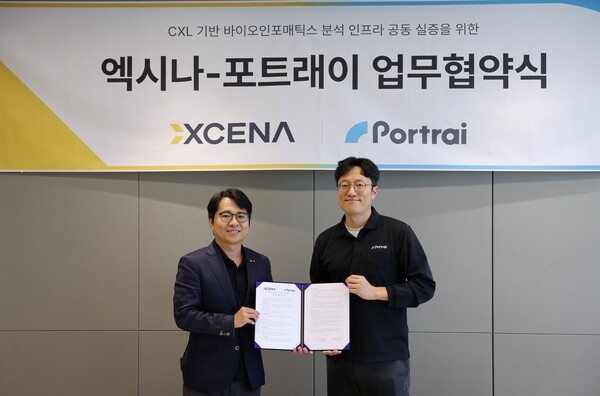
Exina said on the 6th that it has signed an MOU on building and technical cooperation with Portray to jointly develop a CXL (Compute Express Link)-based memory infrastructure for large-scale bio data processing.
Under the agreement, the two companies will jointly develop a computing infrastructure to efficiently process large-scale bio data, including Spatial Omics. They will also conduct technical verification based on actual data.
For the verification, the companies will use Portray's large-scale, high-resolution Spatial Omics data and analysis pipeline. Through this, they plan to verify CXL-based memory expansion technology.
The two companies will pursue tasks to configure and optimize a system for large-scale Spatial Omics analysis. They also plan to go on to verify performance and scalability as data volumes increase.
As Spatial Omics technology advances, the number of cells analyzed is increasing rapidly, and the scale of bio data is also growing quickly. As a result, the memory capacity required for large-scale data analysis is also rising.
In particular, when large-scale genomic data is processed on a single server, there is a limit to the amount of DRAM that can be installed in the server. This DRAM capacity limit can also restrict the scale of data that can be analyzed. Prior to the MOU, the two companies pre-verified Portray's 10x Genomics Spatial Omics analysis workload, ATERA, in an InfiniteMemory® environment, Exina's CXL-based large-capacity memory expansion solution.
Through this cooperation, the two companies will push ahead with applying Exina's next-generation CXL memory solution, MX1. They will also cooperate on developing joint technical case studies and content.
InfiniteMemory is a solution that connects SSDs to a CXL memory expansion device. The solution supports large-scale data workloads that are difficult to handle with DRAM alone and expands the system memory area by leveraging SSD capacity. Existing applications do not require separate modifications, allowing users to utilize a larger memory space.
The two companies conducted a pre-verification using InfiniteMemory and succeeded in analyzing data at a scale of about 35 million cells. Through this, they confirmed the potential for CXL-based memory expansion technology to be used in large-scale bio data analysis environments. They also confirmed improvements in memory capacity and scalability.
Taking the MOU as an opportunity, the two companies will begin additional verification using real data. The verification will be based on analysis data secured through actual operation of Portray's ATERA, and they plan to continue joint verification. They will also expand the data scale to up to 100 million cells to verify the performance and scalability of the CXL-based memory infrastructure, and will refine the configuration and operation methods of an optimized system for large-scale Spatial Omics analysis.
Exina and Portray are pursuing cooperation to apply Exina's next-generation CXL memory solution, MX1, to Portray's AI and bioinformatics infrastructure. The two companies will further define a system combining MX1, DRAM and SSDs, while planning to expand the scope of cooperation to building commercial infrastructure for large-scale bio data analysis in the future. Kim Jin-young, CEO of Exina, said the agreement is meaningful as a starting point for applying CXL-based memory technology to actual large-scale bio data analysis environments and beginning cooperation with Portray to build an optimized system.
Lee Dae-seung, CEO of Portray, said that as Spatial Omics technology advances, the scale of data under analysis is increasing rapidly, and the importance of computing infrastructure for stably processing that data is also growing. Against this backdrop, Portray plans to jointly verify with Exina a memory infrastructure suitable for large-scale bio data analysis.
Kim Jin-young, CEO of Exina, expressed his intention to expand verification based on actual workloads and said cooperation will continue through to the construction of a commercial system using MX1. Lee Dae-seung, CEO of Portray, said the goal is to maximize Portray's AI-based Spatial Omics analysis capabilities and to develop the results of joint verification into an optimized system that can be applied to actual research and drug development business environments.
Exina plans to broaden the scope of CXL-based memory solution applications based on this cooperation, and will expand its current application area, which is limited to AI inference, beyond AI inference to a variety of workloads. Accordingly, bioinformatics and large-scale data analysis that require high memory capacity will be included among the target applications.
Source: TECHWORLD · Park Gyu-chan
Original: https://www.epnc.co.kr/news/articleView.html?idxno=407785
References
This article was produced with the help of an automated content generation algorithm.
Source: TECHWORLD
View originalThis article was summarized and organized by BizCrush based on the original article from TECHWORLD. For exact quotations and full details, please refer to the original article.