KT Checks Dual Deployment of Mobile Base Stations Ahead of Fall Wildfire Season
IT DAILY ·
✦ AI Summary
KT said on the 5th that it participated in the "2026 READY Korea Wildfire Suppression Integrated Drill," hosted by the Ministry of the Interior and Safety.
The drill was held on the 2nd in Chilgok County, North Gyeongsang Province, assuming a large-scale wildfire scenario, and was a whole-of-government disaster preparedness exercise involving central government ministries, local governments, fire authorities, forestry authorities and private companies.
KT checked its communication service support system and network recovery capabilities by simultaneously operating a mobile base station vehicle for the disaster and safety communication network and another for the commercial network.
KT said on the 5th that it participated in the "2026 READY Korea Wildfire Suppression Integrated Drill," hosted by the Ministry of the Interior and Safety, and checked its communication service support system and network recovery capabilities at the disaster-preparedness exercise site by simultaneously operating a mobile base station vehicle for the disaster and safety communication network and another for the commercial network.
The drill was held on the 2nd in Chilgok County, North Gyeongsang Province, assuming a large-scale wildfire scenario. The READY Korea drill is a whole-of-government disaster preparedness exercise involving relevant organizations, including central government ministries, local governments, fire authorities, forestry authorities and private companies.
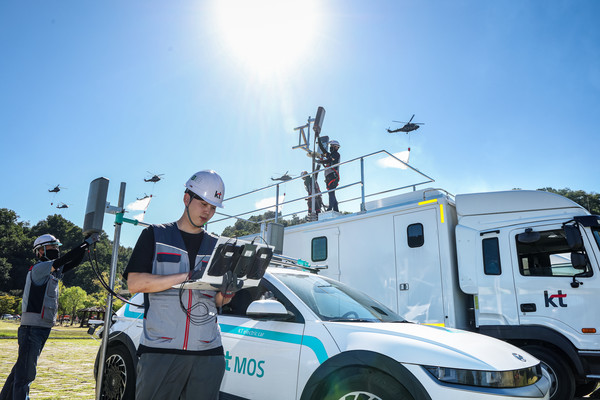
KT Group employees operated mobile base station vehicles at the "2026 READY Korea Wildfire Suppression Integrated Drill" held by Chilgok County. In this drill, KT checked the overall communication service support system, including its support framework for communication services in disaster situations.
The inspection was aimed at confirming the simultaneous operation system, with the goal of reviewing both maintaining the communication network quality of response agencies and providing emergency communications to residents in affected areas. KT was the only telecommunications company to take part on site in this drill.
The drill focused on simultaneously supporting the disaster and safety communication network and the commercial network during the response process to damage to communication facilities. Since disaster sites require both uninterrupted communications for response agencies and communication support for residents, the exercise centered on a method that supports communications for both groups. KT conducted the drill assuming a situation in which wildfire damage to communication facilities had occurred.
As the operator of the disaster and safety communication network, KT deployed a mobile base station vehicle. The vehicle was intended to help maintain the quality of the network used by agencies dispatched to the scene. Separately, KT also operated a mobile base station vehicle for the commercial network, which was intended to provide emergency communications to residents in affected areas and attempt to restore communication services. KT simultaneously operated the two types of mobile base stations to respond to different communication needs.
Along with deploying equipment, KT checked procedures for identifying damage conditions and linking recovery personnel. It also activated emergency contact networks and confirmed whether there were communication outages and the scope of their impact. Headquarters and the field shared the situation in real time, and the collaboration system involving group affiliates and partner companies was also activated.
Communication recovery requires not only deploying equipment on site but also identifying the points where outages occurred and confirming the scope of the impact. The drill proceeded based on these judgments.
During the drill, the organizations involved jointly checked damage assessment, situation sharing, emergency communication support and on-site recovery procedures. The drill was meaningful in that it reviewed the response process from damage assessment to recovery together with the relevant agencies.
KT said it plans to strengthen its network response capabilities to minimize actual disaster damage based on the collaboration system and emergency communication support capabilities confirmed through the drill. Hwang Kyung-hee, head of the East NW Operations Division in KT's Network Division, said that rapid on-site response and strong recovery capabilities are important for providing stable communication services in disaster situations. She added that the company will continue strengthening its network response capabilities, based on close cooperation with relevant organizations, to prevent inconveniences in public communication use when disasters occur.
Source: IT DAILY · Lee Jae-young
Original: https://www.itdaily.kr/news/articleView.html?idxno=242007
References
This article was produced with the help of an automated content generation algorithm.
Source: IT DAILY
View originalThis article was summarized and organized by BizCrush based on the original article from IT DAILY. For exact quotations and full details, please refer to the original article.