5th Chief AI Officers' Council Held... "Bridging the Gaps Between Ministries"
IT DAILY ·
✦ AI Summary
The National AI Strategy Committee held the 5th Chief AI Officers' Council at Seoul Square on the 2nd.
Lee Hae-min, Chief Secretary for AI Future Planning, said inter-ministerial coordination and removing barriers are important, and defined the council as a role that connects ministries.
The meeting discussed the draft Republic of Korea AI Legislative Framework, preparations for Everyone's AI service, the governmentwide data pipeline, and measures to strengthen the public-sector personal information protection management system.
The National AI Strategy Committee held the 5th Chief AI Officers' Council at Seoul Square on the 2nd. Lee Hae-min, Chief Secretary for AI Future Planning, said inter-ministerial coordination is important, something both companies on the ground and the National Assembly commonly feel, and said a process to remove barriers between ministries is needed. He also described the Chief AI Officers' Council as playing a role in connecting ministries.
Lee said that, as chair, he would first make sure the council does not remain limited to listening to reports, but becomes a venue for resolving issues between ministries and addressing field problems. At the meeting, four agenda items were tabled and discussed: the draft "Republic of Korea AI Legislative Framework," preparations for the launch of the "Everyone's AI" service, the current status of the governmentwide data pipeline build and requests for cooperation, and measures to strengthen the personal information protection management system in the public sector. In addition, the results of the implementation review of the Republic of Korea AI Action Plan for the first and second quarters of this year were reported in writing.
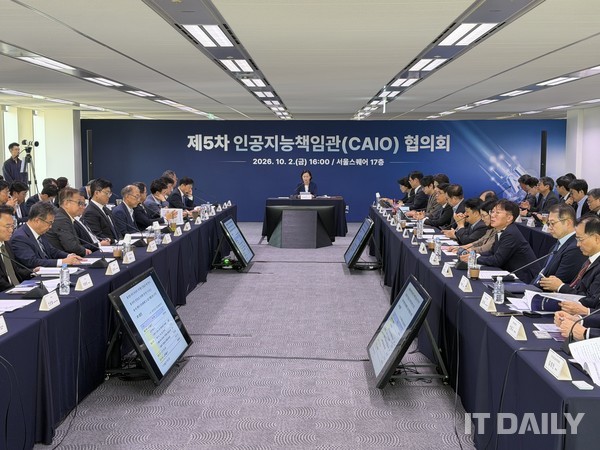
The National AI Strategy Committee held the 5th Chief AI Officers' Council at Seoul Square on the afternoon of the 2nd. The photo credit is Yang Seung-gap, reporter. This meeting was the first time Lee Hae-min, Chief Secretary for AI Future Planning, had presided as chair of the council.
The meeting was attended by AI officers from 42 central administrative agencies and 13 heads of subcommittees, special committees and TFs. Beginning with this meeting, the scope of participation expanded from the previous 28 ministerial-level agencies to 42 central administrative agencies, including 14 vice minister-level agencies such as the Ministry of Personnel Management, the Ministry of Government Legislation and the National Data Office.
Following the entry into force of the AI Basic Act and the resulting sharp rise in legislative demand in the AI field, the committee reported a draft legislative framework that outlines the government's legislative direction. The draft legislative framework includes four basic directions: legislation centered on the AI Basic Act, closing legislative gaps in defense and security, improving predictability for businesses, and enabling immediate responses when adverse effects occur. It also presents sector-specific legislative principles, including promoting AI development, fostering AI convergence, securing AI safety and trust, and preventing AI misuse.
The Ministry of Science and ICT shared the status of preparations for the Everyone's AI service, which is scheduled for official launch in December. It then requested linkage with existing open public APIs for the purpose of embedding a public AI agent. It also requested additional opening of closed APIs and data, asked for standards for the handling and use of personal information by AI agents, and requested cooperation from relevant agencies regarding verification of service security and safety.
The Ministry of the Interior and Safety said it launched the governmentwide data pipeline on September 18. Using that as an opportunity, it requested that ministries register and share high-value data, and also requested the discovery of demand for composite data.
The Personal Information Protection Commission held discussions aimed at responding to the recent string of major hacking and leak incidents in the public and private sectors. Along with that, it discussed measures to establish comprehensive personal information protection and security management systems under the jurisdiction of each ministry, and also discussed ways to strengthen the role of the chief privacy officer (CPO). It also requested cooperation on strengthening risk-based identification of information assets and on strengthening management of handlers, and requested cooperation in preparing and implementing practical comprehensive measures.
Lee said the council had formed a basis for inter-ministerial AI policy cooperation through four council meetings over the past two years. He also explained that, on the basis of that cooperation, it was able to jointly prepare the Republic of Korea AI Action Plan and continue reviewing its implementation.
Lee said the existing participating agencies were 28 ministerial-level bodies, and that with 14 vice minister-level agencies joining as additional participants, the council's perspective expanded with the inclusion of vice minister-level agencies. He added that the council plans to operate on a regular basis going forward, aims for all ministries, including the vice minister-level agencies that participated for the first time, to move as one team in the AI transformation, and plans to actively discuss collaboration projects proposed by ministries.
Source: IT DAILY · Yang Seung-gap
Original: https://www.itdaily.kr/news/articleView.html?idxno=242000
References
This article was produced with the help of an automated content generation algorithm.
Source: IT DAILY
View originalThis article was summarized and organized by BizCrush based on the original article from IT DAILY. For exact quotations and full details, please refer to the original article.