Gyeonggi Virtual Convergence Industry Experts Forum Spotlights 'On-the-Job Experience' to Boost AI Competitiveness
TECHWORLD ·
✦ AI Summary
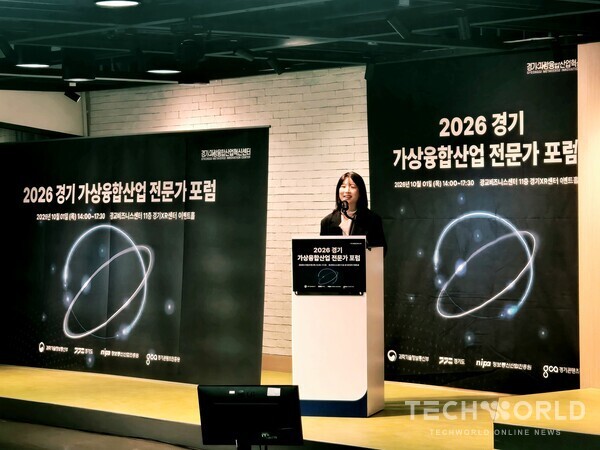
On October 1, the '2026 Gyeonggi Virtual Convergence Industry Experts Forum' was held at Gyeonggi XR Center in Suwon Gwanggyo Business Center, hosted by the Gyeonggi Content Agency.
At the forum, participants discussed ways to connect AI and virtual convergence technologies with human experience. Son Hae-in emphasized the capability to combine domain knowledge with AI understanding and the role of domain staff in defining tasks and designing execution.
Son Byeong-hui highlighted the need to secure data and consider safety and power consumption for on-site robot deployment, while Professor Woo Woon-taek proposed experience transfer and the need to structure and reuse recorded experience.
As AI expands across work automation, robotics, and education, the importance of integrating the experience of people who know the actual work into technology is growing. That is because domain knowledge is needed to define which tasks to automate and set judgment criteria, domain knowledge is also needed to secure training data from skilled workers' tasks, and domain knowledge is needed in the process of passing individual know-how on to others.
Against that backdrop, the '2026 Gyeonggi Virtual Convergence Industry Experts Forum' was held on October 1 at Gyeonggi XR Center in Suwon Gwanggyo Business Center. The forum discussed ways to connect human experience with AI and virtual convergence technologies, under the main theme, 'The Future Industries and Daily Lives Created by Virtual Convergence.'
The speakers that day were Son Hae-in, CEO of Upstage's education division, Son Byeong-hui, head of the defense AI and robotics division at Mind AI, and Professor Woo Woon-taek of KAIST. The forum was hosted by the Gyeonggi Content Agency.
The forum was part of the Gyeonggi Virtual Convergence Industry Innovation Center project. The center was selected this year for a contest run by the Ministry of Science and ICT and is pushing ahead with business support and the training of specialized talent aimed at fostering the virtual convergence industry in the province.
Son Hae-in said AI development is changing the capabilities companies demand from talent. During the deep learning expansion period, the necessary workers were model development engineers. But since the emergence of generative AI, he said the importance of capabilities that combine domain knowledge with AI understanding to implement services has expanded.
He added that as the use of agents increases, the role of domain staff is also expanding. Domain staff are now taking on the role of defining tasks and designing execution processes. He also explained that agent frameworks support connections to external tools and the setup of execution environments, and that this has lowered the barrier to using agent frameworks.
However, he said the person who decides what to delegate and what criteria to use to judge results is the person who knows the work. His point was that even if agent tools lower the threshold for use, the actual targets for delegation and the way results are interpreted must be determined by someone with domain understanding.
Son Hae-in cited an example from manufacturing, comparing drawings and bills of materials. In this case, the work AI can perform is detecting differences between documents. But after detecting differences, it is necessary to decide what action to take next, and it is also necessary to determine which department should carry out follow-up checks. He explained that deciding on follow-up measures and the department responsible for verification requires field knowledge and experience.
Upstage is using agents for internal tasks such as analyzing education trends, analyzing job postings, producing learning card news, and drafting business proposals. To do this, it has turned brand guidelines and work standards into 'skills' and is organizing and sharing them in 'skill' form.
In particular, agents responsible for analyzing existing company introductions, analyzing previous proposals, analyzing the latest product features, and analyzing requests for proposals are taking part in proposal writing. As a result of using these agents, the time spent on information gathering and drafting has decreased, while the time spent discussing customer and business direction and coordinating colleagues' opinions has increased.
These changes are also being reflected in education. In addition to existing coding and modeling training, Upstage is expanding workshops to identify AI application tasks and is also using agents that provide questions and feedback. The scope of agent support ranges from problem definition to proposal writing.
The idea source, Son said, is domain experts. He also pointed to the first priority as defining where an assistant is needed and why. Son said that as agents handle front-end work, time for joint discussion is increasing.
The issue of reflecting judgment criteria in agents is linked to the challenge of learning skilled techniques in robotics. Son Byeong-hui identified the development of AI models, a mass-production base, and a shortage of skilled workers as the main factors behind the spread of humanoids.
He also explained that robots' abilities to perceive, judge, and act are improving, and that conditions are being created to utilize the parts supply chain of the automotive industry. At the same time, he noted that the number of workers who can pass on technology in industrial settings is declining.
Son Byeong-hui emphasized the need to secure data on skilled techniques, citing the case of a welding worker whose retirement is imminent but who has no successor. The trend is that as the number of workers who can pass on technology in the field decreases, the need to turn skilled know-how into data is increasing.
As a necessary condition to respond to this, he said AI models, robot hardware, and operating systems must be secured at the same time. He also said Mind AI has expanded its business scope from model development to on-device AI, edge devices, quadrupedal robots, and control solutions.
For actual use of field robots, model optimization for robots deployed on site is needed, and they must be able to operate even if communications are cut off. Safety control is also necessary because robot malfunctions could lead to loss of life. In addition, battery life and power consumption must be considered together when designing and operating field robots.
In robot learning, a structure that links field operations with data collection is important. After robots are deployed, operational data must be collected, the collected data must be reflected in training, and the training results must then be re-verified in the field. This repetition of data collection, training reflection, and field verification was presented as a condition for improving performance.
Mind AI presented 'No. 1 Data Factory' as an example that implements this structure. 'No. 1 Data Factory' is built as a system that connects a virtual environment, a real robot data collection space, a testing and experience space, and an integrated control space. This approach focuses on securing training data through the combined use of remote operation, work videos, and simulation, while reducing the gap between the virtual environment and real-world working conditions.
Son said software alone or hardware alone is insufficient and that the two fields must be combined. He added that it is important to build a form that can support mass production of data. He also stressed that the side that gathers high-quality data will be the winner.
Professor Woo Woon-taek proposed expanding XR beyond a simple content delivery tool into a tool for transferring an individual's accumulated experience to others. He said the AI-XR-based 'experience transfer' he proposed is a concept in which the experience accumulated by one person is used for another person's learning and performance, and that the target applications are not limited to robots.
Speaking about his research vision on the occasion of the 10th anniversary of the establishment of the KAIST Augmented Reality Research Center, Professor Woo also introduced the implementation platform 'Symbiotic AIR4BTS.' He said the focus of the platform and research vision is to expand the scope of AR use and record personal experiences together with AI.
Professor Woo said his research goal is to expand the possibility of using recorded experiences by others, and to expand the possibility of using recorded experiences in new environments. Through this, he said he wants accumulated experience to move beyond a specific individual and lead to other people's learning and performance, as well as use in new environments.
Professor Woo explained that if experience transfer is to be possible, motion capture alone is not enough; the situation in which the motion was performed, the reason for the motion, the judgment involved, and the tips must be structured. He said this structured information serves as a function that connects later learning and reuse.
The way experience is delivered should not be one-size-fits-all, and differences between the person providing the experience and the learner need to be considered. Even for the same movement, the way it is performed and the guidance given need to be adjusted depending on the learner's physical condition, skill level, and surrounding environment. Professor Woo explained that understanding the environment and the subject is a condition for reproducing the right posture, stressing the importance of the possibility of expanding users' capabilities.
Professor Woo gave a Taekwondo education example, explaining that instruction should go beyond the instructor's movement demonstration and be tailored to the learner's body and posture. He also explained feedback methods for the performance results. This shows that even when the same movement is taught, guidance and checking must differ according to the learner.
He also introduced a method in which overseas learners can leave training records in different time zones, and instructors can check the records afterward and provide additional instruction. Professor Woo said the content in the video needs to be structured so it can be reused, and explained that efficient learning and learning-content management are necessary. This case shows that even in asynchronous environments, instruction tailored to the learner's conditions and situation is possible.
Evaluation criteria need to be expanded from convenience during device use to learning outcomes after use. There is a need to check whether a person can perform the learned movement without help. It is also necessary to recognize the contributor of the experience, and a compensation structure for reuse must be established. In the end, evaluation should be broadened to include actual learning outcomes as well as recognition and compensation for the provider of the experience.
Source: TECHWORLD · Kim Seung-gi
Original: https://www.epnc.co.kr/news/articleView.html?idxno=407692
References
This article was produced with the help of an automated content generation algorithm.
Source: TECHWORLD
View originalThis article was summarized and organized by BizCrush based on the original article from TECHWORLD. For exact quotations and full details, please refer to the original article.