[Scene] “Public SW Must Leave Capabilities Behind After Projects End; Procurement Needs to Shift in the AI Era”
IT DAILY ·
✦ AI Summary
KAIST professor Sook-kyung Kim said public SW projects are centered on individual build and delivery, so a structural shift is needed.
He proposed integrating similar demand from multiple agencies and changing the procurement system by separating actual tasks.
He also said PoC and R&D should lead to purchasing, operations, and reinvestment, and that in the AI era, a model of repeated execution and learning is needed.
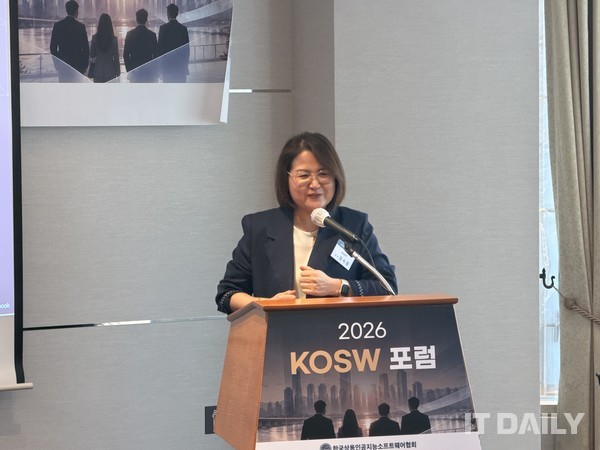
Sook-kyung Kim, professor in the KAIST School of Management Engineering, said on the 2nd at the 2026 KOSW Breakfast Forum, hosted by the Korea Commercial AI Software Association (KOSW) at The Grand Hotel Seoul, that the structure of public SW projects needs to be transformed. The forum was organized to discuss the sustainable growth direction of Korea's AI and SW industries under the main theme, “Conditions for a No. 3 AI Powerhouse: A Robust AI and SW Ecosystem.” Kim delivered a presentation titled “In the Era of Concentrated AI Investment, Review and Transformation for Sustainable Industrial Competitiveness.”
Kim said the current public SW project model has a problem in that it is centered on individual build and delivery. He said the structure, which remains limited to one-off build and delivery, must be changed so that companies can accumulate capabilities and connect to sustained growth.
As a solution, he proposed integrating similar demand across multiple agencies and separating actual tasks. He also explained the need to shift to a procurement system that includes post-build operations linkage and post-build expansion linkage, in order to transform the procurement ecosystem. The photo was provided by reporter Yang Seung-gap.
Sook-kyung Kim, professor in the KAIST School of Management Engineering, gave a presentation on “In the Era of Concentrated AI Investment, Review and Transformation for Sustainable Industrial Competitiveness.”
Professor Kim said that rather than focusing only on expanding AI investment, it is necessary to check whether the results are being translated into the accumulation of capabilities in domestic companies and industries. He said what matters is not the size of the investment, but the capabilities that remain in Korean companies and industries.
Professor Kim said that in the era of concentrated AI investment, it is necessary to deliberate over where to invest appropriately and what results should be left behind. He also said that simply owning a frontier model is not enough to make Korea one of the world's top 3 AI powers.
Kim said government AI investment is expanding rapidly. However, he assessed that the link from PoC and R&D to actual purchasing, operations, and reinvestment remains weak.
Professor Kim said it is necessary to examine whether the expansion of PoC and R&D is actually leading to purchasing, operations, and reinvestment by SW and AI companies. He pointed out that most of these efforts end as one-offs, and said that while budget size matters, it is also necessary to reconsider what capabilities are being accumulated in which companies and markets through the investment.
A structural problem was identified as the background to the public SW market. Systems such as direct purchase of commercial SW, fair pricing, realistic maintenance fees, and protection for small and medium-sized companies have been put in place, but a market structure that connects individual systems to the sustained growth of companies has not materialized. He said many systems to protect companies have been established, but efforts to create a market in which excellent companies become stronger have failed.
He said the biggest problem is that what is needed and what is sufficient for the ecosystem have not been treated as the same thing. He went on to diagnose the public SW market as being trapped in a “co-evolution trap.” Kim explained that a co-evolution trap is a structure in which ordering agencies and supplier companies adapt to existing systems and practices, locking in a vicious cycle.
Kim said the reason ordering agencies rely on detailed regulations and detailed requests for proposal (RFPs) is audit burden, accountability burden, and a lack of expertise. As a result, he explained, supplier companies end up focusing on winning orders and delivering, and lose the room to invest in product advancement.
Amid criticism that public projects are becoming larger, Kim said project size is trending upward. He said the total number of projects is decreasing, which he diagnosed as meaning fewer participating companies.
Kim said the larger the bundled project, the stronger the logic that it favors large companies becomes. As a result, he analyzed, the phenomenon of small and medium-sized SW companies being absorbed into the lower tiers of the supply chain is intensifying.
Kim said the spread of AI could rapidly change the structure of the existing SW market. With advances in generative AI and development tools, companies and institutions can now implement some functions themselves that they previously outsourced to external SW companies, and SW companies that have relied on simple feature delivery or customer-specific customization are facing change. Accordingly, he said the task for SW companies is to more clearly demonstrate to customers why they need to purchase the product.
Kim said AI expansion will not make all SW disappear. However, he diagnosed that the scope of what AI can create directly is expanding, and that the shrinking position of SI-type SW, which depends on simple functions and customization, is inevitable. He said SW that cannot clearly explain why it should be paid for is hard to survive.
Kim said that to respond to these changes, companies should not stop at implementing the requirements of individual projects. He stressed the need to accumulate the experience and capabilities gained during projects into products.
Kim listed domain knowledge, data, connectivity, operational experience, trust, and repeatability as capabilities needed to improve product competitiveness. He said the importance of domain knowledge and data is already well known.
Kim particularly emphasized application connectivity. He said connectivity is important in the application area and that products should be easily connected to any platform or architecture. He also said that for AI-applied products, operational experience accumulated through actual operations is important, as it makes continuous improvement through learning possible.
Kim suggested that the way the SW market is operated should be transformed to fit the AI era. He said that in fields with high uncertainty, such as AI, it is necessary to repeat small-scale execution and learning before linking to the next stage, rather than fixing initial requirements and outcomes as before. He said that while the industry is dealing with unknown territory, existing systems are being applied in full, and identified execution, learning, and an exploratory structure as the important elements now.
Kim said systems need to create room for this. He said that because of the high uncertainty in AI, a method that fixes requirements and outcomes from the outset is not appropriate, and presented the view that systems should be changed so that execution and learning can be repeated.
As for procurement methods, he proposed integrating similar problems from multiple agencies into a single demand pool and then dividing the actual tasks into small module units so that multiple companies can compete. He also proposed a stage-by-stage process of PoC -> pilot -> operations and expansion as the proposal structure.
Each stage is linked to the next based on results. He also proposed a structure in which improvements from the development and operations process are reflected in the product.
The speaker explained that AI and SW demand at the public and institutional level should not be left scattered across separate tasks, but instead similar problems from multiple agencies should be integrated to create common SW demand. He said the model of handing everything over to a single company should be avoided, and a structure in which multiple suppliers compete is needed. He also said it is necessary not to stop at PoC, but to link it to operations and expansion, and that development and operations should not be fragmented, so that improvement costs can be reflected. He explained that such a structure is a condition for forming a repurchase market.
He also said contracts and compensation for AI projects need to be designed differently depending on uncertainty. He said the license and infrastructure areas can use existing methods because the scope and price can be fixed in advance. By contrast, he explained that in the areas of data refinement and model tuning, it is difficult to predict the number of iterations and the scale of additional learning in advance. Accordingly, he said highly uncertain areas need to allow settlement within a certain range, and if performance is proven, they should be linked to follow-up stages or incentives.
The speaker said that when it comes to the conditions for becoming an AI powerhouse, the ability to quickly catch up with good technology is not enough. He said an ecosystem is needed in which companies and products that solve customer pain points can continue to grow.
Source: IT DAILY · Yang Seung-gap
Original: https://www.itdaily.kr/news/articleView.html?idxno=241990
References
This article was produced with the help of an automated content generation algorithm.
Source: IT DAILY
View originalThis article was summarized and organized by BizCrush based on the original article from IT DAILY. For exact quotations and full details, please refer to the original article.