Boston Dynamics Unveils Next-Generation Robot Hand for Atlas
TECHWORLD ·
✦ AI Summary
Boston Dynamics unveiled a next-generation robot hand for the humanoid robot Atlas.
The new hand has a structure with 4 fingers and 13 degrees of freedom, and applies tactile sensors based on fingertip and palm pressure.
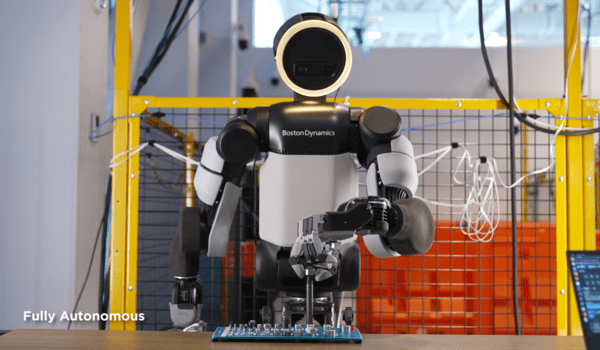
In the released video, Atlas performed tasks such as attaching a drill bit, drilling holes in wood, and fastening a nut.
Boston Dynamics unveiled a next-generation robot hand aimed at improving the industrial work capabilities of the humanoid robot Atlas. On the 1st, local time, the company unveiled a new robot hand with 4 fingers and 13 degrees of freedom, and also showed a video of Atlas fitted with the hand manipulating tools and small parts.
The new robot hand is designed to be about the size of a human hand. It was developed with the possibility of using existing workspaces and tools in mind, and it also incorporates durability and ease of maintenance for industrial settings. The structure has also been simplified and key components modularized.
In the released video, Atlas carried out real work scenes. Atlas picked up a drill bit, mounted it on a drill, and also drilled holes in wood. It then was shown turning and fastening a nut with its fingertips.
The released video also included demonstrations showing Atlas's precise manipulation abilities. Atlas demonstrated rotating a drumstick with its fingers and also showed itself moving two golf balls simultaneously within one hand. The video also included a demonstration of Atlas's ability to reposition objects in its hand.
Boston Dynamics strengthened fine control over movement and force for each finger, applying 4 degrees of freedom to the thumb and 3 degrees of freedom each to the other three fingers. It also placed tactile sensors based on fingertip and palm pressure to enable the robot to grasp objects and to change the position and orientation of objects in its hand.
These tactile sensors detect changes in force when an object makes contact, and are designed to adjust finger movement and grip strength depending on the object's shape, material, and contact condition.
The development process used a Sim-to-Real approach. Results from virtual-environment training were applied to the real robot, hardware operating characteristics and friction were reflected in the simulation, and reinforcement learning was conducted with different motor torque, object shape, and disturbance conditions.
Boston Dynamics cited design complexity, power consumption, cost, durability, and ease of repair as reasons for adopting a four-finger structure. The company said it considered real-world deployment environments for industrial robots and sought a balance between manipulation performance and operational efficiency.
Alberto Rodriguez, Boston Dynamics' head of Atlas behavior manipulation technology, said the company reviewed various hand designs, including the number of thumbs and whether a pinky finger was necessary, to determine Atlas's hand structure. He added that the four-finger structure was chosen after experiments, simulations, and 3D-printed mockups.
Boston Dynamics recently opened the Robotics Metaplant Application Center (RMAC), and through RMAC it is expanding data collection for manufacturing deployment as well as training and validation. The company also plans to accumulate Atlas work data in a space that simulates real industrial environments and build a data flywheel by linking post-deployment feedback and retraining.
Source: TECHWORLD · Kim Seung-gi
Original: https://www.epnc.co.kr/news/articleView.html?idxno=407737
References
This article was produced with the help of an automated content generation algorithm.
Source: TECHWORLD
View originalThis article was summarized and organized by BizCrush based on the original article from TECHWORLD. For exact quotations and full details, please refer to the original article.