National AI Strategy Committee Discusses 'Slowing AI Development' as Frontier Capabilities and Safety Advance in Parallel
TECHWORLD ·
✦ AI Summary
The National Artificial Intelligence Strategy Committee held a seminar on the afternoon of the 1st on the 'Slowing AI Development' debate and discussed domestic and overseas AI development pace issues and South Korea's response direction.
The seminar was attended by more than 70 people, including members of the National AI Strategy Committee and officials from related organizations such as the Ministry of Science and ICT, the Personal Information Protection Commission, and the AI Safety Research Institute.
Experts and panelists raised the need to secure frontier AI competitiveness and capabilities in safety, security, and control, as well as to pursue technological competition and safety in parallel.
As the global debate over the pace of AI development spreads, discussions have also begun in earnest in South Korea. The key issue is how to secure frontier AI competitiveness while also securing capabilities in safety, security, and control at the same time.
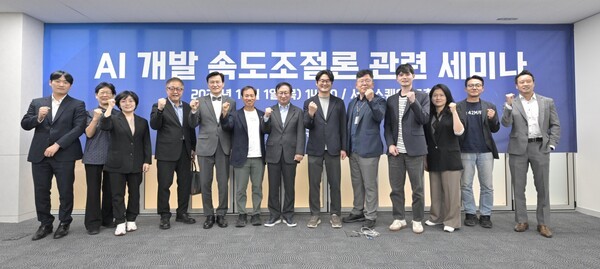
Against this backdrop, the National Artificial Intelligence Strategy Committee held a seminar on the afternoon of the 1st titled 'Slowing AI Development.' The seminar discussed the domestic and overseas debate over the pace of AI development and South Korea's response direction.
The event aimed to seek South Korea's policy direction amid differences among major AI companies, countries, and international organizations over the pace of technological development and safety norms. Through the seminar, the National Artificial Intelligence Strategy Committee examined those international differences in position and reviewed South Korea's policy response direction.
The seminar was attended by members of the National AI Strategy Committee, the Ministry of Science and ICT, the Personal Information Protection Commission, the AI Safety Research Institute, the Korea Internet & Security Agency (KISA), the Korea Information Society Development Institute (KISDI), the Software Policy & Research Institute (SPRi), and others. More than 70 people, including officials from related organizations, attended.
In the first session, experts gave presentations on the debate over the pace of frontier AI development and domestic response strategies. The experts discussed the pace of development and safety responses surrounding frontier AI together.
Lee Won-tae, chair of the National AI Strategy Committee's Special Committee on Security, introduced response directions in major countries. He then said that South Korea needs to simultaneously strengthen frontier AI development capabilities, safety, security, and control capabilities, and stressed the need for a 'speed responsibility theory.'
Choi Dae-seon, head of the AI Safety Research Center at Soongsil University, pointed out that the existing management systems for high-impact AI and advanced AI centered on computing volume alone are limited in responding to frontier AI risks. He explained that the characteristics of frontier AI risks include expanded generality and increased unpredictability, and that technical response measures and institutional response measures related to safety evaluation and control need to be reviewed in parallel in line with technological progress. Kim Sung-hoon, CEO of Upstage, said that AI is evolving beyond superintelligence to a stage where it improves its own performance. He also raised the possibility that preemptively slowing domestic development speed could widen the technology gap with global big tech, arguing that building technological capabilities and safety measures must proceed in parallel.
Lee Han-wool, vice president of Aim Intelligence, suggested that it is necessary to secure independent model evaluation and control capabilities based on South Korea's AI security capabilities and the current response status of companies. He said that South Korea should pursue strengthening domestic evaluation capabilities and international cooperation on frontier AI safety in parallel.
The subsequent panel discussion was joined by Kim Myung-joo, director of the AI Safety Research Institute, and Kim Dong-hwan, CEO of Fourtwofour, and focused on response measures that take both technological competition and safety into account. The panelists discussed support measures to secure South Korea's AI competitiveness, risk evaluation and control for advanced AI, safety verification systems, and policy design that takes corporate burdens into consideration as key agenda items.
Kim said the pace of technological progress is faster than institutional and ethical consensus. He proposed that rather than imposing uniform limits on development speed, industry promotion and safety measures should proceed in parallel, and said that multilateral cooperation through international organizations should be strengthened to avoid norms centered on specific companies or countries. He also said a differentiated management intensity system by risk level is needed.
There were opinions that before AI is widely used in public and industrial settings, preemptive technical safety measures such as hallucination control and data leak prevention should be applied. It was then suggested that a system for evaluating and controlling AI behavior should be established on the basis of such safety measures, and that after such a system is in place, the scope of agentic AI use should be expanded.
Ha Jung-woo, standing vice chair of the National AI Strategy Committee, said that securing safe frontier AI capabilities is essential for securing the global AI core supply chain and advancing into the top 3 in AI. He also said the committee would serve as a focal point to support coordination of cross-government policy, and added that it would pursue a balance between technological catching-up and preemptive security responses.
Source: TECHWORLD · Kim Seung-gi
Original: https://www.epnc.co.kr/news/articleView.html?idxno=407687
References
This article was produced with the help of an automated content generation algorithm.
Source: TECHWORLD
View originalThis article was summarized and organized by BizCrush based on the original article from TECHWORLD. For exact quotations and full details, please refer to the original article.