Sapiens: “Gateway Sprawl in the AI Era Calls for Integrated Management”
IT DAILY ·
✦ AI Summary
Sapiens shared enterprise connectivity management challenges and gateway platform adoption strategies amid the spread of API and AI at “Kong Connect Korea 2026.”
As companies pushed ahead with cloud and MSA transitions and expanded AI use, it explained that connection points between systems are increasing and that operating considerations such as API access permissions, traffic management, and security policies are also growing.
Sapiens said dispersed gateways should be consolidated into an integrated platform while legacy systems are managed through linkage, and that economic evaluation should be based on TCO rather than license costs.
As companies push ahead with cloud and MSA transitions and expand AI use, the complexity of connections between enterprise systems is increasing. As a result, the importance of a consistent operating and control framework for API and AI use is being raised.
Against this backdrop, Sapiens, an IT services company that handles web and app development, enterprise and financial IT integration, and systems build, shared the challenges of enterprise connectivity management and gateway platform adoption strategies at “Kong Connect Korea 2026” on the 1st, under the theme of enterprise connectivity management amid the spread of API and AI. Kong is a company that provides API gateways and an API management platform.
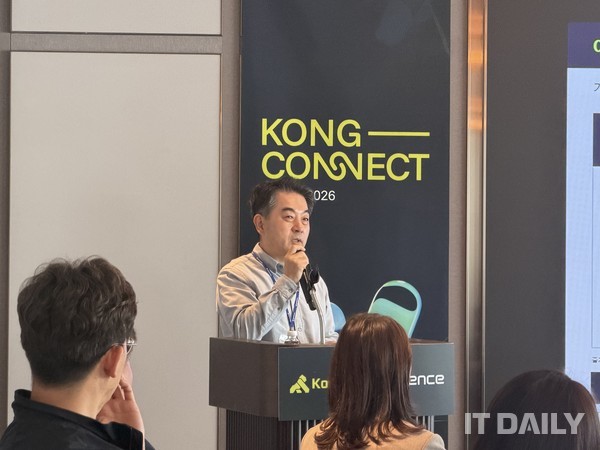
Within the Sapiens Group, Commonstone signed a reseller agreement for Kong API Gateway in 2020. The photo shows Sapiens CEO Choi Sun-kyu speaking at “Kong Connect Korea 2026” on the 1st.
It was explained that as companies expand AI into actual work and customer service, the factors that must be considered during AI operations are growing beyond the simple adoption of functions. Lee Jong-hee, executive vice president at Sapiens, said corporate AI use is expanding into actual work and customer service, and that accordingly the number of factors to consider in AI operations is increasing. Examples of operational considerations included API access permissions, traffic management, and security policies.
Lee said that as service connections increase, operational standards also need to be managed at the same time. He said that as services increase, connections increase, and accordingly the scope of management and responsibility also expands. He added that the key question in an API and AI strategy is not what to connect, but how to operate those connections.
It was also explained that this growing complexity in connection structures emerged alongside cloud and MSA transitions. CEO Choi Sun-kyu said that as companies pursue cloud and MSA transitions to speed up service development and operations, they have separated multiple services and environments within their systems. As a result, the number of connection points between systems has increased, he said.
According to a survey Choi cited, the average number of applications per company is 957, but the actual connection rate stands at about 27%. Direct connection methods by system face growing limits because management burdens rise sharply as scale expands.
For that reason, there was a growing call for unified handling of common functions such as authentication, traffic, and logging, and the need for gateways as a control point for connectivity management became stronger. However, as gateway adoption increased, new complexity also emerged.
As different gateways were introduced according to each organization’s needs, products, authentication methods, logs, and operating teams became fragmented, giving rise to the so-called “Gateway Sprawl” phenomenon. Choi said gateways are proliferating as each department adopts its own gateway, and that now is the time to integrate the proliferated gateways.
Sapiens proposed a plan to consolidate gateways scattered across departments into an integrated platform. At the same time, it presented an approach to connect and manage legacy systems that must be maintained due to regulations and existing systems. The integrated management targets are authentication, logs, and operating policies, and the goal is to reduce control points, it said.
Choi said the approach is to integrate overlapping areas and federate the remaining areas. He explained that this proposal is not calling for the complete removal of existing legacy systems. He added that the key is to keep what is necessary while pursuing synergies through the introduction of an integrated gateway.
Choi said the benchmark for evaluating the economic efficiency of an integrated gateway should be TCO, not simply the license price. He said customers tend to view TCO mainly through license costs, adding that license costs are direct costs. He also said that indirect cost reductions resulting from introducing an integrated gateway need to be reflected in TCO.
He presented direct costs such as licenses and infrastructure, along with operating costs and development costs, as TCO considerations. He also said that security, compliance, and failure-related risk costs, as well as opportunity costs from delays in new service and partner integration, should be included. Choi said it is necessary to review operating, development, risk, and opportunity costs as factors in TCO decisions.
Product selection was presented as a process of first setting evaluation criteria suited to the enterprise environment, then validating them through a PoC. The evaluation is carried out by assigning company-specific weights to areas such as API management and governance, AI gateways, hybrid and regulatory response, security, TCO, ease of operations, and openness.
Choi then explained that the gateway platform is both a cost-saving tool and a governance tool for connectivity and AI governance. He also said that for a meaningful TCO analysis, indirect costs that accompany the license cost must be reviewed together.
Source: IT DAILY · Yang Seung-gap
Original: https://www.itdaily.kr/news/articleView.html?idxno=241970
References
This article was produced with the help of an automated content generation algorithm.
Source: IT DAILY
View originalThis article was summarized and organized by BizCrush based on the original article from IT DAILY. For exact quotations and full details, please refer to the original article.