How a KRW 220 Billion K-Edufine Project Showed the Competitiveness of Mid-Sized and Small SI Firms
IT DAILY ·
✦ AI Summary
The Iitssenentec consortium was selected as the preferred bidder for KERIS's "K-Edufine Operating Environment Upgrade and Disaster Recovery System Establishment" project.
The project is worth KRW 217,363,040,000, and Samsung SDS, LG CNS, and the Iitssenentec consortium competed.
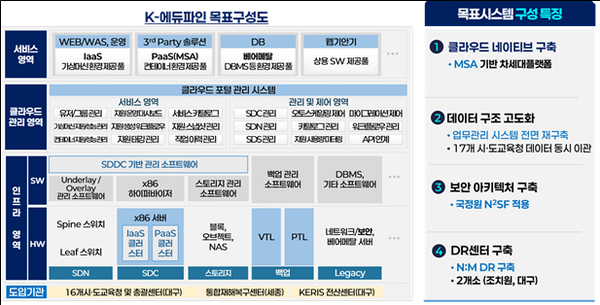
K-Edufine is a core education administration and finance system used by about 810,000 teachers and staff, and the key task of the project is to convert it to a cloud-native environment and newly build a disaster recovery (DR) system.
The Korea Education and Research Information Service (KERIS) has been pushing ahead with the "K-Edufine Operating Environment Upgrade and Disaster Recovery System Establishment" project, and industry reports on the 1st said the Iitssenentec consortium was selected as the preferred bidder. The project is worth KRW 217,363,040,000.
Samsung SDS, LG CNS, and the Iitssenentec consortium competed in the bidding. After the competition, the Iitssenentec consortium was chosen as the preferred bidder.
K-Edufine is a core education administration and finance system used by about 810,000 teachers and staff. The system manages local education finances worth about KRW 100 trillion annually, and more than 200 million electronic documents are subject to management. The key task of this project is to convert the existing operating structure to a cloud-native environment and newly establish a disaster recovery (DR) system.
As a mid-sized and small-company-led consortium was selected as the preferred bidder for a KRW 220 billion public IT project, the competitiveness of mid-sized and small firms in technology and project management stood out in the public SI market, where large companies have been dominant.
This bidding was conducted by selecting the preferred bidder based on a combined score of 90 points for technical evaluation and 10 points for price evaluation. In the technical evaluation, evaluators reviewed each company’s proposal, excluded the highest and lowest scores, took the average, and then applied a differentiated scoring system to calculate the final score.
In the price evaluation, Samsung SDS scored 10 points, LG CNS scored 9.9981 points, and Iitssenentec scored 9.998 points. The gap between the highest and lowest price evaluation scores was only 0.002 points.
Some items in the technical evaluation did not affect the outcome. In the subcontracting plan appropriateness category, all three consortia tied.
The win-win cooperation evaluation was an item based on the equity share held by small businesses, with 5 points allocated. However, the win-win cooperation scores were not disclosed. A comparison of the disclosed raw technical scores and other item scores showed that Samsung SDS, LG CNS, and Iitssenentec all received 5 points in win-win cooperation.
In the price, subcontracting plan appropriateness, and win-win cooperation categories, the score gaps among the consortia were negligible or nonexistent, so they had little ability to distinguish rankings. The actual ranking was determined by the technology implementation and project management evaluations.
In particular, "technology and functions" carried 30 points, making it a heavily weighted category. The average scores in "technology and functions" were 28.61 points for Iitssenentec, 27.67 points for Samsung SDS, and 27.30 points for LG CNS, with Iitssenentec scoring higher than Samsung SDS and LG CNS in this category.
The "technology and functions" evaluation covered cloud system equipment performance, compatibility with the existing system, cloud migration plans, data migration, security, and disaster recovery design. This category assessed practical upgrade measures, and score gaps also emerged in the project execution system category.
The K-Edufine upgrade is a comprehensive project spanning cloud migration, application modernization, infrastructure deployment, disaster recovery, and security. For that reason, not only individual system building but also the role of the integrator, which handles schedule coordination, work coordination among participating vendors, and overall project management, was evaluated as important.
In this evaluation, "project management and support" was a heavily weighted category worth 25 points. The evaluation covered schedule, risk, quality, and security management, the composition of the project management organization, collaboration and governance among participating vendors, and reporting and decision-making systems. Iitssenentec received an average of 24.14 points in this category, while Samsung SDS scored 23.05 points and LG CNS scored 23.03 points.
In the heavily weighted technology implementation and project management categories, Iitssenentec received higher marks than its rivals. That evaluation gap translated into the overall score difference. The final technical scores were 90 points for Iitssenentec, 86.1556 points for Samsung SDS, and 83.1556 points for LG CNS.
The gap continued in the overall scores after price evaluation was added. Iitssenentec received 99.998 points, Samsung SDS 96.1556 points, and LG CNS 93.1537 points. The advantage in technology implementation and project management accumulated into the difference in the final technical and overall scores.
In this evaluation, the mid-sized and small-company-led consortium received higher marks than the large companies in both technology implementation and project management. This shows that in large public SI projects, the ability to combine participating firms' expertise into a single execution framework can also become a key competitive factor, beyond the technology of each individual company.
It was confirmed that mid-sized and small companies can compete for large projects at the consortium level if they clearly divide roles by participating company and establish a collaboration system. This time, it means the possibility of competing for large projects based on the consortium’s overall execution capability was confirmed.
However, the selection of the preferred bidder this time was based on the evaluation of the proposal stage. Therefore, the key issue going forward is actual execution after selection.
Follow-up tasks include cloud migration, data migration, and building a disaster recovery system. In this process, maintaining continuity in existing education administration and finance work is a condition for execution, and the challenge ahead is to stably implement the technology and project management measures that were highly rated at the proposal stage during the actual building process.
If the project is completed smoothly, it can be used as a reference for securing similar-scale public IT projects in the future. In addition, it is meaningful as a case that demonstrates the execution capability of a mid-sized and small-company-led consortium in large public IT projects.
An industry source said the reason Iitssenentec outperformed large companies in the technical evaluation was its domain knowledge in the education business, experience in multiple large-scale projects, accumulated SI capabilities, and accumulated cloud capabilities, adding that the technical score results were based on the company's understanding of the education sector and the technical capabilities it had built through large-scale project execution.
Source: IT DAILY · Yang Seung-gap
Original: https://www.itdaily.kr/news/articleView.html?idxno=241964
References
This article was produced with the help of an automated content generation algorithm.
Source: IT DAILY
View originalThis article was summarized and organized by BizCrush based on the original article from IT DAILY. For exact quotations and full details, please refer to the original article.