AMD Unveils “AMD Ross” to Bring Agentic AI to the Entire Embedded Development Lifecycle
TECHWORLD ·
✦ AI Summary
AMD unveiled the agentic AI assistant “AMD Ross(AMD Ross)” on the 1st.
“AMD Ross” supports the entire embedded development process, from design, optimization, debugging, PCB design, schematic review, software and AI development to actual system deployment.
AMD aims to use it to accelerate the development lifecycle, automate repetitive tasks, and help engineers focus on higher-value design work.
AMD will apply agentic AI across the entire embedded systems development process. Through this effort, AMD aims to accelerate the development lifecycle, including design, debugging, optimization, and deployment.
AMD unveiled the agentic AI assistant “AMD Ross” on the 1st. “AMD Ross” is designed to support the full embedded development workflow and to assist throughout the development process.
Its scope covers architecture planning, optimization, debugging, PCB design, schematic review, software and AI development, and actual system deployment. In this way, it spans the full range from design to deployment.
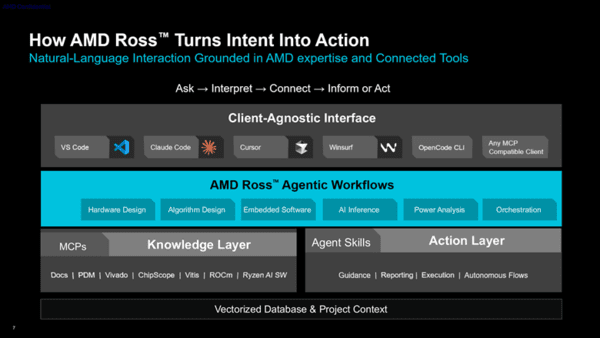
“AMD Ross” can use natural language-based tool interactions and can also leverage expert developer agent skills. It also provides reusable workflows and uses the AMD Knowledge Base based on AMD verified information.
AMD provides FPGA, adaptive SoC, embedded x86 processors, specialized edge AI platforms, and a range of embedded development tools. Against this backdrop, AMD Ross is focused on addressing the increasingly complex embedded systems development environment and was designed to improve engineers’ efficiency in using diverse resources and in applying proven engineering methods.
Based on integration with development tools, AMD Ross automates proven iterative workflows and helps speed the transition from an engineer’s design intent to actual implementation. It expands the use of specialized knowledge and also makes it possible to implement reusable agent skills for expert methodologies.
This structure could improve access to specialized knowledge within organizations and ensure consistency across the development process. It also supports automation of repetitive work and allows engineers to focus on higher-value design tasks, which are among AMD Ross’s main goals.
Salil Raje, AMD senior vice president and general manager of Embedded, said embedded development is becoming more complex. He cited the broadening scope across hardware design and debugging, software development and deployment, AI inference, and system-level design as the reason.
In response, he said AMD Ross is based on technologies and methodologies customers use every day. He also said AMD Ross takes AMD embedded tools, trusted expertise, and expert development workflows and integrates them into a single agentic AI environment. He added that AMD Ross integrates multiple development resources into an agentic AI environment and provides embedded developers with agentic AI capabilities.
He further said this environment is designed to support accelerating the entire lifecycle and speeding the progression of product innovation from design intent to deployment. He explained that AMD Ross covers hardware design and debugging, software and algorithm development, and edge AI implementation and deployment. He added that developers can perform document searches, check tool status, execute commands, receive debugging guidance, and run verified workflows by asking natural language-based AI agents.
AMD Ross supports hardware and software partitioning, and it also supports hardware design implementation using high-level synthesis tools, as well as silicon design optimization and debugging. It also covers embedded software application and algorithm development, optimization of machine learning algorithms using AMD embedded AI software, power estimation and low-power design optimization, and system schematic review and board layout implementation.
AMD Ross has a client-independent architecture and supports integration with AMD embedded development tools. Development teams can use their preferred LLM, as well as their preferred IDE and preferred command-line environment.
What differentiates AMD Ross from a general-purpose AI assistant is its combination with the AMD embedded development environment, AMD’s accumulated engineering knowledge, and expert development methodologies. AMD Ross is not an add-on AI coding assistant layered on top of development tools; it is an environment specialized for embedded development that directly accesses AMD’s development environment and combines AMD documentation, development workflows, and reusable engineering expertise.
AMD Ross combines four core components. Among them, the Model Context Protocol (MCP) server is based on an open standard and connects AI agents with AMD embedded tools. This connection enables information lookup, command execution, and work within the design environment.
The AMD Knowledge Base is AMD’s verified vector database. It includes user guides, product guides, white papers, application notes, and Q&A materials. It also provides cloud support and support for locally usable offline environments, which makes it possible to access AMD-verified answers and related documents.
Agent skills are provided in the form of open markdown files written by experts. They include repeatable, shareable best practices for general design tasks, with example tasks such as timing optimization and performance improvement through C++ design refactoring in AMD Vitis HLS. The role of agent skills is to guide the LLM through structured workflows.
“Design examples” provide ready-to-run designs and show how agent skills are applied to real embedded applications. AMD said that using AMD Ross can shorten prototype development time through AI-based workflow automation. It also said debugging cycles can be reduced by using AMD-verified guides, and optimization cycles can be shortened through reusable methodologies.
AMD added that it expects productivity to improve through repeated tool interactions and automation of tasks. It also said onboarding for new engineers can be accelerated and consistency in best practices across teams and projects can be secured. In addition, it was presented as helping improve the reusability and scalability of engineering knowledge within organizations.
Gita Govindaraj, associate director of the FPGA SOM division at iWave Global, said the AMD Ross agentic AI assistant is very useful in the company’s development workflow. She said the tool helps improve efficiency in identifying and resolving issues. She added that it helps reduce time and effort during debugging and initial bring-up.
Source: TECHWORLD · Park Kyu-chan
Original: https://www.epnc.co.kr/news/articleView.html?idxno=407634
References
This article was produced with the help of an automated content generation algorithm.
Source: TECHWORLD
View originalThis article was summarized and organized by BizCrush based on the original article from TECHWORLD. For exact quotations and full details, please refer to the original article.