Gartner: 30% of Workers Replaced by AI Will Ultimately Be Rehired
TECHWORLD ·
✦ AI Summary
Gartner presented 4 changes CIOs should prepare for amid AI's spread. It said that if AI is treated only as a tool for automation, companies will lose the opportunity to strengthen employee capabilities, and that AI-centric organizations capable of job redesign, crossing organizational boundaries, and accumulating AI value could gain a competitive advantage. Gartner forecast that by 2029, 30% of employees laid off because of AI replacement will be rehired, and that by 2027, 75% of companies that use gains in AI productivity primarily for cost reduction will be overtaken by competitors that reinvest those gains in innovation and employee capability enhancement.
Gartner announced 4 key changes CIOs should watch as AI rapidly expands the speed and scope of work, saying CIO preparedness is critical as AI quickly reshapes how work gets done.
Tori Polman, a Gartner VP analyst, said the biggest mistake in the early AI era would be to focus only on automation, because doing so would mean missing the opportunity to strengthen employee capabilities. She added that future competitive advantage will belong to AI-centric organizations that redesign jobs, span workflows across organizational boundaries, and continuously accumulate AI value.
Gartner forecast that 30% of workers replaced by AI will ultimately be rehired. It said workforce reductions may bring short-term financial gains, but their side effects can include a weakened talent pipeline and the loss of institutional knowledge.
Gartner also noted that, globally, labor force growth is slowing or the labor force is shrinking. As a result, it expects competition among companies to secure the talent they need to intensify, while hiring, training, and onboarding costs also rise.
Gartner said hasty layoffs during AI adoption could lead to future rehiring and additional costs. According to Gartner's outlook, by 2029 companies will rehire 30% of employees laid off because of AI replacement, and most of that rehiring is expected to cost far more than before.
Polman said companies and IT executives using AI primarily to cut costs face the risk of reducing headcount too much too early. She added that excessive early cuts could undermine the capabilities needed for business model innovation and competition in new markets as AI continues to advance.
Accordingly, Polman emphasized the need to redesign jobs to fit AI use. She also stressed that employees handling low-productivity work should be redeployed into new roles and opportunities, and proposed a 'talent remix' as a strategy for doing so.
Gartner stressed that companies effectively responding to AI-driven change should guard against the temptation to automate everything. It also said they should resist the temptation to delegate decision-making entirely to AI.
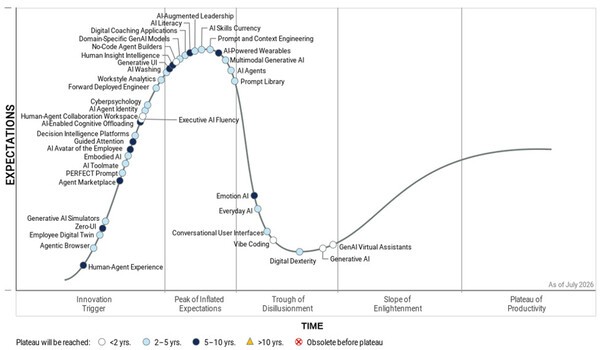
Gartner and Polman explained that the focus of AI adoption is shifting from the technology itself to augmenting human capabilities. Based on Gartner's '2026 Hype Cycle for the Future of Work,' Polman said the early-stage AI investment phase has entered the Trough of Disillusionment.
Polman went on to explain that the core task for CIOs and business leaders is shifting from technology issues themselves to using AI to enhance human intelligence, expertise, and creativity. In other words, the center of AI adoption is moving from implementation of the technology itself to improving people's capabilities.
Gartner said there is a need to prepare for a work environment in which humans and AI collaborate. It also said CIOs and business leaders should examine 4 changes that affect how work is performed and how corporate value is created.
At the same time, the evolution of AI was presented as a move toward a 'toolmate.' Companies therefore need to establish a closer collaboration model that satisfies both accountability and human capability enhancement, and successful companies are expected to use AI not to replace employees but to strengthen their judgment, creativity, leadership, and decision-making abilities.
Employee AI avatars, AI toolmates, digital coaching applications, employee digital twins, and emotional AI are cited as technologies that support workplace change. These AI-based technologies are presented as the foundation for changes in work.
As technological change accelerates, gaps in capability, adaptability, and workforce readiness are becoming apparent. Accordingly, companies will need employees who can keep learning, work across multiple disciplines, and deliver results even in fluid work environments.
To prepare for the future, companies face the challenge of investing in strengthening AI literacy, enhancing AI-based capability management, improving digital fluency, and reinforcing the ability to analyze work methods. At the same time, executives must meet the conditions of having sufficient understanding of AI and being proficient in its use.
At the same time, as AI is applied more widely to business processes, the risks of losing work context, human judgment, and accumulated corporate knowledge will also rise. For that reason, future-ready company systems need to be designed to improve decision quality and maintain human oversight.
The scope employees must understand is also expanding. Employees need to understand not only how a work process is carried out, but also why it is carried out.
AI-related technologies CIOs may review include conversational user interfaces, decision intelligence platforms, and generative UI.
However, long-term success requires building a foundation that goes beyond adopting everyday AI tools. That foundation must meet the requirements of speeding implementation, improving cost efficiency, and securing safety each time a new AI use case is added.
Gartner forecast that by 2027, 75% of companies that prioritize using gains in AI productivity for cost reduction will be outpaced by competitors reinvesting those gains in innovation and employee capability enhancement.
In the process of driving change, CIOs can also use AI-based wearables, generative AI models specialized for industry and work domains, embodied AI, and vibe coding.
Source: TECHWORLD · Lee Gwang-jae
Original: https://www.epnc.co.kr/news/articleView.html?idxno=407644
References
This article was produced with the help of an automated content generation algorithm.
Source: TECHWORLD
View originalThis article was summarized and organized by BizCrush based on the original article from TECHWORLD. For exact quotations and full details, please refer to the original article.