Internet Newspaper Ethics Committee Discusses Institutionalizing Journalism Ethics Education in the National Assembly
TECHWORLD ·
✦ AI Summary
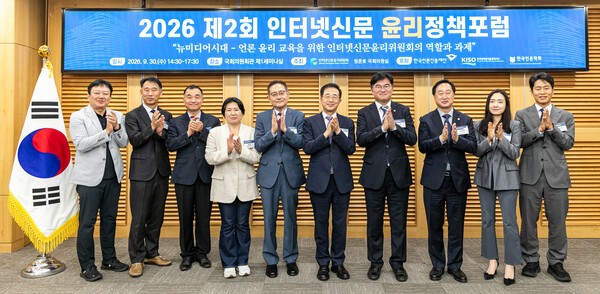
The Internet Newspaper Ethics Committee announced on Sept. 30 that it would hold the "2026 2nd Internet Newspaper Ethics Policy Forum" jointly with the office of Rep. Jeong Jun-ho.
The forum discussed ways to institutionalize journalism ethics education in the new media era under the theme, "The Role and Tasks of the Internet Newspaper Ethics Committee for Journalism Ethics Education in the New Media Era."
It was supported by the Korea Press Foundation and sponsored by the Korea Internet Self-Governance Organization (KISO) and the Korea Journalists Association, with emphasis placed on cooperation among the National Assembly, academia, and civil society and on the importance of preventive education.
The Internet Newspaper Ethics Committee (INEC), jointly with the office of Rep. Jeong Jun-ho, announced on Sept. 30 that it would hold the "2026 2nd Internet Newspaper Ethics Policy Forum." The forum discussed ways to institutionalize journalism ethics education in the new media era under the theme, "The Role and Tasks of the Internet Newspaper Ethics Committee for Journalism Ethics Education in the New Media Era."
The forum was supported by the Korea Press Foundation and sponsored by the Korea Internet Self-Governance Organization (KISO) and the Korea Journalists Association.
At the opening ceremony, Rep. Jeong Jun-ho said it was important to establish journalism ethics in order to raise trust among internet newspaper readers. He also expressed his intent to help institutionalize journalism ethics education in the new media era through the forum's discussions.
Rep. Kim Jun-hyeok said that as internet newspapers spread across a wide range of fields and formats, it is necessary to jointly consider journalism's social responsibility and minimum ethical standards. He also said he would continue discussions at the National Assembly level on the institutional improvements proposed that day.
A congratulatory address from Kim Min-ho, chairman of the board of the Korea Internet Self-Governance Organization (KISO), was read by Secretary General Shin Ik-jun. Kim said the creation of a healthy media ecosystem cannot be achieved through regulation and punishment alone. He added that public trust can be restored when the media fulfills its responsibilities and adheres to high ethical standards.
Kim Tae-hee, head of policy at INEC, then gave a presentation on "The Current State and Improvement Direction of Journalism Ethics Education for Internet Newspapers." She introduced cases of journalism ethics, job-related, and media environment education conducted for 1,473 people in total over the past 3 years. She also presented examples of preliminary education for new participating pledge members.
Based on these operating examples, Kim Tae-hee argued that the role of self-regulation needs to expand from post-review to preventive education. She also said the center of self-regulation should be broadened toward preventive education rather than post-review.
Professor Pyo Si-young of the Department of Media and Communication at Kangwon National University presented "The Need for Journalism Ethics Education When Registering New Internet Newspapers and Legislative Proposals." She proposed making journalism ethics education mandatory before registration for new internet newspaper publishers or editors. She also presented amendments to the Newspaper Act.
Professor Pyo said INEC has the basis to serve as an institution for such education because it has experience in internet newspaper education and in self-regulation of articles and advertisements.
The subsequent expert panel discussion was moderated by Professor Lee Seung-sun of the Department of Journalism and Information at Chungnam National University, with participation from Professor Kim Kyung-hwan of the Department of Media Image Advertising at Sangji University, Kim Seong-soon, managing attorney at Hanil Law Firm, and Yoon Myung, secretary general of the Korea Consumer Citizens' Movement.
The discussion identified several key areas for improvement: linking pre-education for publishers and editors with the actual reporting staff, the need for regular education that includes not only new registrations but also existing outlets, flexible educational methods that take into account freedom of expression and barriers to entry, and the need to accumulate objective performance data to prove educational effectiveness.
At this forum, the first cohort of INEC college student supporters officially participated and covered the event on site. Based on the forum's main points and their on-site reporting, the supporters plan to produce articles, card news, and reviews, and the content they create will be distributed.
INEC Chairman Lee Jae-jin said that completing proper journalism ethics is difficult through post-review and sanctions alone. He said that post-action alone is not enough to establish journalism ethics, and emphasized the importance of preventive education that supports understanding of basic ethical principles and social responsibility from the early stages of journalistic activity.
Lee also said he would pursue cooperation with the National Assembly, academia, and civil society. He also expressed his determination to expand the foundation for internet newspapers to practice voluntary ethical responsibility.
Source: TECHWORLD · Lee Gwang-jae
Original: https://www.epnc.co.kr/news/articleView.html?idxno=407637
References
This article was produced with the help of an automated content generation algorithm.
Source: TECHWORLD
View originalThis article was summarized and organized by BizCrush based on the original article from TECHWORLD. For exact quotations and full details, please refer to the original article.