Samsung AI Learns from User Experience to Correct Itself and Act, Reducing Mistakes
IT DAILY ·
✦ AI Summary
Samsung Electronics unveiled research on AI that improves performance based on real-world experience at the "Samsung AI Forum 2026" on September 30.
The research aims to reduce repeated mistakes by including AI task failure records and users’ correction behavior in training signals.
Samsung Research also introduced continual learning that preserves existing knowledge while learning new information, along with technologies to verify and correct user-related memories.
Samsung Electronics disclosed research into AI that improves performance after product launch by learning from user experience. The research aims to reduce repeated mistakes by including records of task failures in AI training signals, along with users’ direct correction of wrong results.
However, there are challenges in the process of continuously incorporating new experiences. New learning can weaken existing capabilities, and old and new information can conflict. Samsung is studying technologies to manage what to remember and what to revise, assuming personal data is processed on-device.
Samsung Electronics held the "Samsung AI Forum 2026" on September 30 and unveiled related research at the event. Samsung Research introduced self-evolving AI that improves performance based on real-world usage, continual learning that combines new information learning with retention of existing knowledge, and technologies for verifying and correcting user-related memories.
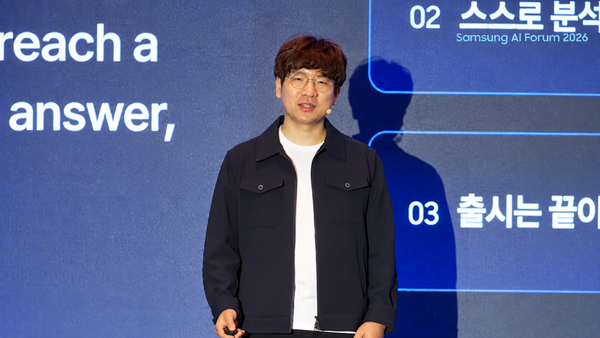
On September 30, Lee Kang-wook, VP at Samsung Research, gave a presentation at the "Samsung AI Forum 2026" under the theme "Self-evolving AI: AI That Grows on Its Own." The photo is provided by Samsung Electronics.
Lee Kang-wook explained the need for self-evolving AI and identified long-tail problems as its target. He said long-tail problems have characteristics that make them infrequent across the overall user base.
He also said long-tail problems are difficult to address individually during development, and the same inconvenience can recur for specific users. He explained that errors that are rare overall can become a daily annoyance for an individual.
As a representative example, he cited AI misrecognizing a family member’s name. He explained that while only a small number of users among the total user base may experience the error, the person affected may encounter the same problem every time they call a family member’s name.
Lee said AI that continuously learns in real usage environments can reduce these problems. He explained that AI that keeps learning in the usage environment can help ease such repeated inconvenience.
Samsung presented how AI works through the example of booking a train ticket on a smartphone. The initial request was, "Book me one ticket from Suseo to Busan at 1 p.m. next Wednesday after Chuseok." After searching trains, the AI still could not be sure the conditions were met and repeatedly checked by moving back and forth between date and time settings.
Samsung said that reflecting previous experiences in these repeated actions raises the task success rate. It also said unnecessary attempts decrease, execution time decreases, and token usage decreases.
Samsung announced that the scope of learning has expanded from AI’s own execution records to users’ AI correction behavior. However, it said users do not explain what is wrong every time AI makes an error.
Samsung gave an example in which a user said a program name on a TV, but due to a voice recognition error, the desired channel did not appear. In such cases, the user changes the channel directly with the remote control instead of explaining the cause of the error. Samsung said it is studying a method of inferring the original intent from such follow-up actions after AI output, as well as ways to use user behavior to improve performance. Samsung described user behavior as a source of information for improvement.
Issues that require personal context appear in cases that are difficult to understand from photos alone. For example, if a user asks AI to find "my beloved stuffed toy," AI can identify the stuffed animal in the photo. However, it is hard to judge from the photo alone which of several toys has special meaning for the user.
For that reason, the direction is to use actions that emerge naturally during actual use rather than asking for separate evaluations or explanations. The goal is to secure clues that improve the next task.
This perspective leads to the argument that attention should be paid not only to the moment of talking with AI, but also to the time outside that interaction. The perspective is to focus on so-called time when people are not talking to AI.
To learn from user behavior, the company says device usage experience during AI non-interaction time is important. Yi Yoon-soo, VP of Samsung Electronics’ MX Business Division, said direct interactions with AI agents such as ChatGPT, Gemini, and Claude are only part of the overall smartphone experience.
The photo shows Yi Yoon-soo, VP of Samsung Electronics’ MX Business Division, giving a lecture on the theme of "Samsung On-Device AI Platform" at the "Samsung AI Forum 2026" on September 30.
Samsung has used information accumulated while users continue to use smartphones for browsing the web, taking photos, and watching content even when they are not directly talking to AI, and has applied that information to personalization. For this purpose, Samsung operates a data platform that processes user information and uses it for personalization.
Samsung is planning to combine information generated during agent interactions with its existing data platform. The VP said extracting meaningful information from user data outside the agent and combining it with agent interaction information is a differentiating factor for smartphone makers. He also said that, beyond the performance of general-purpose AI models, user context formed during device interaction is the basis for personalization.
The VP said AI phones have so far been defined as phones that know me well and understand me well. He added that the next stage is a phone that acts for me.
As personalization expands, the sensitivity of the information handled by AI increases. In response, Samsung is developing an AI platform that processes data generated on-device into structured knowledge, and it is also developing a processing platform that uses on-device models.
The VP emphasized privacy by explaining that the process is carried out inside the device. Samsung presented a direction in which user data needed for personalization is kept on-device, and said the learning process is also kept on-device.
However, this does not mean that all AI operations are processed on the terminal. For each function, cloud models can be used, and the executive said that even when a cloud model is used, if the runtime operates on the device, collected user data can be used on the terminal without being transferred to the cloud.
Samsung also raised the same issue in its self-evolving AI announcement. It said that if users’ AI correction behavior is also used, the amount of training information increases, and thus storage location and processing method become design conditions for the product.
Storing data on the device does not solve the personalization problem. The next challenge is memory accuracy. The core capability of personalized AI is remembering new information and accurately updating old information.
Juan Carlos Nieblas, VP at Samsung Research, pointed to problems in the process of continuously updating user information. As an example, he presented a case in which AI remembers a user’s family schedule and exercise time. If life patterns change, only the new schedule may be added to the existing memory.
As a result, old and new information remain at the same time. Later, when AI is asked a related question, it can bring up conflicting information simultaneously and produce a wrong answer.
Samsung Research identified three problems with a simple memory update method. Problem 1 is corruption, where existing facts are changed into incorrect information. Problem 2 is omission, where facts that should be remembered are lost. Problem 3 is hallucination, where nonexistent facts are newly introduced.
Instead of unconditionally adding new information, Samsung Research is studying a "memory agent." When a new fact is entered, this system compares it with existing memory and then determines whether to add, revise, or delete it. In addition, a separate verifier checks whether the memory change is appropriate.
This approach is closely tied to the conditions needed for self-evolving AI. Self-evolving AI needs to maintain existing capabilities while learning from new experiences. Samsung Electronics described continual learning technology as technology that "quickly learns new information without forgetting prior knowledge."
However, after a product is launched, the content learned can differ by user. As a result, the gap between the initial verified state and the actual operating state may widen.
There is also a possibility that new learning could degrade the performance of existing functions. This decline in existing-function performance is called regression.
The executive said that, when applied to actual products, preventing problems in the process of diverging from the initial model is an important constraint. He also identified as a challenge the difficulty of performing continuous regression tests on AI that differs by user.
As one way to implement self-evolving AI, the executive proposed a non-parametric approach, which serves as an alternative. This method stores experience-based knowledge separately instead of continuously changing model parameters, and memory was given as an example of a medium for storing knowledge.
He said he believes this approach is safer because it is relatively easy to restore the original state when problems occur, and that is why Samsung is focusing on related research. He also said the aim of self-evolving AI is for the time spent with AI to lead to a better experience.
Source: IT DAILY · Kim Byung-joo
Original: https://www.itdaily.kr/news/articleView.html?idxno=241948
References
This article was produced with the help of an automated content generation algorithm.
Source: IT DAILY
View originalThis article was summarized and organized by BizCrush based on the original article from IT DAILY. For exact quotations and full details, please refer to the original article.