XGate to Cooperate With LIG Defense and Keyper on Introducing Quantum Security for Defense
IT DAILY ·
✦ AI Summary
XGate, LIG Defense and Aerospace, and Keyper exchanged a memorandum of understanding (MOU) on advancing missile security technologies and strengthening competitiveness in military satellite communications.
The three companies decided to combine their capabilities in defense, network security, and encryption technologies to strengthen competitiveness in missile security and military satellite communications.
They will also pursue joint research and development using next-generation cryptography technologies, including post-quantum cryptography (PQC), and cooperate on introducing quantum security into the defense sector.
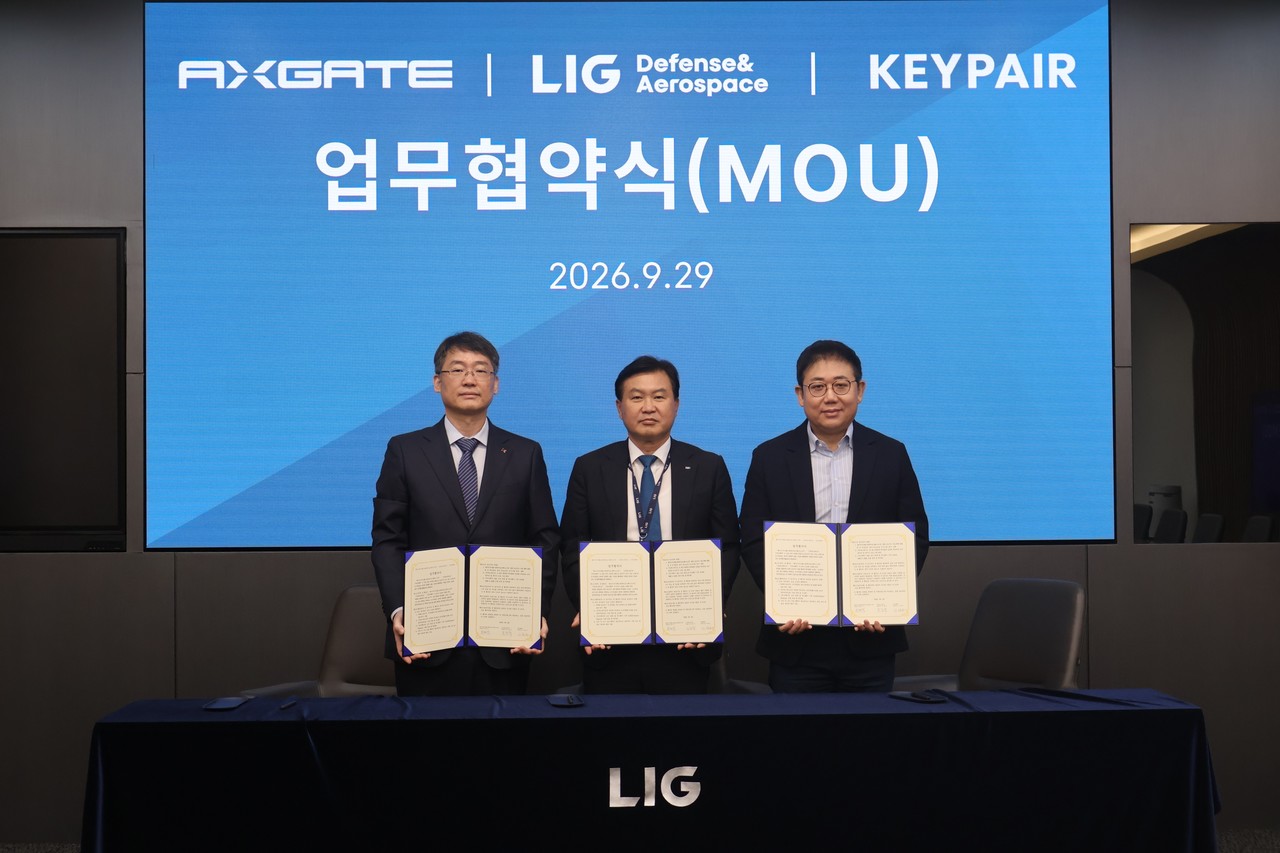
XGate will work with LIG Defense and Aerospace and Keyper to introduce quantum security for defense. On the 1st, XGate announced that XGate, LIG Defense and Aerospace, and Keyper had exchanged a memorandum of understanding (MOU) on advancing missile security technologies and strengthening competitiveness in military satellite communications. On September 29, XGate CEO Joo Gap-su, Park Tae-sik, head of a division at LIG Defense and Aerospace, and Keyper CEO Lee Chang-geun posed for a commemorative photo after exchanging the three-way MOU.
The three companies decided to combine their capabilities in defense, network security, and encryption technologies to strengthen competitiveness in missile security and military satellite communications. Accordingly, they will begin building a security communications system optimized for future missile operations environments.
The three companies will also pursue joint research and development using next-generation cryptography technologies, including post-quantum cryptography (PQC). As part of their cooperation to introduce quantum security into the defense sector, they will also work to advance related technologies.
XGate is a network security specialist with capabilities in virtual private networks (VPNs), encrypted communications technologies, and PQC. In this cooperation, XGate will provide VPN and encrypted network security technologies suited to military communications environments and participate in architecture development. Based on this, it plans to lead the transition to quantum security in the defense sector.
LIG Defense and Aerospace will take on the role of specifying the defense operating environment and information protection requirements based on its systems expertise in missiles and military satellite communications. To this end, it will analyze and design security requirements for missile systems and military satellite communications and support technical integration among the three companies.
Keyper will be in charge of PQC security chips and hardware-based encryption technologies. By linking its hardware-based PQC technologies, Keyper plans to implement a consistent encryption system spanning weapon systems and ground control infrastructure.
Based on this, the three companies will jointly study a security architecture that considers not only data protection in communication links but also a next-generation cryptographic system that can respond to a future quantum computing environment. In addition, they plan to identify additional cooperative projects in the defense security and communications sectors.
XGate CEO Joo Gap-su said that network connectivity and a high level of security reliability for communications data are key elements of the future defense environment. He added that XGate will pursue optimization of the network security and next-generation cryptographic technologies it has accumulated for military communications environments and contribute to strengthening the competitiveness of domestic defense communications security technologies.
Keyper CEO Lee Chang-geun said that long-term operating weapon systems, including missiles, have the characteristic that hardware replacement is difficult for a long period after deployment, so PQC needs to be considered from the initial introduction stage. He added that the three companies will cooperate so that the security communications system they are jointly developing becomes a representative model for the transition to PQC in the defense sector.
Source: IT DAILY · Kim Ho-jun
Original: https://www.itdaily.kr/news/articleView.html?idxno=241951
References
This article was produced with the help of an automated content generation algorithm.
Source: IT DAILY
View originalThis article was summarized and organized by BizCrush based on the original article from IT DAILY. For exact quotations and full details, please refer to the original article.