SK AX Launches “AI Bootcamp Vibe,” Letting Workers Build AI for Their Own Jobs
IT DAILY ·
✦ AI Summary
SK AX announced on the 1st that it has launched the training program “AI Bootcamp Vibe.”
The program is based on Vibe Coding and is aimed at employees at companies with no coding experience.
Trainees will spend 4 weeks learning the full process of analyzing work processes, selecting targets for AI application, and implementing agents, while also receiving support for integration with internal email and data sharing and storage repositories.
SK AX announced on the 1st that it has launched the training program “AI Bootcamp Vibe.” The program is based on “Vibe Coding” and is aimed at employees at companies with no coding experience.
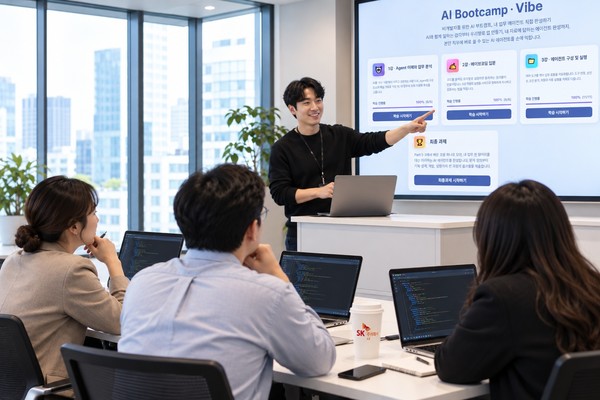
Rather than simply helping users build AI agents using generative AI or teaching them how to use AI tools, the program is structured as integrated training that takes employees through the full process of identifying inefficiencies in their work, selecting tasks, and implementing agents. It is designed to help practitioners with strong job knowledge design the functions they need.
The target groups are non-development roles such as HR, planning, marketing, and sales. They can present requirements in natural language and build the AI agents needed for their work with AI supporting code creation.
SK AX is seeking to involve even non-specialist development staff in agent creation by incorporating Vibe Coding into training. Under the Vibe Coding approach, users describe the functions they want in natural language, and generative AI writes the development code and implements the program. SK AX plans to apply this to training so that members without specialized coding knowledge can take part in agent development.
To this end, the course was designed not to be limited to following fixed examples. Its defining feature is that trainees’ real work is set as the starting point for development tasks.
Trainees analyze their own work processes, directly select the targets for AI application, and break down their work in detail. They then look for repetitive or time-consuming tasks and select those with the greatest AI impact.
Over the following 4 weeks, lectures and hands-on practice will be conducted on the AI Bootcamp platform. The learning content covers the agent design process and implementation of the selected tasks.
This approach also expands the role of practitioners. They move beyond being users who ask AI questions and become designers who set work requirements and review the results of implementation. In the process, the burden of writing code is reduced, while practical job knowledge is used to determine which problems to solve.
SK AX said its internal employees have completed the course and are now developing and using AI agents for actual work sites. However, in this announcement, it did not provide figures for reduced work hours or productivity improvements for each development case.
Instead, SK AX focused on the use of AI during the training operation stage. It said practice sessions, assignment submissions, and evaluations are being run with AI support.
It said that an AI agent is assigned to each trainee to serve as a dedicated mentor. Under this setup, trainees enter requirements into a chat window according to the AI mentor’s guidance and check the implementation results in a preview. The company said the AI mentor has functions that remember each trainee’s progress, level of understanding, and error patterns, and adjusts the level of terminology explanation and coaching accordingly.
SK AX said this approach can ease the burden on companies in operating training and evaluation. It also said the training target needs to be expanded to non-development roles, and that this requires support for differing levels of understanding and learning speeds among employees. It added that the purpose of using the AI mentor is to help operate the training program.
SK AX said AI agents are strong in agent-to-agent collaboration and the use of internal company data. It also said that if the AI transition remains limited to only some organizations, there are limits to how much it can translate into productivity gains.
SK AX said that for an enterprise-wide AI transition, it is necessary to raise employees’ ability to use agents as well. Accordingly, it has prepared a way to connect and use the agents created in the training course with actual company systems.
SK AX offers a separate service called “Context Operator.” Using this service, employees’ developed agents can be linked with internal company email, as well as with data sharing and storage repositories.
It also supports sharing the agents developed by employees with colleagues. This helps expand the scope of use, and the service bridges the stage of implementing functions during training and the stage of using them in connection with internal systems.
AI Bootcamp Vibe is included in SK AX’s “AI Talent Lab” training system. “AI Talent Lab” consists of “AI Literacy,” “AI Bootcamp,” and AI Bootcamp Vibe. “AI Literacy” handles the assessment of AI literacy and execution capability, while “AI Bootcamp” is run as an advanced course for developers. Companies can choose each course according to their employees’ development goals.
This program aims to expand the scope of corporate AI capabilities from development teams to frontline business staff. Employees with a strong understanding of the work will be responsible for selecting tasks, implementing AI agents, and connecting the implemented agents to internal company systems. The criterion for judging the results of the program is expected to be whether it leads to real workplace improvements.
Kim Min-hwan, head of the HRX promotion team at SK AX, said that practitioners directly designing, building, and using AI agents they need is the true form of “AI augmentation.” He also expressed the company’s determination to support the creation of an AX innovation ecosystem in which innovation in AI use across the organization takes root as part of corporate culture.
Source: IT DAILY · Lee Jae-young
Original: https://www.itdaily.kr/news/articleView.html?idxno=241947
References
This article was produced with the help of an automated content generation algorithm.
Source: IT DAILY
View originalThis article was summarized and organized by BizCrush based on the original article from IT DAILY. For exact quotations and full details, please refer to the original article.