Korea Internet Corporations Association Discusses Policy Issues for K-Content in the AI Era
TECHWORLD ·
✦ AI Summary
The Korea Internet Corporations Association held a forum on the 29th to discuss changes in the content industry driven by the spread of AI and the policy issues that need to be addressed.
With AI use increasing across games, webtoons, music, and video, the forum sought ways to promote technological innovation while protecting creators' rights.
Presentations and discussions covered AI usage standards by production stage, standard contracts and guidelines, copyright and technology leakage issues, and the importance of planning capability and IP ownership.
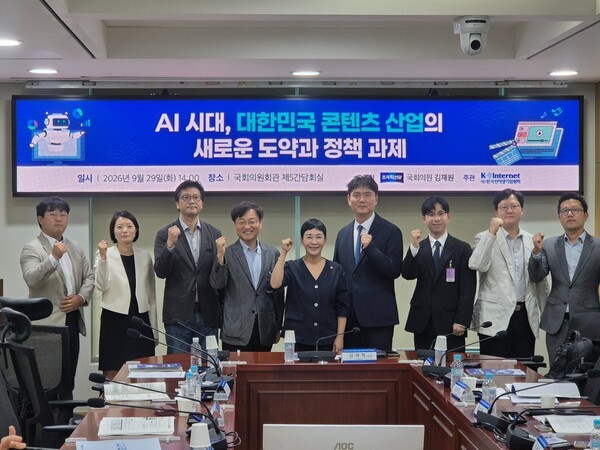
The Korea Internet Corporations Association and National Assembly member Kim Jae-won of the Rebuilding Korea Party discussed changes in the content industry driven by the spread of AI and policy issues that need to be addressed. On the 29th, the Korea Internet Corporations Association held a forum titled "New Leap and Policy Challenges for Korea's Content Industry in the AI Era."
The event was organized against the backdrop of rising AI adoption across the content industry, including games, webtoons, music, and video. The forum aimed to seek ways to promote technological innovation while also protecting creators' rights.
The first presentation was delivered by Dong-A University professor Lee Dong-gyu. He suggested that the scope of AI use should be specified by stage in the content production process.
Lee said it was necessary to establish standards for usage limits by genre and production process rather than remaining trapped in a binary view that either allows or restricts AI. He also said that hybrid production combining human creativity and review should be institutionally recognized.
He also said that standard contracts and production guidelines containing creators' consent, compensation, and control rights are needed.
Kang Seung-mi, executive director at Samjeong KPMG, referred to the trend in which AI and software technologies accumulated in the game industry are expanding into the physical industries. She named robotics, mobility, defense, shipbuilding, and logistics as target industries for expansion. Kang said AI use is expanding beyond content production in the game industry into the physical industries.
Kang said this is leading to a full-fledged diversification of game companies' businesses and also to full-fledged cooperation between companies. She added that these changes could become an opportunity to reshape the competitive landscape in the game industry. She also raised the possibility that they could become an opportunity to restructure the industry as a whole.
During the discussion, the speed of AI use in the field and regulatory improvements were key agenda items. Kim Seong-joon, head of Korea Creative Content Agency, said more than 99% of current support projects are already using AI. He explained that the pace of change in the field is rapid and said the agency is supporting the use of various AI tools to help small and medium-sized companies adopt AI smoothly.
At the same time, copyright issues and technology leakage issues emerged as points of contention. Attorney Lee Yong-min of Yulchon LLC said that, regarding copyright issues arising during AI training on existing data, clear standard guidelines that the industry can refer to are needed. He also said that when game technologies are used in other industries such as defense, the risk of technology leakage could arise, and that legal and institutional improvements are needed in response.
Je Seong-won, a director at Wrtn Technologies, predicted that as AI use expands, the importance of planning capability and IP value will increase. He said AI can play a role in supporting content production. However, he noted that planning capable of delivering great emotional impact remains in the human domain.
Je said that in the future, the factors determining competitiveness will be not whether AI technology is used itself, but who is responsible for planning and production, and the value of IP ownership. He made clear the view that, amid the spread of AI, the basis for content competitiveness could shift from the use of technology itself to human planning ability and IP ownership.
Kim Min-cheon, chief of the Korea Internet Corporations Association, said it is difficult for policy and legislation to keep pace with the speed of technological development. He said communication channels with industry are therefore needed, and that the necessary order should be established before regulation. He also said government support in administration, finance, and diplomacy needs to proceed in parallel.
Lawmaker Kim Jae-won delivered the opening remarks, saying that AI is rapidly changing not only the production process in the content industry but also the ways content is distributed and used. He said that in the midst of these changes, it is necessary to define the roles of technology use and human creativity. He also emphasized that concrete standards and policies to protect creators' value and rights are urgently needed.
Park Seong-ho, chairman of the Korea Internet Corporations Association, said AI provides a new growth engine for K-content while also bringing policy challenges that need to be addressed, and therefore a harmonious ecosystem of technology, content, and policy must be built. He also expressed his determination to continue supporting the industry.
Source: TECHWORLD · Kim Seung-gi
Original: https://www.epnc.co.kr/news/articleView.html?idxno=407587
References
This article was produced with the help of an automated content generation algorithm.
Source: TECHWORLD
View originalThis article was summarized and organized by BizCrush based on the original article from TECHWORLD. For exact quotations and full details, please refer to the original article.