Flitto Reorganizes AI Translation Service Under 'Vogl' to Expand Personalization and On-Premises Use
TECHWORLD ·
✦ AI Summary
Flitto is reorganizing its AI translation services under the integrated brand 'Vogl' and pushing ahead with solution expansion.
Vogl will include personalization features and note-taking and AI summary linkage functions, while the company also plans to broaden its on-premises deployment and device applications.
Flitto also unveiled an expansion of its data area from text, voice, images, and video to physical AI, along with a data marketplace and a 2027 vision.
Flitto is reorganizing its AI translation services under the integrated brand 'Vogl' and plans to expand solutions around it. By grouping its AI translation services under 'Vogl,' Flitto plans to strengthen personalization features based on multilingual data, broaden on-premises deployment for enterprise customers, and expand the range of devices it supports.
To that end, Flitto will step up its use of multilingual data, broaden the scope of its data building from text, voice, images and video to physical AI, and expand its data marketplace. Lee Jeong-soo, CEO of Flitto, said the company has not simply been combining APIs to provide services, but has continuously considered what data should be trained to improve accuracy and how to secure solution competitiveness in the global market.
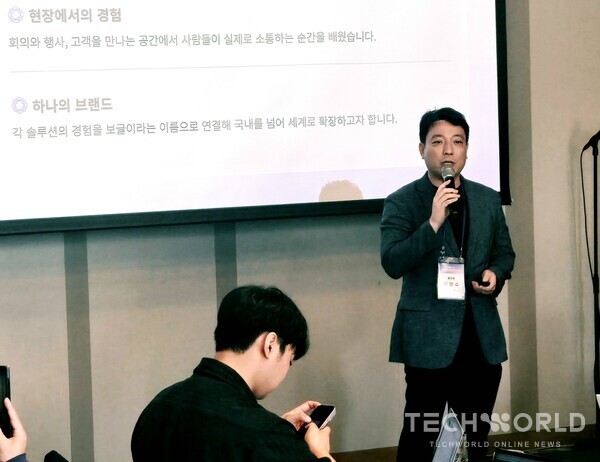
On the 30th, Flitto held its second 'Media Insight Day' at Grand InterContinental Seoul Parnas and unveiled Vogl at the event. The company also disclosed its data strategy and 2027 vision at the event.
Flitto has consolidated its translation services, which had been operated under separate names, into a single brand, 'Vogl.' The name Vogl comes from 'Voice of Global Languages.' Flitto said the integration is intended to raise brand recognition and strengthen links between services.
Flitto has also brought related integration services and operating methods under the Vogl brand system, in addition to the translation services that had been distributed across different offerings. The Vogl brand includes Webex integration services, API, and on-premises operation on enterprise internal servers.
The product lineup is divided by use environment. The AI interpretation solution for meetings, lectures, and counseling is branded as 'Vogl,' the one for conferences and seminars is 'Vogl Stage,' and products for airports, banks, and stores are branded as 'Vogl Zone.'
The core feature of Vogl is personalization. Vogl learns users' voices, pronunciation, and frequently used words and proper nouns, and reflects them in speech recognition and translation results. Misrecognized expressions are handled by relearning them after user confirmation.
Flitto has also built note-taking and AI summary linkage features into Vogl. This allows users to record and summarize meeting and interview content, and it suggests additional questions based on the user's job and areas of interest. In addition, interpretation content from Vogl Stage can be called up through the note function.
Lee said that without personalization, translation errors can occur when venue-specific proper nouns are misrecognized. He also explained that how well a system understands an individual is an important factor in interpretation quality. As a direction for Vogl, Lee suggested a way to use the personalization engine by linking it with multiple services.
Flitto said the number of events using Vogl Stage was 150 in 2024 and rose to 442 last year. The company expects the number of events using Vogl Stage this year to exceed 600.
Flitto is also expanding on-premises supply for companies and public institutions. The on-premises model targets customers for whom it is difficult to store meeting and interpretation data on external cloud services. This model builds interpretation models on internal servers.
Vogl Zone serves as an offline expansion tool. Flitto is expanding Vogl Zone's use to stores, information desks, and hotels.
To improve accuracy, the company uses a method of pretraining proper nouns such as product names, book titles, and internal company terms. General translation models have difficulty handling those proper nouns accurately. Pretraining is effective in improving recognition accuracy.
Flitto is reviewing both in-house development of interpretation-related hardware and ways to connect existing devices. Items under review include portable interpretation devices and equipment for university lecture halls. For integration with existing devices, the company is considering glass-based interpretation functions and earphone-based interpretation functions.
Lee said demand for on-premises deployment is increasing, especially among government agencies and large companies that place a high value on security. He explained that this demand is tied to a method of building systems directly on the customer company's servers.
Lee said this type of business requires in-house technical capabilities. He also said the company has been deliberating over the hardware field for more than 2 years. Hardware is currently in the research and development stage.
Lee said he believes related devices could be unveiled in 2027. Flitto's data area initially centered on multilingual text.
Flitto later expanded its data area to multimodal data such as voice, images, and video. More recently, it has broadened the scope of its data building to include inference and benchmarks, domain-specific data, and physical AI data.
The first priority for physical AI is collecting large-scale video data. The flow involves filming people picking up and moving objects, extracting hand movements and object positions from the footage, and then processing the extracted information into data for robot training.
Flitto has added related functions to its app for this purpose. The company is currently collecting and verifying data.
Precise data collection using sensor gloves and special suits is also under consideration, but the company has adopted a phased approach in light of the burden of equipment and labor costs for precise collection. Lee said sensor-based data carries high equipment prices and labor costs, and that large-scale collection of sensor-based data is difficult. He added that the company is currently focusing on securing large volumes of video data by using a global network of workers.
At the same time, Flitto is also pursuing expansion of its data marketplace. It plans to establish a structure in which companies and individuals can register the data they own, and connect AI developers so they can purchase the data they need. It also aims to support further processing of raw data and the use of processed data for AI training.
More than 500 submitted data sets are in Flitto's data marketplace. However, these data sets undergo review for copyright, personal information, and ownership, and 300 to 400 data sets have been disclosed externally after passing that process.
Lee said that companies carrying out government projects have been finding needed data on the platform and completing actual transactions. However, he explained that commission revenue is not yet at a meaningful scale.
Lee said expanding external data transactions is a task through the end of the year. Accordingly, even though transaction cases are appearing within the platform, expanding external transactions was presented as a key task for the company.
Meanwhile, Flitto judged that growth in its solutions segment this year is faster than in its data segment. It said this is due to the expanded application of its AI translation solutions and rising demand for on-premises deployment.
The data business has the characteristic that revenue is recognized after a project is completed. Accordingly, revenue from data projects underway in the first half will be reflected after the third quarter, and performance tends to be concentrated in the second half.
Lee said current revenue is exceeding forecasts and current net profit is also above expected levels. He added that last year's results need to be proven to be one-off through this year's growth.
Under this direction, Flitto plans to pursue global expansion of its data marketplace by 2027, expand Vogl-based solutions by 2027, and expand overseas on-premises operations by 2027. It also plans to use Vogl as an integrated brand linking translation services and to expand overseas applications of Vogl.
Lee said excellent technology needs to be used overseas as well. He also said the company will pursue greater global market competitiveness through linking data and solutions.
Source: TECHWORLD · Kim Seung-gi
Original: https://www.epnc.co.kr/news/articleView.html?idxno=407568
References
This article was produced with the help of an automated content generation algorithm.
Source: TECHWORLD
View originalThis article was summarized and organized by BizCrush based on the original article from TECHWORLD. For exact quotations and full details, please refer to the original article.