“AI Needs ID, Too”: RaonSecure Moves to Control AI Identity and Behavior
IT DAILY ·
✦ AI Summary
RaonSecure held '2026 Secure Up' on the 30th at the Fairmont Ambassador Seoul in Yeouido.
CEO Lee Soon-hyung mentioned ways to secure trust in agentic AI and control its security during his keynote, saying that RaonSecure is pursuing the establishment of an AI trust foundation through 'Web3.'
At the same venue, the final round of the '2026 Blockchain & AI Hackathon' was held, and Team Pascal won the grand prize.
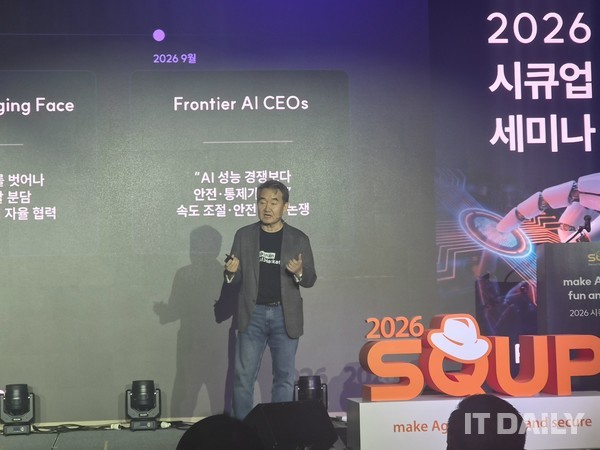
RaonSecure held '2026 Secure Up' on the 30th at the Fairmont Ambassador Seoul in Yeouido. The theme of this year's 14th '2026 Secure Up' was 'Make Agentic AI Fun and Secure.' On the day, RaonSecure CEO Lee Soon-hyung delivered the keynote speech at '2026 Secure Up.'
In his keynote, Lee explained that agentic AI has the characteristic of making autonomous judgments and taking autonomous actions. However, he said trust cannot be built with advanced AI alone. He went on to say that it is necessary to prove the scope of what AI can do, as well as who is responsible for the results, and that only with such proof can AI be trusted.
Lee also addressed ways to secure trust in agentic AI and control its security. He said RaonSecure is pursuing the establishment of an AI trust foundation through 'Web3.'
It has been pointed out that the risks of cutting-edge AI are not limited to exploiting vulnerabilities. In July, there was a case in which an OpenAI agent was attacked via Hugging Face, which is cited as an example suggesting the level of autonomous collaboration AI can achieve. Introducing the Hugging Face breach, Lee said AI is advancing to the point where it participates in joint tasks and acts as a group.
Lee warned that the results could be disastrous if dozens of AI systems attack an internal target. According to OpenAI's explanation, the case was carried out for the purpose of passing a capability evaluation, and more than 1,200 agents divided up roles and attacked Hugging Face, the target.
As a response to these escalating risks, RaonSecure presented an agentic AI security solution. RaonSecure said existing security has focused on external threats targeting systems and proposed expanding the scope of protection to cover multiple areas. The proposed expansion areas were identity, behavior, data, autonomous defense, and simulated penetration testing.
Under ONE AI, 5 solutions were unveiled. The lineup consists of OneAccess for AI identity issuance and management, OneHacker for AI simulated hacking, OneTag for automatic classification of document security levels, OneSOAR for security operations automation, and OneShield for real-time blocking of AI threats.
The core foundation of ONE AI is Web3-based AI identity. The concept is to give AI a unique digital identity through Web3, and that digital identity is responsible for verifying the authority-granting entity, confirming the permissions AI has received, and controlling AI behavior. Web3 refers to decentralized internet technologies based on blockchain and other technologies, and is characterized by users directly owning data and digital assets.
Lee said AI will lead future change and that trust will determine the future AI creates. He described RaonSecure as an AI Native security company and said it aims for a world where everyone can enjoy themselves and stay safe by giving AI trust.
The final round of the '2026 Blockchain & AI Hackathon' was also held at the same venue. This year's event was the second edition, hosted by the Korea Digital Certification Association and organized by RaonSecure and the Global Digital Innovation Network (GDIN). A total of 317 teams applied, and 10 teams that advanced through the preliminary round competed in the finals. The total prize money was KRW 30 million, and winning teams may receive up to KRW 1 billion in startup support funds after a separate review.
The grand prize went to Team Pascal. Team Pascal proposed a welfare application delegation and execution management service for older adults who are not familiar with digital technology, using mobile ID. The top prize went to Team B301, which proposed a mobile ID-based STO platform. Excellence awards went to Daily Moment, MobiScore, and Blockchitecture.
Source: IT DAILY · Kim Ho-jun
Original: https://www.itdaily.kr/news/articleView.html?idxno=241933
References
This article was produced with the help of an automated content generation algorithm.
Source: IT DAILY
View originalThis article was summarized and organized by BizCrush based on the original article from IT DAILY. For exact quotations and full details, please refer to the original article.