Samsung Puts Robots in Factories Before Homes, Citing Low Automation in Appliance Manufacturing
IT DAILY ·
✦ AI Summary
Samsung Electronics sees manufacturing sites, rather than homes, as the first application target for its robotics business.
The company said appliance manufacturing is less than half automated and that production lines require a 99.99% success rate.
Samsung plans to first secure industrial robot use cases in manufacturing and then expand into home and service uses.
Samsung Electronics has chosen its own manufacturing sites as the first proving ground for its robotics business, seeing ample room for automation in manufacturing and the need for extremely high reliability on production lines. The article’s central point is that Samsung’s robotics rollout will prioritize factories over homes. For example, appliance manufacturing, including refrigerators, was cited as a target area. Samsung said more than half of appliance manufacturing remains unautomated, and that introducing robots to production lines requires reliability above 99%.
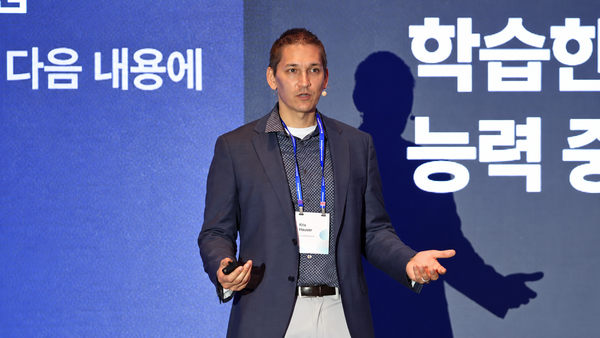
Based on that assessment, Samsung plans to prioritize robots that can perform limited tasks reliably rather than release general-purpose humanoids right away. The company’s plan is to apply them first in manufacturing sites and then expand them to home and service uses. Chris Houser, head of the Robotics Lab at Samsung Electronics’ RX Business Promotion Office, said at the Samsung AI Forum 2026 held on the 30th at Samsung Electronics’ Seocho building in Seoul’s Seocho District that RX wants to first look at industrial robot use cases in manufacturing and eventually expand into home and service robots.
Samsung Electronics established the RX Business Promotion Office in July to oversee its robotics business. The office is reviewing the potential for robot deployment in industrial sites such as manufacturing and logistics. Its long-term goal is to expand the business into consumer robots.
Samsung Electronics held the Samsung AI Forum 2026 on the 30th. At the event, Chris Houser, head of the Robotics Lab at Samsung Electronics’ RX Business Promotion Office, explained the company’s robotics AI strategy. The photo was provided by Samsung Electronics.
Samsung is giving priority to factories for robot deployment because it believes many tasks in manufacturing sites are still not automated. Samsung operates more than 100 factories and more than 100 production lines for its products.
Mobile production and semiconductor production are highly automated. In contrast, there is room for robot deployment in logistics, equipment monitoring, inspection, quality control, and packaging.
Appliance production has more tasks that are not automated than mobile or semiconductor production. Houser said the share of automation in manufacturing tasks for home appliances such as refrigerators is less than half. He also said many tasks remain that are difficult to handle with existing robot automation technology.
Samsung plans to first secure examples of industrial robot deployment in manufacturing processes. It then plans to expand the scope of deployment to home and service areas.
The long-term goal for robots is a 'Home Helper' that can do housework, care for older adults, and care for pets. However, there is still a large gap between current robot technology and actual field requirements.
Houser said that from a factory operator’s perspective, both an 80% success rate and a 99% success rate are insufficient. He explained that a success rate of 99.99% is needed for successful deployment on actual production lines.
Factories also require speeds comparable to those of humans. Even if a robot succeeds at most tasks, it is difficult to introduce if occasional failures stop the production line, and it is also difficult to introduce if its work speed is slower than a human’s.
Current robot AI falls short of that level. Houser noted that humanoids have full-body athletic ability, including the ability to do backflips, but are weak in precision manipulation.
He said that even if a robot can do a backflip, it may not be able to unscrew a water bottle cap. He added that current success rates fall short of the standards needed for deployment in homes and factories.
He pointed to the robot’s operating structure as the background for these limitations. Robots consist of motors, sensors, an operating system (OS), and AI, he said, and multiple components must work together in real time.
He also said that even a partial error can cause the entire task to fail. In particular, if a humanoid falls while operating, the machine and nearby equipment could be damaged, he added.
The subheading related to this point is about selecting areas of strength and then verifying performance. Houser presented an approach for RX’s research direction that moves away from an all-purpose focus.
RX’s priority is to secure stable performance within a certain range of tasks rather than perform many tasks from the outset. Houser described this as Quality before Generality, meaning quality before generality.
This contrasts with the recent focus of robot foundation model research. Recently, the emphasis has been on learning a variety of tasks and then expanding the ability to handle previously unseen tasks, but Houser said that in reality, even within learned tasks, strengths and weaknesses can appear irregularly.
RX believes that to broaden the scope of robot deployment, a Multi-function approach is needed that concentrates data on predictable specific areas and generalizes within that scope. This approach begins by checking the level at which a robot can perform each task. Houser also said there is a need to focus on data from specific areas and train a generalization model within a predictable range.
The next step is to verify performance in that area and then deploy it in the field. Houser said certification is needed for proper operation of robots in that area. The operating structure is also designed to deploy tasks that can be performed stably first.
Robots deployed in the field serve as a means of generating additional training data. Data gathered in real-world environments is then used again for AI training. Through this feedback loop, the range of tasks robots can perform expands.
As an example of this expansion strategy, Houser proposed broadening capabilities step by step, from folding laundry to washing dishes and then to pet care. It is a plan to gradually expand a robot’s verified task domain, much like the way a smartphone adds functions.
Cost is an obstacle to the commercialization of humanoids. Houser said industrial-site humanoids need to compete on cost with both humans and existing industrial robots.
One cost factor for humanoids is the price of the machine itself. In addition, the cost of training for specific tasks is also a factor.
Developing and operating humanoids requires PhD-level R&D personnel, data collection staff, and GPUs. For fixed tasks, existing industrial robots plus SI automation may be cheaper.
For that reason, Houser said RX’s task is to reduce both humanoid hardware costs and AI costs at the same time. He also said there is room to improve AI for existing industrial robots, in addition to humanoid AI.
Houser compared the current stage of general-purpose robot AI to autonomous driving in 2016. That suggests that general-purpose robot AI has strong potential, but that additional technological progress is still needed before trustworthy robots can be realized.
Samsung is preparing a 'Data Factory' that collects data from people remotely controlling robots and uses it to train robot AI. The data collection targets include manufacturing tasks such as appliance and electronics assembly, as well as kitchen and home tasks.
Samsung plans to combine the Data Factory with simulation, evaluation, and the operation of multiple robots. The goal is to build a foundation for robot AI development.
At present, developing robot AI tailored to a specific customer task requires R&D personnel, data collection, and separate training. The process can take several months.
What RX is ultimately targeting is shortening the time needed to teach new tasks. Under the current approach, the number of tasks that can be applied each year is limited.
Houser said that when robot AI performance is sufficient, customers can customize it themselves, which could enable large-scale expansion. He also explained that if robot task training takes only a few hours, users can train it themselves, creating a catalyst for wider adoption.
In line with that direction, Samsung is conducting research on teaching robot actions based on a single human action video. The research tracks the movements of hands and objects in the video and converts them into robot hand motions, using a technology called Physics-aware Retargeting. The current stage is an early one focused on a small number of rigid objects and human hand movements. As next steps for expanding the research, Samsung is pursuing the use of first-person video shot with smart glasses and demonstration videos shot with smartphones, with the goal of extracting motion information needed for robot training.
Source: IT DAILY · Kim Byeong-ju
Original: https://www.itdaily.kr/news/articleView.html?idxno=241930
References
This article was produced with the help of an automated content generation algorithm.
Source: IT DAILY
View originalThis article was summarized and organized by BizCrush based on the original article from IT DAILY. For exact quotations and full details, please refer to the original article.