[Watch This Product] Dell Technologies Unveils Next-Generation All-Flash 'PowerStore Elite'
IT DAILY ·
✦ AI Summary
As AI technology spreads and data volumes surge, uncertainty in enterprise IT infrastructure and the burden of storage costs are growing.
To address this, Dell Technologies unveiled its next-generation all-flash storage, PowerStore Elite, highlighting a 6:1 data reduction guarantee and an E3.S, TLC and QLC mixed architecture.
PowerStore Elite also presents hardware acceleration, a high-density 3U chassis, up to 5.8PBe density, and performance, latency and data reduction comparisons for PowerStore 9500.
As AI technology spreads and non-linear data growth continues, uncertainty in enterprise IT infrastructure is accelerating amid constraints in global memory and NAND flash supply chains. Volatility in storage media prices, including SSDs and HDDs, is also widening, increasing the burden of storage procurement costs. In an Omdia survey, 81% of companies said the pace of change in their IT environment had accelerated, and 69% said infrastructure complexity had significantly deepened over the past 2 years.
Amid these changes, enterprise IT teams face the challenge of keeping mission-critical workloads such as VM and DB stable. At the same time, they must also support modern workloads based on AI/ML and containers on a single infrastructure. As a result, enterprise IT teams are facing a dual challenge: maintaining legacy workloads while accommodating modern workloads.
In the enterprise storage market, the cost of expanding media capacity in response to data explosion has emerged as an immediate challenge, while prices for high-capacity enterprise SSDs, HDDs and memory are rising sharply. These price increases are becoming a serious obstacle to corporate IT investment planning. The photo source is Dell Technologies.
Dell Technologies unveiled its next-generation all-flash storage, PowerStore Elite, to address this pressure on infrastructure budgets and complexity. The goal of the launch is to respond to soaring component prices and optimize data center total cost of ownership (TCO).
Positioned around a hardware-accelerated 6:1 DRR guarantee, Dell PowerStore Elite is based on PowerStoreOS 5.0. Dell PowerStore Elite contractually guarantees an average 6:1 data reduction ratio (DRR), which is said to be among the best in the industry.
Dell Technologies presented a 6:1 data reduction guarantee without performance degradation as a strategic element. The average 6:1 DRR guarantee was presented as a direct solution to cost pressure.
In addition, Dell Technologies highlighted adoption of the latest E3.S form factor and the combination of a mixed TLC and QLC architecture as strategic elements. Through this, it aims to respond to soaring component prices while optimizing data center TCO.
Previously, when heavy deduplication and compression were applied, controller CPU bottlenecks often occurred, and in many cases this was accompanied by I/O performance degradation (Performance Penalty). PowerStore Elite integrates the next-generation Intel QAT (QuickAssist Technology) hardware accelerator and combines Unaligned Deduplication and compression offloading algorithms to fully separate complex data reduction operations onto a dedicated acceleration chipset. This enables Always-on inline deduplication and compression without latency or throughput degradation for real service workloads.
PowerStore Elite's 6:1 data reduction technology serves as a cost shield amid the recent round of memory, SSD and HDD price increases. Applying this technology allows massive amounts of original data to be physically compressed and stored at about one-sixth of the size, and reduces the number of physical media units needed for the same-capacity service, significantly lowering hardware procurement costs.
Being able to store data on fewer physical media not only reduces hardware acquisition costs but also leads to lower data center operating expenses. Storing large volumes of data on fewer physical media improves storage efficiency.
At the same time, it can reduce rack rental costs, and power consumption per rack is also expected to decline. Air conditioning and cooling costs also follow.
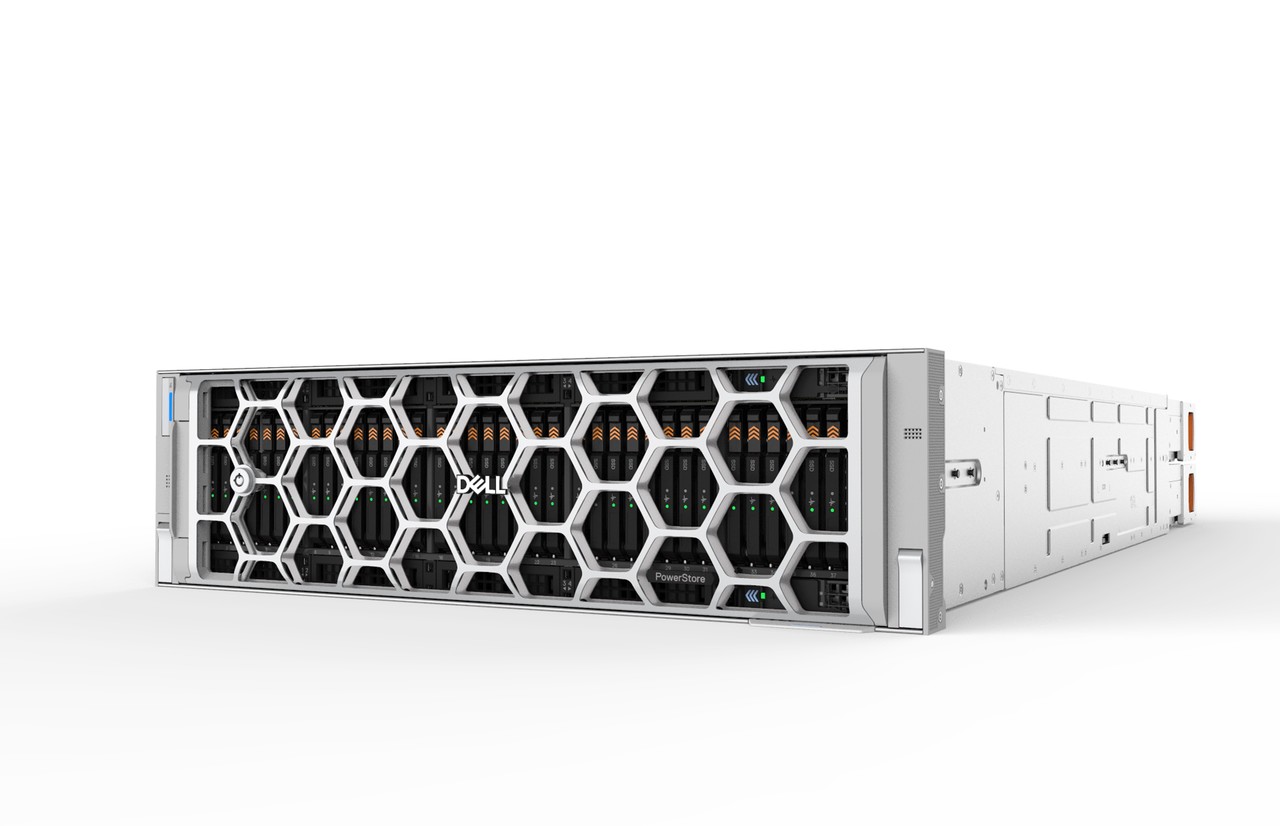
Against this backdrop, PowerStore Elite further strengthens its efficiency benefits at the physical chassis architecture level. PowerStore Elite adopts a 3U high-density chassis structure that improves efficiency in terms of space and power.
PowerStore Elite also fully adopts the latest E3.S standard form factor. This moves it beyond the limitations of the existing 2.5-inch drive format.
E3.S is a standard NVMe flash drive form factor for highly integrated, ultra-compact designs. It also supports an E3.L expansion bracket to maximize physical space efficiency.
PowerStore Elite also supports a mixed QLC and TLC configuration. This broadens the range of drive configuration choices.
The system is designed to allow mixed use of 30.72TB QLC and 15.36TB, 7.68TB, and 3.84TB TLC drives within a single system. Accordingly, drive configurations can be tailored to specific workload characteristics.
This configuration is intended to address enterprise environments that require both high performance and large capacity. By combining drives of different capacities and types within a single device, it also enables cost-efficient media deployment.
The system also adopts a 3U form factor and significantly improves airflow and Thermal Dynamics design to strengthen heat management capabilities. A separate NVRAM bay that previously occupied space at the front has been removed, and the system has been converted to a software-defined persistent memory module. As a result, all 40 front bays can be used for customer data storage.
As a result, PowerStore Elite achieves up to 5.8PBe density on a single 3U base chassis. While legacy storage infrastructure used to occupy dozens of U of rack space, it can now be consolidated into a single 3U chassis. This enables reductions in data center floor space costs and eases power delivery burden.
The photo source is Dell Technologies.
As a metric for enterprise storage, a spec sheet's single maximum IOPS figure has limitations. Maximum IOPS alone does not adequately represent real-world operating environments in which multiple applications run simultaneously.
In actual data centers, the key considerations are whether sustained throughput, response latency, and effective data reduction rates work together.
Principled Technologies conducted Vdbench mixed workload testing on the same dataset. The comparison target was PowerStore 9500 and a competitor's latest all-flash NVMe array.
PowerStore 9500 is the top-tier model. The test results demonstrated PowerStore's technical superiority.
In the average test for the OLTP mixed workload, PowerStore 9500 delivered 834,558 IOPS, while the competitor's product delivered 357,427 IOPS. In the throughput comparison, PowerStore 9500 achieved up to 2.33 times that of the competitor.
Dell Technologies conducted a 310K IOPS target database test and compared the performance and efficiency of PowerStore 9500 with competitive products and other vendors in an identical dataset environment.
In the latency comparison, the competitor's product posted 1.22 ms, while PowerStore 9500 recorded 0.44 ms. PowerStore 9500 was presented as reducing latency by up to 63.94% compared with the competitor's product.
In the data reduction ratio comparison, PowerStore 9500 posted a data reduction ratio of 6.6:1, while the other vendor's ratio was 2.76:1. PowerStore 9500 was shown to deliver up to 2.39 times better data efficiency than the other vendor.
PowerStore 9500 also supports AIops-based intelligent operations and always-on lifecycle support.
It has also completed a unified architecture that fully integrates block and file workloads on a single platform.
PowerStore 9500 provides Dynamic Core Allocation, automatically reallocating controller CPU resources in real time between file and block workloads in response to workload fluctuations.
It also applies machine learning-based autonomous data path intelligence and log-structured metadata technology to optimize the lifespan and durability of QLC SSDs while accelerating data read performance. The photo source is Dell Technologies.
For easier management and stronger security, the controller applies the iDRAC architecture, Dell PowerEdge servers' standard remote management tool, and the controller removal and attachment structure has been improved to a tool-less forward latch method that does not require tools. At the software layer, linking Dell Cyber Detect and Dell AIOps enables real-time detection of ransomware attacks and predictive AI-based health scoring to reduce infrastructure management resources by up to 95%.
It also provides a Lifecycle Extension program aimed at avoiding the burden of a Forklift hardware replacement, and supports Data-In-Place upgrades that replace only the controller without downtime while keeping the existing 3U chassis and E3 drives. It can also form a single cluster with heterogeneous-generation devices such as Gen 1, Gen 2, and Gen 3, and supports nondisruptive data migration within a single cluster. In addition, when Dell Private Cloud and the Dell automation platform are built together, implementation costs can be reduced by up to 65% compared with standard HCI, while also providing flexibility through integrated deployment of Dell Private Cloud and the Dell automation platform.
Lee Kyung-geun, executive director at Dell Technologies Korea, said that while PowerStore Elite belongs in the high-performance all-flash storage category, it is not merely storage but a data platform that responds to environments with increasing AI and data. He explained that in an environment where infrastructure costs and infrastructure complexity are expanding due to AI and data growth, PowerStore Elite is designed to handle more workloads with less infrastructure. He added that its flexible architecture and multi-generation scalability break the Forklift upgrade cycle, extend the life of existing investments, and enable seamless integration of new capabilities. The executive director emphasized that this is a major advantage in an era when infrastructure planning cycles have shifted from years to months.
Source: IT DAILY · Kwon Young-seok
Original: https://www.itdaily.kr/news/articleView.html?idxno=241921
References
This article was produced with the help of an automated content generation algorithm.
Source: IT DAILY
View originalThis article was summarized and organized by BizCrush based on the original article from IT DAILY. For exact quotations and full details, please refer to the original article.