“AI Infrastructure Must Include a Reusable Platform and Space Securing System”
IT DAILY ·
✦ AI Summary
At CXLab's 'Astrago AIDC Infrastructure Day 2026' session, measures for scaling AI infrastructure across the enterprise and criteria for selecting AIDC were introduced. An Juhyun, director at Dell Korea, explained that AI projects stall between PoC and production because of the operating framework, connectivity, responsible owner, and lack of standard processes. Lee Minwoo, director at JLL, said GPU server procurement and power equipment procurement are taking longer while spare floor space in the Seoul metropolitan area is nearly exhausted, and emphasized the need for rapid verification of data center contracts.
Companies seeking to deploy AI infrastructure in real-world operations should avoid approaches focused solely on procuring hardware, observers said. They also said organizations need to establish a reusable platform framework and proactively respond to shortages of data center floor space in the Seoul metropolitan area and delays in procuring core facilities.
The remarks were introduced at CXLab's 'Astrago AIDC Infrastructure Day 2026' session held on the 30th. The session presented measures for scaling AI infrastructure across the enterprise and criteria for selecting AI data centers (AIDC).
The speakers were An Juhyun, director at Dell Korea, and Lee Minwoo, director at JLL. The two speakers presented the session content centered on enterprise-wide AI infrastructure expansion measures and AIDC selection criteria, respectively.
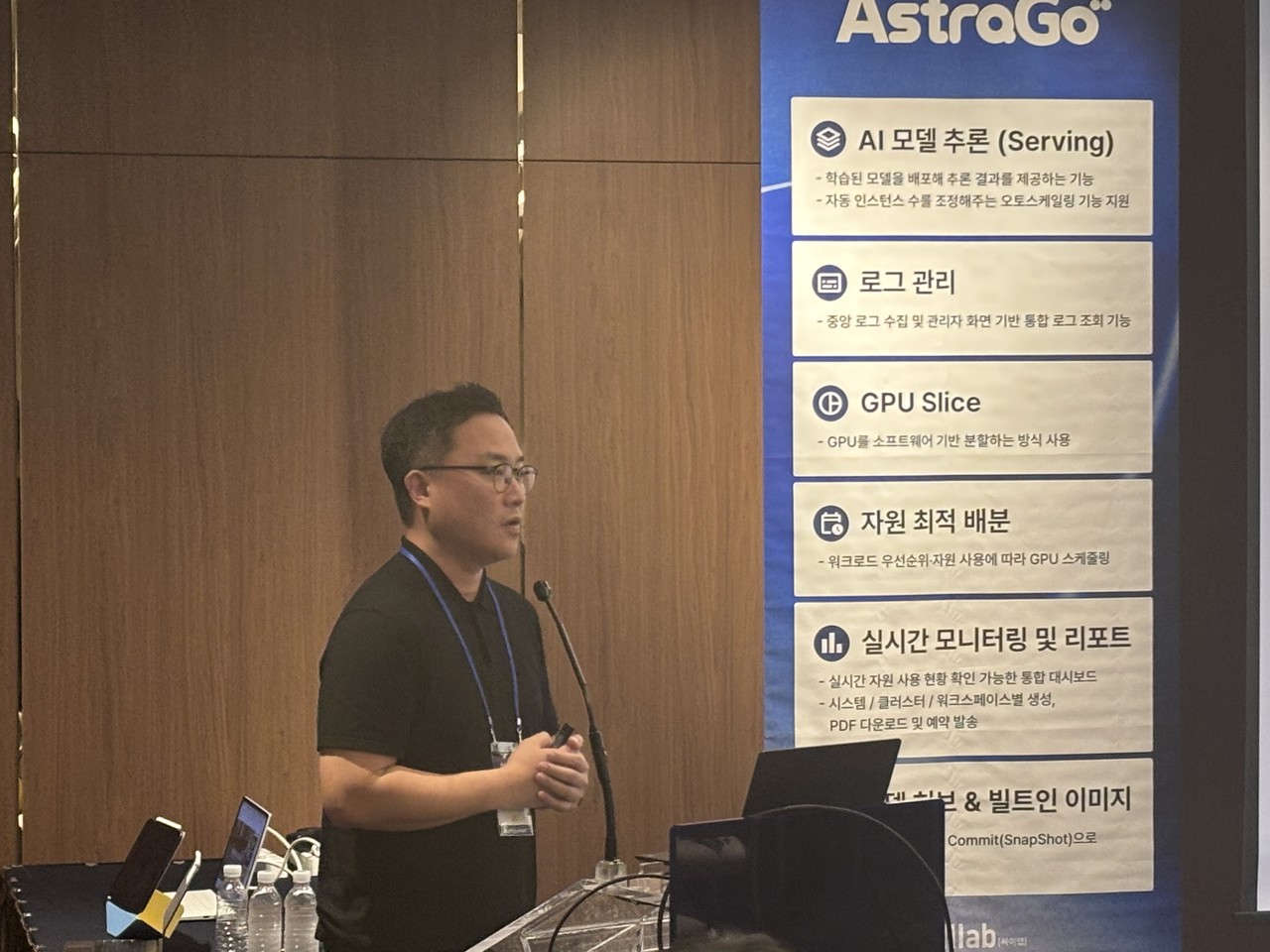
An Juhyun, director at Dell Korea, gave a presentation under the theme, 'AI Infrastructure Optimization Strategy: Scaling from PoC to Production at the Right Size.' An said the cause of AI project stoppages lies in the operating framework rather than the model itself.
This photo shows An Juhyun, director at Dell Korea, during the presentation. The photo credit is to reporter Kwon Young-seok.
An said about 88% of AI projects stall between PoC and production, adding that the main reason lies in the surrounding framework rather than model performance. Technically, he said, PoC environments are not well connected to operational environments. From an organizational standpoint, the owner responsible for AI operations is unclear, and from a governance standpoint, many cases lack standard processes such as model management and security compliance.
An explained that as projects move toward the operations stage, requirements for monitoring, incident response, security, and compliance expand. As a result, he added, some cases require architecture redesign in the operations phase.
As a solution, An proposed shifting from individual PoC-centered efforts to a reusable 'enterprise AI platform' and moving from scattered projects to an AI operating model with governance applied. He cited chatbots, document search, and quality inspection as examples of new use cases, and explained that the approach of building infrastructure anew for each new use case should be avoided. Instead, common resources such as GPU, network, and storage, along with common resources such as model services, vector databases, and security reference architectures, should be reused.
Business goals were presented as the starting point for infrastructure sizing. The proposed sequence is to organize service functions, peak-time concurrent requests, and response time targets, then decide which model to use, and afterward calculate model and KV cache memory to select the appropriate GPU.
An said companies tend to ask first how many GPUs they need. He explained that the starting point for infrastructure is business, not technology, and that business goals need to be clearly defined.
An said clarifying business goals can prevent excessive investment and insufficient performance. Accordingly, it was emphasized that infrastructure sizing should begin by setting business goals before technical specifications.
Lee Minwoo, director at JLL, spoke at the event on the current state of the AIDC market, data center selection criteria, and precautions in contracts. Lee said the domestic server market grew 72.7% year over year in 2024, and that this has led to surging demand and worsening supply chain bottlenecks.
Lee explained that procurement of GPU server systems takes 28 to 32 weeks, while procurement of power equipment such as large transformers can take as long as 36 to 48 months. He said data center completion delays continue because of the prolonged procurement of power facilities.
Lee explained that under these circumstances, there is almost no spare floor space in the Seoul metropolitan area. Accordingly, he said the need for rapid contract verification related to securing data centers is growing.
Vacancy rates at major data centers in the Seoul metropolitan area were mostly 0%. In Seoul, most of the preleasing for completed and soon-to-be-completed data centers has already been finished, underscoring the lack of available floor space in the city. Lee said future large-scale additional power supply in the Seoul metropolitan area will also be limited because of regulatory effects.
At the same time, the power consumption of the latest GPU servers was said to reach as much as 142 kW per rack. Because such power and cooling requirements make it difficult for in-house data rooms to accommodate the latest GPU servers, companies are shifting demand to professional leased data centers. Professional leased data centers were highlighted for being fully equipped with ultra-high-power and cooling facilities, allowing servers to be brought online immediately.
Lee said that securing expensive GPUs alone is not enough, and that they cannot be used without dedicated floor space for stable operations. He added that rapid and thorough verification is essential in data center contracts. He also said that, when signing contracts, it is necessary to specify clauses for concrete safeguards rather than paper specifications.
Source: IT DAILY · Kwon Young-seok
Original: https://www.itdaily.kr/news/articleView.html?idxno=241920
References
This article was produced with the help of an automated content generation algorithm.
Source: IT DAILY
View originalThis article was summarized and organized by BizCrush based on the original article from IT DAILY. For exact quotations and full details, please refer to the original article.