Automobiles Evolve From 'Mobility' to 'Living Platforms' as In-Car Consumption Expands Beyond Fueling and Parking to F&B and Retail
TECHWORLD ·
✦ AI Summary
The basis for competition in automobiles is shifting from driving performance to the ability to carry out in-car activities.
KPR Insight Research Institute analyzed online mobility big data related to autonomous driving, in-car payment, hyper-personalization, and healthcare.
In-vehicle services are expanding beyond fueling and parking to F&B and retail, as well as driver state detection and management.
The basis for competition in automobiles is changing. As the focus of evaluation shifts from driving performance to the ability to carry out in-car activities, a trend is emerging in which in-vehicle consumption channels are expanding beyond fueling and parking to F&B and retail.
KPR's KPR Insight Research Institute analyzed online big data related to mobility. The keywords analyzed were autonomous driving, in-car payment, hyper-personalization, and healthcare. Starting from the change in which the burden of driving is easing as technologies such as autonomous driving spread, KPR Insight Research Institute said cars are evolving into living platforms that go beyond simple transportation to encompass consumption, rest, and health management as they combine with software, AI, and sensors.
Reduced driving burden was presented as the background for this change. Counterpoint Research predicted that the share of vehicles equipped with ADAS and autonomous driving systems will rise from 66% in 2025 to 94% in 2035. As the time and attention devoted to driving decrease, the importance of in-car services is expected to grow further.
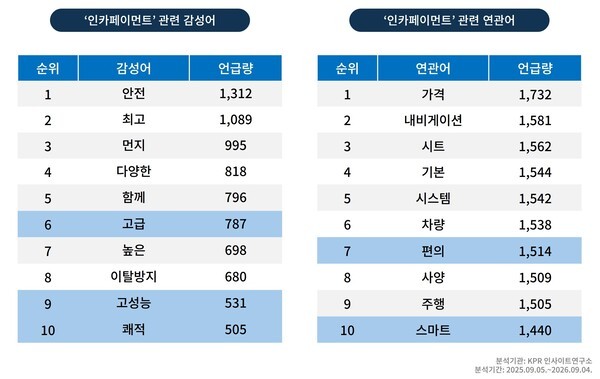
The expansion of consumption and personalization was presented as the core of changes in in-vehicle services. In particular, "consumption in the car" emerged as the area with the fastest pace of change. Big data analysis found that related terms for in-car payment, or "in-car payment," included "convenience" and "smart," while emotional terms included "premium" and "comfortable."
The scope of in-car payment is also expanding from fuel and parking fees to everyday consumption. Hyundai Motor offers a function that lets users order and pay for Starbucks drinks through the vehicle screen and voice commands. Renault Korea operates a "drive pick" service that allows customers to order CU convenience store products from the car and pick them up in front of the store.
Personalization is also expanding from a single driver to a household unit. Genesis offers a function that automatically calls up driver-specific seat, mirror, HUD, and navigation settings with fingerprint authentication alone.
This trend is also extending to passenger and pet care. Volvo EX90 detects people and pets left inside the car using radar sensors. Hyundai Motor and Kia's "pet mode" maintains the interior temperature when a pet is left in the car while the owner steps away briefly, and consumer response analysis showed a 93% positive rate.
Automobiles are expanding their functions beyond transportation to detect and manage the condition of drivers and passengers. Cars are showing a trend of attempting to understand the driver's physical condition and mood as well.
According to KPR Insight Research Institute, LG's "in-cabin sensing" is a feature that uses cameras and AI. LG's "in-cabin sensing" analyzes gaze, facial expressions, and heart rate, and it has the ability to detect drowsiness and health abnormalities.
BMW and Mercedes-Benz have unveiled a function that automatically brings the vehicle to a stop and connects emergency rescue services if normal driving is deemed difficult. It is presented as an example of a vehicle determining the driver's condition and carrying out both driving safety and rescue connection.
Genesis' "Mood Curator" and Mercedes-Benz's "Energizing Comfort" are functions that adjust lighting, music, fragrance, and seats at the same time. These features are intended to manage passenger fatigue and mood.
Shin Myung-hee, head of KPR's corporate and institutional strategic communications division, said automobiles are expanding the handling of travel routes, payment records, and biometric information. She added that social trust related to personal data protection and data utilization is becoming a new competitive condition in the mobility industry. She also said that with technological advancement, there is a need to transparently inform consumers about systems and standards. She added that if such communication is carried out in parallel, new vehicle experiences can take root in the market.
Source: TECHWORLD · Lee Gwang-jae
Original: https://www.epnc.co.kr/news/articleView.html?idxno=407540
References
This article was produced with the help of an automated content generation algorithm.
Source: TECHWORLD
View originalThis article was summarized and organized by BizCrush based on the original article from TECHWORLD. For exact quotations and full details, please refer to the original article.