VR Walking Tech Adds a Sense of Incline While Seated
AI TIMES ·
✦ AI Summary
According to AI TIMES, a joint research team from GIST and MIT unveiled a virtual walking system on September 30 that lets users feel as if…
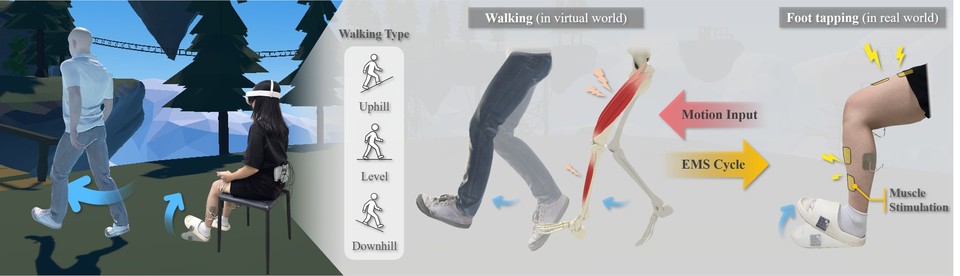
According to AI TIMES, a joint research team from GIST and MIT unveiled a virtual walking system on September 30 that lets users feel as if they are walking on flat ground and slopes in VR by linking foot movements with leg muscle stimulation while seated in a chair. Even without visual cues, users identified uphill terrain with 78% accuracy and flat ground with 72% accuracy, suggesting that they could physically sense terrain differences that had been difficult to detect through simple stationary movements alone. The technology alternates toe-lifting motions with virtual steps and stimulates the muscles used in actual walking at those moments, increasing the sense that the avatar's movements are connected to the user's own body. The research team said that when the stimulation was adjusted to match the terrain, the sense of presence in the virtual space became stronger. In contrast, there were no clear differences among the comparison conditions in motion sickness or physical and mental burden. The key point is that it could supplement the sense of walking without a large movement space or sloped equipment, broadening its potential use in immersive content with significant space constraints.
Perspective
The significance of this study lies in showing that one of virtual reality's weaknesses, the sensation of movement, can be supplemented not by large equipment but by a more refined design of bodily stimulation. It marks a step forward from merely making the screen look convincing to aligning even the body's sensations. In particular, the fact that it can be implemented even in space-constrained environments lowers the barrier to content design and creates room for the standard in immersion competition to shift from visual focus to sensory integration. In the end, the next differentiator may be not how widely something can show, but how naturally it can make users believe they are walking.
This perspective is BizCrush's own commentary and is not part of the reporting by AI TIMES.
This article was produced with the help of an automated content generation algorithm.
Source: AI TIMES
View originalThis article was summarized and organized by BizCrush based on the original article from AI TIMES. For exact quotations and full details, please refer to the original article.