Fake 'Mail Arrival Notice' Emerges... How Far Will Phishing Tactics Evolve?
TECHWORLD ·
✦ AI Summary
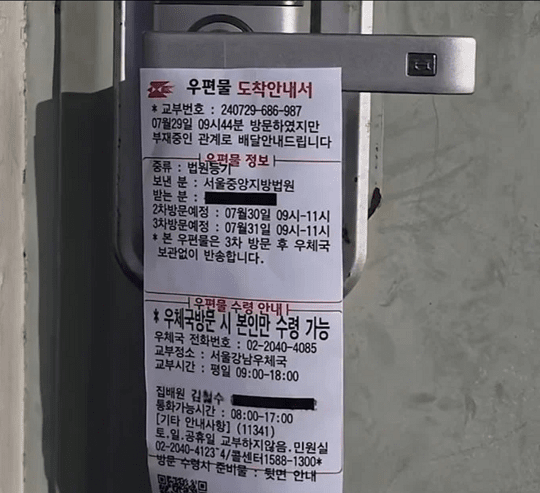
The Korea Post issued a warning on the 29th after suspected letter-phishing cases disguised as the Korea Post-issued 'Mail Arrival Notice' were reported in some regions.
It said there had been cases in which the courier's contact information in forged or altered notices was changed to a phishing number, or only the QR was altered, and that ordinary people would have difficulty distinguishing them with the naked eye.
The Korea Post said genuine notices use special thermal paper and a low-residue adhesive, and advised people to contact the post office directly if they suspect anything.
As phishing tactics become more sophisticated, cases are emerging that exploit everyday life beyond text messages and phone calls. There have also been cases of forged mail arrival notices, a tactic intended to lure people into entering personal information or visiting malicious websites, so caution is needed.
The Ministry of Science and ICT's Korea Post on the 29th issued a warning. This came after suspected letter-phishing cases disguised as the Korea Post-issued 'Mail Arrival Notice' were reported in some regions.
The Korea Post said that in some forged and altered notices, the courier's contact information had been changed to a phishing number, and in other cases only the QR had been altered. It also said the forgeries were so precise that they are difficult for ordinary people to distinguish with the naked eye.
Accordingly, the Korea Post pointed to the quality of the paper as a difference from genuine notices. The material used for the actual notices is special thermal paper, also known as receipt paper, and the adhesive used on the actual notices is a low-residue, easy-to-remove type similar to Post-it notes.
The Korea Post emphasized that anything attached to plain paper with clear tape, or anything that cannot be cleanly removed like a regular sticker, is not a Korea Post-issued item, adding that such cases warrant suspicion of forgery or alteration. It also said it does not collect resident registration numbers or account numbers over the internet or by phone, and urged people not to share that information.
Park In-hwan, head of the Korea Post, said the ways of impersonating the post office have recently been diversifying and increasing, and added that if there is any doubt about whether something was sent by Korea Post, people should contact the post office directly to confirm. He said that checking directly is the way to prevent major damage.
Source: TECHWORLD · Kim Hye-jin
Original: https://www.epnc.co.kr/news/articleView.html?idxno=407532
References
This article was produced with the help of an automated content generation algorithm.
Source: TECHWORLD
View originalThis article was summarized and organized by BizCrush based on the original article from TECHWORLD. For exact quotations and full details, please refer to the original article.