Samsung Electronics Bets on Agentic AI, Unveils 'Self-Evolving AI'
TECHWORLD ·
✦ AI Summary
Samsung Electronics announced on the 30th that it will hold the 'Samsung AI Forum 2026' at its Seocho headquarters in Seocho-gu, Seoul.
The forum's theme is 'The Agentic Shift: From Intelligence to Impact,' and the main agenda is ways to link the latest AI technologies, including Agentic AI and Physical AI, to actual work and outcomes.
In the afternoon session, Samsung Electronics introduced research achievements and real-world applications, as well as AI transformation cases from global partners, through the DX division's 'AI Technology' track and the DS division's 'AX Innovation' track.
Samsung Electronics is seeking ways to connect AI technology centered on Agentic AI to results in the workplace and industrial settings. Samsung Electronics placed at the center of the forum an approach that would move AI technology beyond the research stage and into tangible field results.
Samsung Electronics announced on the 30th that it will hold the 'Samsung AI Forum 2026' at its Seocho headquarters in Seocho-gu, Seoul. This year marks the 10th edition of the 'Samsung AI Forum 2026.' The forum's theme is 'The Agentic Shift: From Intelligence to Impact.'
The main agenda of this year's forum is ways to link the latest AI technologies, including Agentic AI and Physical AI, to actual work and outcomes. The participants are leading scholars and experts in the AI field from Korea and abroad.
A total of 400 people will attend, including 100 professors and researchers from domestic AI graduate schools and 300 Samsung Electronics employees in AI-related roles. The event will be livestreamed on YouTube.
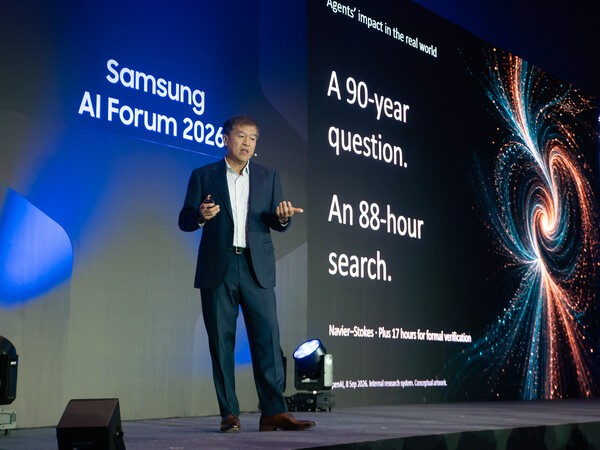
In a welcome address, Samsung Electronics Vice Chairman and CEO Jun Young-hyun said Agentic AI goes beyond technological innovation and brings fundamental changes to work styles and organizational culture.
Jun Young-hyun, Vice Chairman and CEO of Samsung Electronics, also said the company will seek future directions with global AI leaders and push ahead with practical AI technology innovation.
At the morning session that day, experts from OpenAI and AWS, along with AI scholars, discussed the future of Agentic AI.
The morning session featured keynote speeches from experts at big tech companies leading the global AI ecosystem, as well as AI scholars.
Richard Ho, vice president of hardware at OpenAI, introduced the changes that LLM-based autonomous decision-making Agentic AI will bring to companies and industries at large. David Green, AI technology leader for Asia Pacific and Japan at AWS, presented security and governance strategies for implementing Agentic AI safely and economically in enterprise environments.
The afternoon session was divided into the DX division's 'AI Technology' track and the DS division's 'AX Innovation' track.
The AI Technology track covered Efficient AI, Physical AI, and Continual Learning. In this track, Samsung Electronics introduced its research achievements and real-world applications.
It also unveiled Samsung research achievements ranging from on-device AI to Physical AI.
Ranjay Krishna, a University of Washington professor and researcher in Physical AI, introduced a paradigm for overcoming the limitations of vision-language model reasoning and building high-performance robotics AI using small models.
Kim Yoon-hyung, executive vice president at Samsung Research and also a professor at MIT, presented plans for next-generation Agentic Intelligence architecture innovation. His presentation focused on strengthening agent capabilities and expanding their scope of application.
Different AI topics were introduced in each session at the event. The Efficient AI session shared principles for device design and optimization technologies aimed at delivering the best user experience, along with examples of products that apply on-device AI platforms. The Physical AI session covered the possibilities, limitations, and future outlook of World Model and Robot Foundation Model, and Samsung Electronics introduced related research achievements. World Model is a technology that learns how the real world works, predicts what happens next, and pre-simulates the results of actions.
The Continual Learning session introduced 'Personalizing AI' and 'Self-Evolving AI.' 'Personalizing AI' combines learning new information with not forgetting existing knowledge, while supporting reliable memory editing. 'Self-Evolving AI' is a technology that independently analyzes experiences and pain points during real-world use after a product is released, then uses feedback from those analyses to improve performance.
In the DS division's AX Innovation track, Samsung first introduced AI technologies directly applied to the semiconductor business, and also presented AI transformation cases from global partners.
Dell Technologies and Anthropic, among other global partners, presented how trustworthy AI agents can be applied in the workplace.
They also presented methods for building an enterprise AI factory and examples of enterprise AI factories.
The DS division's AX/PI Center introduced design innovation cases and manufacturing innovation cases based on applying AI across semiconductor operations, and shared directions for AI-based workplace innovation to solve on-site semiconductor challenges.
Source: TECHWORLD · Park Gyu-chan
Original: https://www.epnc.co.kr/news/articleView.html?idxno=407539
References
This article was produced with the help of an automated content generation algorithm.
Source: TECHWORLD
View originalThis article was summarized and organized by BizCrush based on the original article from TECHWORLD. For exact quotations and full details, please refer to the original article.