OpenAI Puts ‘Working AI’ Front and Center, Unveils Always-On AI Agent “Dots”
IT DAILY ·
✦ AI Summary
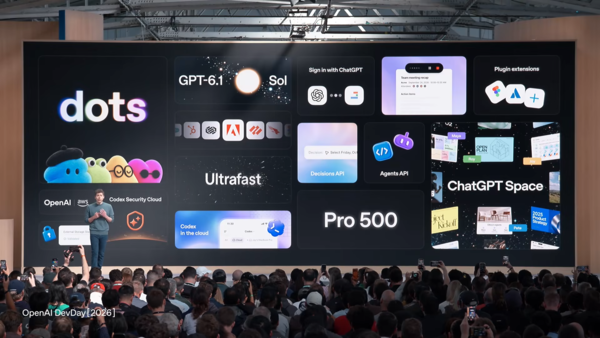
OpenAI on the 29th, at DevDay 2026 in San Francisco, unveiled the AI agent “dots,” the AI model “GPT-6.1 Sol,” and the speed-enhancing option “Ultrafast.” Dots continuously carries out assigned tasks once the user sets the goal and scope of authority, using a dedicated cloud computer, its own browser, and connected apps. GPT-6.1 Sol improves performance on difficult tasks and cost efficiency compared with GPT-6 Sol, while Ultrafast is a separate option that increases response and generation speed.
OpenAI on the 29th, at its annual developer event, DevDay 2026, held in San Francisco, unveiled major new products and developer tools. The releases included the AI agent “dots,” the AI model “GPT-6.1 Sol,” and “Ultrafast,” a feature that boosts AI processing speed.
At the event, OpenAI put forward “working AI” that goes beyond question-and-answer chatbots and can identify and continuously carry out autonomous tasks. OpenAI presented this direction as its core theme while unveiling multiple new products and tools together.
OpenAI focused on moving beyond simple Q&A chatbots and highlighting AI that understands work on its own and keeps carrying it out. The representative example of that direction was the AI agent “dots.”
Sam Altman, OpenAI CEO, introduced the AI agent “dots” at DevDay 2026. The unveiling was presented as a centerpiece of the event, which put “working AI” front and center.
Dots is an AI agent that keeps carrying out assigned work as long as the user sets the goal and scope of authority. The service uses GPT-6 Astra as its base model and draws on a dedicated cloud computer and its own browser. It is also structured to move between apps connected by the user and perform the tasks needed.
Dots is characterized by its ability to understand a user's work style and priorities. As time spent working together accumulates, it better learns how the user works and where the user focuses, and can proactively alert the user when something needs attention. It also has a feature that allows it to continue ongoing work.
This operating method is emphasized as something that can be applied to tasks that involve multiple steps and continue over long periods. Examples cited included software development, budget planning, and project management.
Sam Altman, OpenAI CEO, said dots is what he has always imagined as true AI. He described dots as an AI assistant that handles the things the user does not want to do 24 hours a day, helping them focus on higher-level work. He also said it has strong capabilities as an always-on agent designed to handle almost everything one can think of.
Holly Li, a member of OpenAI's product team, explained the task execution features of the AI agent “dots” at DevDay 2026. She said what feels new about dots is that over time it learns how she works and what she focuses on. She also described how dots can review overnight incoming items and alert the user to urgent matters before the morning starts.
Holly Li of OpenAI's product team then demonstrated dots' task execution features on site. The demo showed dots checking a changed meeting schedule and updating the calendar. It also introduced a process in which user feedback from tests was analyzed and design changes were implemented in the app.
The on-site demonstration also continued with a process of identifying bugs, investigating the issue, and fixing it. The demonstration was conducted by Holly Li of OpenAI's product team. The photo credit was listed as “Photo: Screenshot from OpenAI YouTube.”
Holly Li of OpenAI's product team explained that OpenAI engineers use dots to fix dozens of bugs a day. She mentioned as a defining feature of dots that it can provide all context and memory. She added that dots eases real work burdens and affects perceptions of what is possible, beyond simply speeding up repetitive tasks.
Dots will be rolled out sequentially starting today to ChatGPT Pro users outside the EEA, Switzerland, and the UK. OpenAI unveiled GPT-6.1 Sol.
GPT-6 Sol was unveiled on the 22nd. One week after the unveiling of GPT-6 Sol, OpenAI introduced GPT-6.1 Sol.
On the same day, Anthropic unveiled “Claude Opus 5.5.” Anthropic also unveiled “Claude Sonnet 5.5” on the 28th. As a result, competition among AI companies over models appeared to be accelerating.
GPT-6.1 Sol is a model that improves agent-based coding performance, computer-use performance, and specialized work performance. It also aims to come close to GPT-6 Astra on difficult tasks while focusing on offering lower costs.
CEO Altman said that after Astra's launch, users raised two demands. Those demands were for a cheaper model and a faster model. Altman said GPT-6.1 Sol is a model that emphasizes a balance between cost and capability, and that it delivers intelligence very close to Astra at one-fifth the price.
Sam Altman, OpenAI CEO, introduced the new AI model “GPT-6.1 Sol” at DevDay 2026. In unveiling GPT-6.1 Sol, OpenAI also released benchmarks comparing it with the existing GPT-6 Sol.
OpenAI said that in OSWorld 2.0, a benchmark for advanced computer-use ability, GPT-6.1 Sol's performance at maximum reasoning intensity was 7 percentage points higher than GPT-6 Sol's. It also said GPT-6.1 Sol's OSWorld 2.0 cost was less than half that of GPT-6 Sol. OpenAI also said the score gap with Astra in OSWorld 2.0 was 2.1 percentage points.
OpenAI said that in Terminal-Bench Science 0.1, a benchmark for scientific research workflows, GPT-6.1 Sol scored more than twice as high as GPT-6 Sol. It also said GPT-6.1 Sol's cost per task in Terminal-Bench Science 0.1 was less than half that of GPT-6 Sol. GPT-6.1 Sol has improved cost efficiency, and its standard API pricing is USD 2 per 1 million input tokens and USD 10 per 1 million output tokens.
Sam Altman, OpenAI CEO, said it aims to become the main model for everyday use while surpassing Astra in some respects.
OpenAI unveiled “Ultrafast,” a separate option that increases speed. The feature is designed to improve the response and generation speed of AI models.
It applies to the high-speed processing options for GPT-6 Astra and GPT-6.1 Sol. It is offered for Astra Ultrafast, the API, ChatGPT Work, and Codex. Speed is up to 6 times faster than standard Astra in the API, and up to 8 times faster than standard Astra in ChatGPT Work and Codex.
CEO Altman noted that there is demand for using top-tier intelligence very quickly when needed. The price for Ultrafast is 6 times the standard rate. OpenAI said the price increase for Ultrafast is commensurate with the speed it provides.
Sam Altman, OpenAI CEO, conducted a demonstration at DevDay 2026 comparing the processing speed of “Ultrafast” and the standard mode. The photo credit was listed as a screenshot from OpenAI's YouTube.
At the event, a DevDay demonstration compared the speed at which the standard mode and Ultrafast generated results from the same prompt, showing the performance difference. Ultrafast finished the rocket-building task first, and its screen displayed the rocket launch status. By contrast, the standard mode was still in progress at the same point. Altman then claimed there is no similar case in the current market and said that once people use it, they will not want to go back to the previous method.
Afterward, Thibault Sottiaux, OpenAI's product lead, demonstrated real-time editing of a 3D space using Ultrafast. Based on several photos from the venue, he recreated a 3D space and then instructed dots to move to an empty seat in the audience. Immediately after the instruction, the movement result appeared on the screen.
Thibault Sottiaux then carried out follow-up tasks on the spot. He switched the camera viewpoint to face the audience and displayed the event livestream video on a large screen in the virtual space. All of those tasks were performed using Ultrafast.
CEO Altman emphasized that the direction of AI should not be limited to automating human labor. He said that if AI is implemented properly, the future looks closer to a new renaissance than to a new industrial revolution. He also stressed that AI should give people more tools to strengthen agency in their lives and to create, learn, discover, and expand knowledge.
Meanwhile, the market sees OpenAI's Dots as likely to compete in earnest with Meta's personal AI agent “Muse.” Meta unveiled Muse earlier this month. Muse is a personal AI agent that, beyond question-and-answer functions, uses a dedicated cloud computer and browser and continuously carries out tasks in apps connected by the user.
The Verge introduced dots as a competitor to Muse. According to The Verge's report, OpenAI is responding to Meta's Muse with its own AI agent dots.
Source: IT DAILY · Yang Seung-gap
Original: https://www.itdaily.kr/news/articleView.html?idxno=241901
References
This article was produced with the help of an automated content generation algorithm.
Source: IT DAILY
View originalThis article was summarized and organized by BizCrush based on the original article from IT DAILY. For exact quotations and full details, please refer to the original article.