Jensen Huang: “With Korea for Decades” as Lee Jae-yong and Chey Tae-won Stress AI Alliance
IT DAILY ·
✦ AI Summary
NVIDIA CEO Jensen Huang received the Van Fleet Award at the Korea Society’s “2026 Annual Gala” in New York on the 28th local time.
Samsung Electronics Chairman Lee Jae-yong and SK Group Chairman Chey Tae-won congratulated Huang on his award at the same event, each referring to their company’s cooperation with NVIDIA.
Huang said he intends to keep working with Korean companies such as Samsung Electronics and SK for decades to come.
As NVIDIA CEO Jensen Huang referred to his long-term cooperation with Korea, Samsung Electronics Chairman Lee Jae-yong and SK Group Chairman Chey Tae-won appeared together, underscoring the AI alliance. According to industry sources on the 29th, Huang attended the Korea Society’s “2026 Annual Gala,” hosted by the Korea Society, a Korea-U.S. friendship nonprofit, in New York on the 28th local time.
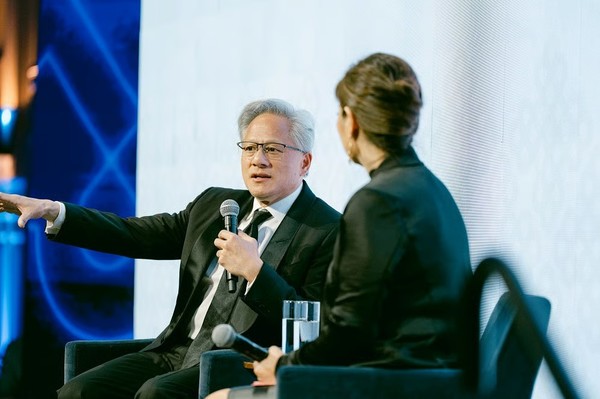
Huang received the Van Fleet Award at the event. At the Korea Society’s annual gala in New York on the 28th local time, Lee Jae-yong, chairman of Samsung Electronics, and Chey Tae-won, chairman of SK Group, attended the Van Fleet Award stage together and congratulated Huang on his honor.
At the event, Lee described cooperation between NVIDIA and Korean companies as a true partnership. Chey said the front line of the Korea-U.S. alliance is not a battlefield but a data center.
Huang said he intends to continue working with Korean companies such as Samsung Electronics and SK for decades to come. As a result, the event highlighted both the cooperation between Korean companies and NVIDIA and the Korea-U.S. AI partnership structure.
The Van Fleet Award, presented by the Korea Society, is given to individuals or organizations that have contributed to the development of Korea-U.S. relations. The Korea Society cited Huang’s leadership and contributions in the AI and semiconductor industries as the reason for his selection. It also additionally recognized his cooperation with Korean companies such as Samsung Electronics, SK Group, Hyundai Motor Group, and Naver.
In a congratulatory speech, Lee said he could not think of anyone more deserving of the award than Jensen. He also said Jensen had placed his company at the center of the current AI transformation. He went on to say Jensen had redefined the possibilities of computing.
Lee added that he is now powering industries around the world and helping build something greater. He said he sees those achievements as the result of a true partnership between the United States and Korea and as influence.
Samsung honorary chairman Lee Kun-hee received the Van Fleet Award in 2006. After mentioning his father’s award, Lee said he would introduce three things he and Huang have in common.
At the Korea Society’s “2026 Annual Gala” in New York on the 28th local time, Lee Jae-yong, chairman of Samsung Electronics, made remarks congratulating NVIDIA CEO Jensen Huang on receiving the Van Fleet Award and noted as a first commonality that both companies are all-in on AI.
Lee then cited another commonality between the two men: their daughters are both named “Madison.” He explained that “Madison” is the English name of his daughter Won-ju and also the name of Huang’s daughter.
In his closing remarks, Lee drew laughter from the audience by saying they all love the Galaxy Z Fold8. Separately, Samsung Electronics aired a video on a Times Square billboard in New York congratulating Huang on receiving the Van Fleet Award.
SK Group Chairman Chey Tae-won also spoke at the same event to congratulate NVIDIA CEO Jensen Huang on receiving the Van Fleet Award. According to the photo caption, Lee Jae-yong, chairman of Samsung Electronics, and Chey Tae-won, chairman of SK Group, congratulated Huang on receiving the Van Fleet Award at the Korea Society’s “2026 Annual Gala” in New York on the 28th local time.
Chey explained the partnership between NVIDIA and SK by comparing it to the roles of AI computing and memory. Saying that NVIDIA is the brain and SK is memory, he described the relationship between NVIDIA and SK as corresponding to the roles computing and memory play in an AI system.
Chey said that whenever he meets Jensen, the essence of the question is whether faster production is possible. He said Jensen’s attitude is similar to the Korean “ppalli-ppalli” spirit, adding that in that sense the two sides are a good fit. He also said he knows whom Jensen should contact when he forgets something.
NVIDIA designs AI accelerators, while SK Hynix produces AI memory, including HBM. Chey likened the roles of the two companies to “brain” and “memory.” He explained that NVIDIA’s role is design and brain, while SK’s role is memory production.
Chey said this corporate cooperation is also linked to changes in the Korea-U.S. alliance. He said Jensen stands at the front line of the Korea-U.S. alliance, which was built by General Van Fleet 70 years ago.
He then said the current front line is not a battlefield but a data center. The division of labor and cooperation between the two companies was explained as being tied to the nature of this changed front line.
Huang is said to often use the expression, “The more you buy, the more you save.” Chey said he truly believes in that expression as well and expressed great joy at becoming a partner. He then said he hopes the pace of the partnership’s growth will outpace GPU demand and proposed a toast.
Chey succeeded his father, the late SK chairman Chey Jong-hyun, as a Van Fleet Award recipient. With that, the SK family has produced two generations of recipients.
The late Chey Jong-hyun received the award in 1998. Chey received it in 2017.
Jensen Huang expressed his intention to continue long-term cooperation with Korean companies. Huang pointed to Korea’s strengths as an industrial base that can pursue AI technology development and manufacturing application at the same time.
Huang said he was deeply impressed by the way Korean society embraces technology. He also said he intends to keep working with Korean companies such as Samsung Electronics and SK for decades to come.
Huang rejected arguments that AI development should be slowed because of AI risks. He argued that technological progress can improve both AI performance and safety at the same time.
Huang said the belief that AI development should be slowed to improve safety is not true. He then said that view is a false choice.
Pointing to hallucinations as a prominent problem in early generative AI, Huang said hallucinating AI is not safe and AI that is not grounded in truth is not safe either. He added that hallucinations are decreasing as frontier AI models advance, explaining that safety and capability are correlated and cannot be separated.
Huang also said concerns that AI could slip out of human control require technical means of control. For that purpose, he said AI should initially be given no broad authority, only the level of access needed, and should be controlled by continuously monitoring its behavior.
In that context, Huang said the prerequisite for realizing AI’s potential is solving AI safety issues. He added that while continuing to explore the frontier of AI capability, there is a need to move faster in discovering the frontier of AI safety.
Source: IT DAILY · Kim Byung-ju
Original: https://www.itdaily.kr/news/articleView.html?idxno=241892
References
This article was produced with the help of an automated content generation algorithm.
Source: IT DAILY
View originalThis article was summarized and organized by BizCrush based on the original article from IT DAILY. For exact quotations and full details, please refer to the original article.