Samsung 6 Affiliates Invest USD 1 Billion in U.S. AI Infrastructure Firm 'Helix'
IT DAILY ·
✦ AI Summary
Samsung announced on the 29th that six affiliates will invest a total of USD 1 billion in U.S. AI infrastructure company Helix Digital Infrastructure.
Samsung Electronics will invest USD 500 million, while Samsung C&T, Samsung SDS, Samsung SDI, Samsung Life Insurance and Samsung Fire & Marine Insurance will jointly invest USD 500 million.
The investment links Samsung's semiconductor, cooling, construction, data center operations and power backup capabilities with the AI infrastructure business.
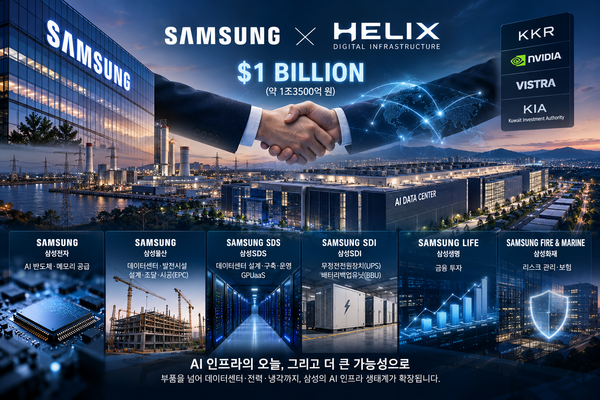
The article image is AI-generated, and IT Daily reported it. Samsung said on the 29th that six companies, including Samsung Electronics, Samsung C&T, Samsung SDS, Samsung SDI, Samsung Life Insurance and Samsung Fire & Marine Insurance, will invest a total of USD 1 billion in U.S. AI infrastructure company Helix Digital Infrastructure. The investment size is about KRW 1.35 trillion. Samsung Electronics will invest USD 500 million, while the combined investment from Samsung C&T, Samsung SDS, Samsung SDI, Samsung Life Insurance and Samsung Fire & Marine Insurance will also total USD 500 million.
Through this investment, Samsung will participate as a founding investor in Helix. Helix's co-founding investors are KKR, Nvidia, Vistra and the Kuwait Investment Authority (KIA). By having six affiliates invest together, Samsung presented a structure that combines each affiliate's technological and business capabilities with the AI infrastructure business.
The investment was presented as going beyond a simple financial stake. Samsung Electronics will link its semiconductor and data center cooling capabilities, Samsung C&T its infrastructure construction capabilities, Samsung SDS its data center design, operation and GPU as a Service capabilities, and Samsung SDI its power backup technology. Through this approach, Samsung showed its intention to connect Group capabilities with the global AI infrastructure business.
This is linked to a direction that does not stop at supplying AI semiconductors and components. The investment is interpreted as a strategy to directly participate in building an infrastructure ecosystem that includes data centers, power and cooling.
Helix is an AI infrastructure company under global investment firm KKR and was launched in June this year. Helix aims to develop and operate hyperscale data centers and provide integrated AI computing infrastructure, including power generation, transmission and distribution, optical communication networks and networks.
KKR launched Helix under a strategy to integrate data centers, power and networks into a single business structure instead of the traditional approach of securing them separately. KKR viewed the process of procuring data centers, power and networks separately as a bottleneck and designed it as an integrated business.
KKR believes that the ability to secure land, power, networks, capital and permits at the same time determines the speed at which AI infrastructure projects can be built. Accordingly, KKR secured more than USD 1 billion in long-term investment funds when Helix was launched, and is seeking to speed up execution by securing the necessary funding and personnel together.
Helix is led by Adam Selipsky, the former AWS CEO. The management team consists of experts from the data center and power industries, and about 170 of KKR's infrastructure specialists can also be utilized.
Helix's business focus includes data centers, power generation infrastructure and transmission and distribution infrastructure. This aligns with the background in which power has emerged as a major bottleneck as AI data centers (AIDC) expand. AIDC's power demand is much higher than that of conventional data centers because it must accommodate large-scale GPUs.
For that reason, securing GPUs alone is not enough to operate a data center in practice. To actually run a data center, an additional need arises to secure the power grid and power sources at the same time. Accordingly, Helix is targeting not only data centers but also power generation and transmission and distribution infrastructure.
Helix plans to invest in its own power infrastructure. It also plans to work with founding investor Vistra. The purpose of this cooperation is to secure the power needed for data centers.
The reason this investment is drawing attention is that there is a high degree of overlap between Samsung affiliates' business areas and the main components of AIDC. The gist of the subheading also focuses on linking Group capabilities, from Samsung Electronics to Samsung SDI, with AIDC. The investment is drawing attention because it aligns with the possibility of linking Group-level capabilities.
Samsung Electronics' DS division supplies memory and semiconductors for AI servers. Samsung Electronics' DX division has a path to use FläktGroup, which it acquired last year. FläktGroup is a company specializing in data center HVAC.
Samsung Electronics' DX division supplies air-cooled cooling products and cooling distribution units (CDU) for liquid cooling. Through this, it has a scope to provide data center cooling solutions. FläktGroup has 14 production sites and a supply and service network in 65 countries worldwide.
As the power density of AI GPUs rises, cooling is emerging as a core technology for data centers. As air cooling alone reaches limits in handling the heat generated by high-density GPU servers, demand for liquid cooling technologies such as direct liquid cooling (DLC) and CDU is also increasing.
Against this backdrop, large-scale data center construction increasingly requires integrated design not only for the building itself but also for substations, power and cooling facilities. Accordingly, infrastructure construction capabilities are becoming more important in large-scale data center construction.
Samsung C&T's construction division can handle EPC for data centers and power generation facilities. Samsung SDS is carrying out data center design, construction and operation businesses, and recently expanded its business scope to GPUaaS (GPU as a Service).
Samsung SDS is applying power usage effectiveness (PUE)-related technologies to its own data centers, and is also applying PUE-related technologies to the National AI Computing Center project. Samsung SDI is seeking additional business opportunities in batteries for uninterruptible power supply (UPS) and battery backup units (BBU) with the goal of ensuring data center power stability.
Samsung has a structure that can supply major AI infrastructure components internally within the Group. Those components include semiconductors, cooling, construction, data center operations and power backup. This investment is intended to expand Samsung's role in the AI market from a focus on semiconductors and component supply to the broader infrastructure space.
In June, Samsung announced a long-term plan to invest KRW 2,655 trillion domestically through 2040, including AIDC and future energy. Of this, the investment in semiconductor clusters and related areas is KRW 2,030 trillion, and the investment in AI semiconductors, robots, batteries, IT components and materials is KRW 625 trillion. This Helix investment carries the meaning of going beyond domestic investment and directly participating in global AI infrastructure construction as part of this broader trend.
A Samsung official said the investment is expected to serve as an opportunity to expand the component competitiveness held by its affiliates into influence at the system and infrastructure level. The official added that Samsung will expand its standing in the AI ecosystem by not remaining merely a component supplier, but by directly participating in building the infrastructure ecosystem.
Source: IT DAILY · Lee Jae-young
Original: https://www.itdaily.kr/news/articleView.html?idxno=241867
References
This article was produced with the help of an automated content generation algorithm.
Source: IT DAILY
View originalThis article was summarized and organized by BizCrush based on the original article from IT DAILY. For exact quotations and full details, please refer to the original article.