Quandela Picks South Korea as Asian Quantum Computing Hub, Seeks Cooperation Opportunities With Government’s Three Quantum Clusters
TECHWORLD ·
✦ AI Summary
Quandela said it will pursue business expansion by making South Korea a key base in the Asian market.
It is reviewing cooperation in photonic hardware manufacturing, cryogenic control, system integration, and AI·GPU·HPC-based operations by leveraging domestic semiconductor and manufacturing capabilities.
It also plans to pursue links with the government’s three quantum clusters and identify domestic strategic partners.
Quandela said it has selected South Korea as a key base for the Asian market and will pursue business expansion in the country. To that end, it plans to leverage domestic semiconductor and manufacturing capabilities, with cooperation ranging from quantum computing hardware to system operations. It is also reviewing plans to seek links with the government’s three quantum clusters.
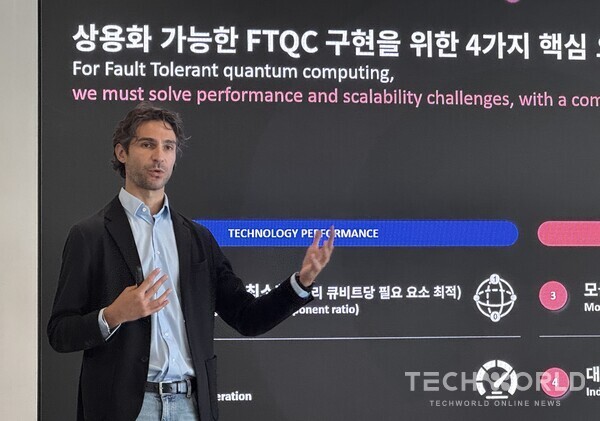
Quandela held a news briefing on the 28th and unveiled its domestic market business strategy. At the event, it also unveiled a mid- to long-term technology roadmap for implementing Fault-Tolerant Quantum Computing (FTQC).
Quandela plans to identify domestic strategic partners over the next 2 years. Its focus areas are quantum hardware manufacturing, cryogenic control and system integration, and AI·GPU·HPC-based quantum system operations. It plans to pursue joint development and technical cooperation with the domestic strategic partners it identifies, and is envisioning a cooperation structure that runs from hardware manufacturing to system integration, demonstration and verification, and actual operations.
At the briefing, Nicolo Somaschi, CEO of Quandela, said he sees South Korea as a potential Asian hub and intends to continue cooperation. He outlined a policy of linking with local ecosystems in Europe, North America, and Asia, and explained a cooperation plan that would make South Korea the company’s base in Asia.
The areas of cooperation were presented as manufacturing, system integration, cloud deployment, and the discovery and use of new algorithms. Among them, cooperation in quantum chip manufacturing will be pursued through heterogeneous integration technology centered on photonic integrated circuits (PIC), electronic integrated circuits (EIC), single-photon sources, and superconducting nanowire detectors, with the goal of developing photonic modules that can verify mass-production suitability by leveraging domestic capabilities in advanced semiconductor packaging, wafer-level testing, and precision optical alignment. The company also plans to establish a joint manufacturing roadmap.
System integration will focus on 2-4K cryogenic platforms, real-time feedforward, and high-speed control electronics, with efforts to build a low-latency control demonstrator and an integrated test environment. In operations, the company will jointly develop error-correction decoding, AI·GPU integration, and HPC·cloud integration technologies, and plans to pursue a QPU-HPC integration proof of concept (PoC) in South Korea.
The proposed cooperation model is aimed at forming a quantum manufacturing consortium involving South Korean companies and research institutions. Under this consortium structure, Quandela would share its technology and system roadmap and its experience deploying and operating QPUs in Europe, while domestic partners would handle semiconductor capabilities, photonic capabilities, advanced manufacturing capabilities, and system integration capabilities.
On intellectual property (IP), existing IP would remain with each institution, while newly created IP would be shared based on roles and contributions. The company is also considering participation in related projects such as the government’s Quantum Manufacturing Challenge, and its current target government project is the three quantum clusters. The government’s direction has been presented as quantum computing in Seoul, quantum communications in Gwangju and South Jeolla, and quantum sensing in Busan, Ulsan, and South Gyeongsang.
However, Quandela said the cooperation is not yet at a specific finalized stage. Even so, it said it sees the possibility of domestic manufacturing cooperation and also mentioned potential partnerships with large South Korean companies in areas such as semiconductors and module integration. Quandela said it is considering the direction of the government’s Manufacturing Challenge and is discussing ways to cooperate with South Korean companies. It said quantum computing is its priority area, while also presenting possibilities for each business area.
The company is pursuing technology development for practical industrial applications of quantum computing. It plans to secure the fast computing speed, system scalability, and large-scale manufacturability of its photonic approach. It aims to develop the underlying technologies it secures into FTQC.
To that end, Quandela emphasized single-photon generation using semiconductor technology. It also highlighted deterministic operation delivery. The company said semiconductor-based single-photon generation and deterministic operation can reduce the number of system components needed for existing photonic approaches.
It also said that combining photonic integrated circuit technology would allow the system to scale in modular units. It added that such a combination could also enable a structure linking multiple servers.
The company said the speed of interoperability between QPU and GPU in a hybrid environment that combines AI and quantum computing is a strength. Under conventional asynchronous integration, the time needed to send and receive computation results is at the level of dozens of seconds, but with Nvidia technology applied, that time can be reduced to the millisecond (ms) level, it said. Nicolo Somaschi, CEO, emphasized that hybrid technology can both improve performance and curb additional consumption of computing resources, and that the resulting efficiency is significant.
Quandela said it aims to integrate photonic quantum computing into AI·HPC environments and seeks to enable low-latency connections among GPU, QPU, and HPC resources. Through this, it said, it plans to build a hybrid quantum-AI computing environment.
As part of its mid- to long-term plan, Quandela said it is focusing on implementing logical qubits and believes that prioritizing error detection and correction during computation is more important than increasing the number of qubits. Based on this, it expects to be able to unveil an AI-quantum computing combined system within the next 5 years, and it also expressed confidence in its technological competitiveness in the quantum system market.
Source: TECHWORLD · Kim Hye-jin
Original: https://www.epnc.co.kr/news/articleView.html?idxno=407423
References
This article was produced with the help of an automated content generation algorithm.
Source: TECHWORLD
View originalThis article was summarized and organized by BizCrush based on the original article from TECHWORLD. For exact quotations and full details, please refer to the original article.