Alibaba Unveils Agentic AI 'Qwen Intelligence' for Smartphones
TECHWORLD ·
✦ AI Summary
Alibaba unveiled "Qwen Intelligence," a full-stack agentic AI solution for smartphone makers.
"Qwen Intelligence" consists of a mobile Qwen foundation model, an agent execution environment, and a task-execution application layer.
HONOR joined as the first partner, and the first products to combine Qwen Intelligence with MagicOS are the Magic9 series and HONOR Robot Phone.
Alibaba unveiled "Qwen Intelligence," a full-stack agentic AI solution for smartphone makers. "Qwen Intelligence" is designed to support AI features that can move across multiple applications on smartphones, and it provides a single technology stack ranging from a mobile-optimized foundation model to agents that plan and execute tasks.
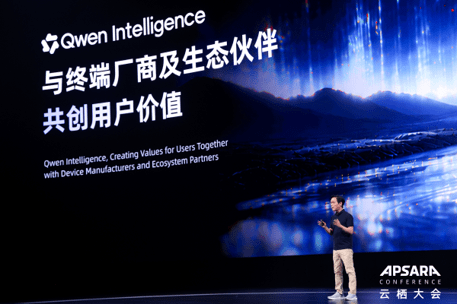
Alibaba Group announced the unveiling of "Qwen Intelligence" at the Apsara Conference, held in Hangzhou, China, from the 22nd to the 24th.
"Qwen Intelligence" is made up of a mobile Qwen foundation model, an agent execution environment, and a task-execution application layer.
Smartphone makers can adopt the full solution. They can also selectively apply only the components they need, such as the foundation model and individual agents, to their own systems.
HONOR joined as the first partner. Alibaba and HONOR are jointly developing models and solutions for next-generation AI smartphones.
Alibaba and HONOR are combining Qwen Intelligence with MagicOS. The goal is to build a smartphone environment that can plan and execute needed tasks beyond simply responding to requests. The first products to receive the technology are HONOR's Magic9 series and HONOR Robot Phone.
The structure starts with three initial agents. The initial agents are the mobile planner agent, mobile use agent, and mobile creative agent. The mobile planner agent handles task planning, the mobile use agent handles execution across apps, and the mobile creative agent handles image generation and editing.
Among them, the mobile planner agent breaks down multi-step user requests, selects the necessary tools, and coordinates the order of execution. It is also linked with memory functions and proactive service capabilities. If circumstances change, it can revise the existing plan.
An itinerary for a business trip to Shanghai was given as an example request. The request includes flight bookings, hotel reservations, calendar entries, and overall itinerary planning. If variables such as flight cancellations arise, it is designed to rebook or suggest alternatives based on related information.
The mobile use agent is responsible for carrying out real tasks based on movement between multiple apps. The agent operates by prioritizing API use and uses GUI in parallel when the task is difficult to handle with API alone. The implementation approach is an API+GUI hybrid. Meanwhile, the mobile creative agent handles image generation and editing in a lightweight model environment tailored for smartphones. Alibaba also plans to add personalized memory, multimodal interaction features, and domain-specific agents.
The overall architecture supporting this structure consists of three layers: foundation, platform, and agent. The foundation layer is where the mobile-optimized Qwen foundation model is placed.
The platform layer is designed as a device-cloud connected structure, and manages model deployment, the agent execution environment harness, tool governance, and evaluation functions. It also adjusts performance, latency, and cost according to task characteristics.
Domain-specific agents corresponding to actual user purposes are placed in the top layer. The purpose of this layer is to support manufacturers in integrating their own services.
Alibaba established its own evaluation system to verify the real-world performance of agentic smartphones. The system is intended to measure the stability of agents' task planning and execution based on actual mobile environments, and the company built 4 benchmarks for this purpose.
Among them, MobilePA-Bench is designed to evaluate end-to-end planning and execution capabilities for complex requests using more than 1,000 tasks and more than 200 mobile tools. The remaining benchmarks target cloud phones and real devices, and assess execution success and safety with a focus on multi-step tasks that move across multiple apps.
Based on this evaluation system, Alibaba said the maximum task accuracy in HONOR's AI smartphone self-evaluation using Qwen Intelligence was 91.8%. It also said the HONOR AI smartphone using Qwen Intelligence handled workflow sequences exceeding 100 steps.
Steven Hoi, head of Qwen mobile AI at Token Foundry and vice president at Alibaba Token Hub, said agentic smartphones are a key gateway connecting personal AI and the real world. He said Alibaba plans to support manufacturers in delivering personalized AI features through the combination of mobile-optimized Qwen models and the agent execution environment.
Source: TECHWORLD · Kim Seung-gi
Original: https://www.epnc.co.kr/news/articleView.html?idxno=407432
References
This article was produced with the help of an automated content generation algorithm.
Source: TECHWORLD
View originalThis article was summarized and organized by BizCrush based on the original article from TECHWORLD. For exact quotations and full details, please refer to the original article.