OpenAI Bets on “Working AI” After “Answering AI” at DevDay
IT DAILY ·
✦ AI Summary
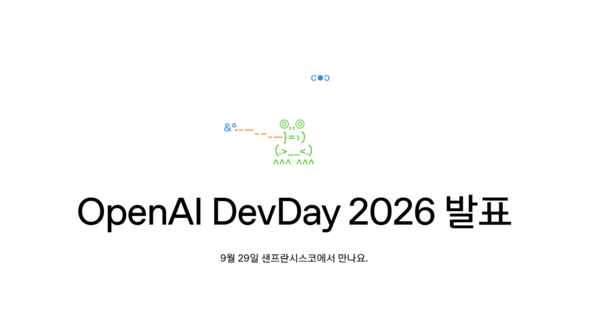
OpenAI will hold “OpenAI DevDay 2026” on the 29th at Fort Mason in San Francisco, California, local time.
The event will consist of technical sessions, demos, and workshops related to API and developer tools, and the keynote will be livestreamed online.
The specific details of the new products to be announced this year have not yet been made public, but AI agents are likely to play a larger role.
Generative AI is moving from a question-and-answer-centric stage to one where it handles work on behalf of people. Against that backdrop, OpenAI’s “DevDay 2026” is expected to be a venue that signals a direction beyond advanced model development, toward expanding an ecosystem of “AI agents” that can actually get work done.
OpenAI will hold “OpenAI DevDay 2026” on the 29th at Fort Mason in San Francisco, California, local time. The event will begin with a keynote by Sam Altman, OpenAI CEO.
This year’s event will consist of technical sessions, demos, and workshops related to API and developer tools. The keynote will be livestreamed online.
The specific details of the new products to be announced at this year’s DevDay have not yet been made public. However, based on OpenAI’s recent moves, AI agents are likely to play a larger role in this year’s developer strategy.
One piece of evidence is the “Agents API,” which was unveiled on the 10th. Released about 3 weeks before DevDay, the product points to the next stage of AI as OpenAI sees it. Through it, OpenAI showed a shift in how AI is used: from simple responses to delegated work.
The “Agents API” is an API that supports developers in building and running cloud-based AI agents. As a building tool, it uses OpenAI’s “Codex harness.” In this structure, OpenAI handles session orchestration, context management, and recovery, while developers handle the connections to the tools and functions needed for each service.
The API is being offered in public beta. It differs from traditional chatbots in that work does not end after a single question and a single answer.
Rather than stopping at simple response generation, agents can continuously carry out work based on functions such as reviewing files and checking contents, executing code, and calling needed tools. They can also re-examine results, save intermediate outputs during work, and divide different tasks among multiple sub-agents. OpenAI described such agents as providing stable long-term execution infrastructure, and said the standard for “long-term” here is days.
In the example request to analyze last quarter’s sales data and write a report, the role of conventional generative AI was limited to analysis methods and sentence generation based on the provided data. By contrast, an agent handles the entire process as one task, from exploring data files and reading files to code-based analysis, chart creation, and report writing. This shows that the unit of AI use is shifting from questions to work.
OpenAI distinguishes agentic AI from traditional chatbots, and this was also mentioned in OpenAI’s public materials in June. OpenAI said chatbot interactions are generally short and independent. By contrast, agents can call multiple tools, interact with different environments, and work independently for minutes or hours.
The way AI is used inside OpenAI is changing. Using data from Codex, OpenAI showed that the range of work users assign to AI is expanding beyond simple question-and-answer tasks to work that takes a long time. The pattern of generative AI use is also shifting from question-based tools to the batch delegation of long-running tasks.
According to OpenAI, as of May, more than 70% of Codex users had delegated at least one task to Codex that would take more than an hour if done directly by a person. That figure shows that users are using AI not merely as a simple assistive tool, but as a tool for handing off work that takes a long time.
Also, the share of users requesting tasks that take more than 30 minutes rose to 80.6% between last December and May this year. Over the same period, the share of users requesting tasks that take more than an hour also rose to 70.2%.
This trend aligns with OpenAI’s agent strategy. OpenAI’s agent strategy did not appear suddenly; agents were presented as one of the key themes at DevDay 2025. At the time, OpenAI unveiled “AgentKit,” a tool designed to provide the basis for developers to create, deploy, and manage AI agents for real-world services.
OpenAI introduced AgentKit, Codex SDK, and Apps SDK together as part of its bundle of developer agent tools. AgentKit includes “Agent Builder,” which visually designs agent workflows; “ChatKit,” which supports embedding AI conversation interfaces into applications; input-output management guardrails; and evaluation tools. OpenAI also unveiled Codex SDK and Apps SDK, and Apps SDK supports the use of external services in ChatGPT.
This trend also reflects the shift in focus between last year and more recently. Last year, the emphasis was on providing developers with “how to build agents,” whereas the recently introduced Agents API is closer to providing an execution environment for already created agents to carry out long-running work.
As the background to this transition, OpenAI emphasized the fact that it is opening up technology accumulated through operating Codex to outside developers. OpenAI has been running Codex and ChatGPT for work, and the scale of operations runs into several million users. OpenAI said it found that long-running agents need more than a simple high-performance large language model (LLM), and that they require context retention over long tasks, proper tool selection, coordination among multiple agents, and an execution environment.
In AI competition, the importance of the harness and tool ecosystem that makes real-world deployment possible is growing alongside model performance. As a result, one of the key things to watch at this year’s DevDay is not just whether a new AI model appears. The main focus is shifting to how AI will be made to work.
Amid this trend, OpenAI unveiled AgentKit at last year’s DevDay. OpenAI also unveiled Apps SDK at the same event. OpenAI also unveiled Codex SDK at last year’s DevDay.
This year, OpenAI has expanded the use of work-oriented agents. OpenAI recently unveiled the Agents API. OpenAI is sequentially building components for agent creation and execution, as well as for connecting corporate data and external tools.
OpenAI’s official DevDay program is focused on API- and tool-centered technical sessions. OpenAI’s official DevDay program is also focused on live demos.
A major point of interest at this event is the expansion of the agent development environment, including the Agents API. Another major point of interest is the tools that support linking AI to live services and work. In the end, this year’s key DevDay question is how far OpenAI has expanded its API and tool stack for agent development, connection, and operation.
Expectations for the event are rising after Sam Altman CEO hinted at major announcements ahead of DevDay. On the 15th, Altman posted “big this week” on his X account, and then also posted “and then for devday.”
Altman CEO then posted a series of ship emojis, implying product launches. In the IT industry, the idiomatic meaning of “ship” is the release of a product or feature.
OpenAI is presenting DevDay 2026 as its biggest event of the year. DevDay 2026 will be held on the 29th in San Francisco, and Altman CEO is scheduled to deliver the opening keynote.
The competitive landscape for generative AI is shifting from competition over AI that answers like a human to competition over AI that takes work from humans. At this DevDay, attention is focused on the connection between the multiple launches Altman CEO hinted at and OpenAI’s agent strategy.
Source: IT DAILY · Lee Jae-young
Original: https://www.itdaily.kr/news/articleView.html?idxno=241855
References
This article was produced with the help of an automated content generation algorithm.
Source: IT DAILY
View originalThis article was summarized and organized by BizCrush based on the original article from IT DAILY. For exact quotations and full details, please refer to the original article.