Korea's Generative AI User Share at 40.6%, Biggest Increase Among Major Economies
IT DAILY ·
✦ AI Summary
AI Economy Institute on the 28th released "AI Diffusion Report: Q2 2026 Trends and Insights."
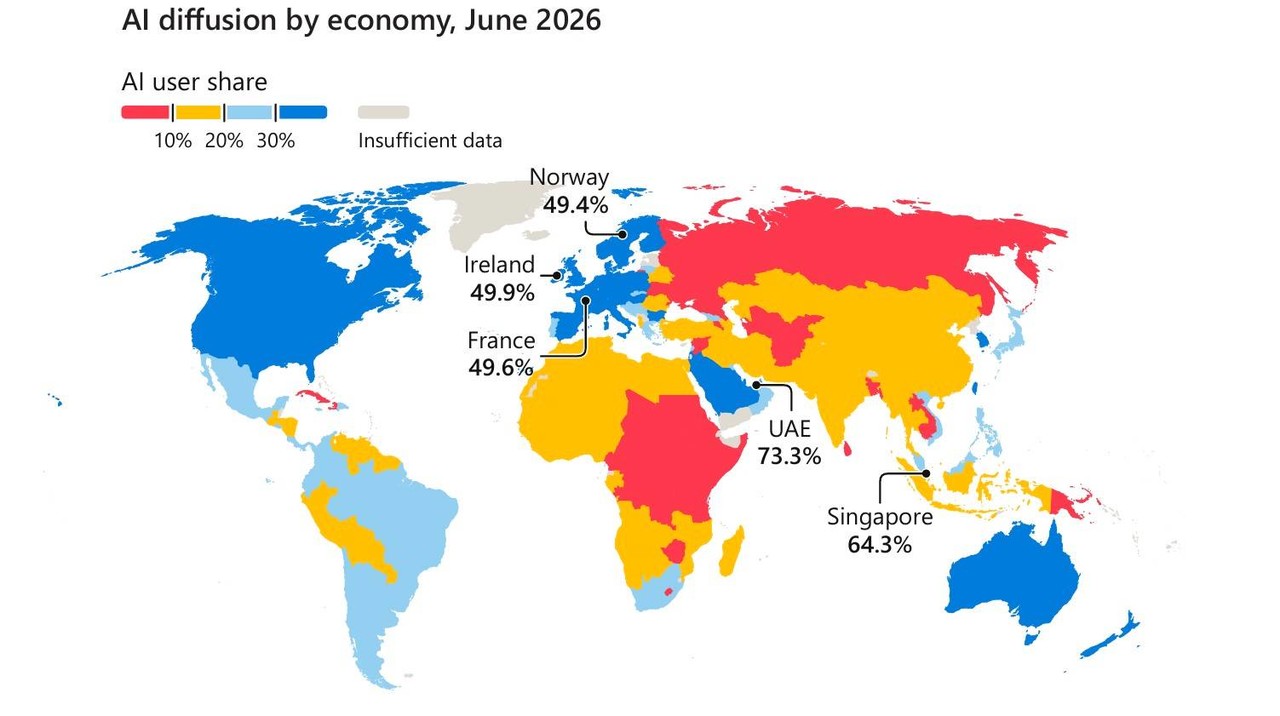
According to the report, the global AI usage rate among the working-age population aged 15 to 64 in Q2 2026 was 18.8%, and Korea's generative AI user share was 40.6%.
AI usage shares in the Global North and the Global South were 28.8% and 16.2%, respectively, and the usage share of Open-weight models has recently surged to as much as 75%.
Microsoft-affiliated think tank the AI Economy Institute on the 28th released "AI Diffusion Report: Q2 2026 Trends and Insights," which contains country-by-country generative AI user shares as of Q2 2026.
According to the report, the global AI usage rate among the working-age population aged 15 to 64 stood at 18.8% in Q2 2026. Korea's generative AI user share came in at 40.6%.
Korea's increase from the previous quarter was 3.5 percentage points, the largest gain among major economies. Over the past 12 months, Korea's user share rose by about 15 percentage points.
With this increase, Korea moved up from 16th to 12th place globally, a rise of 4 spots. The leading countries worldwide were the United Arab Emirates at 73.3% and Singapore at 64.3%.
The report noted that the gap in AI usage rates between advanced-economy regions and emerging-economy regions widened further from the previous quarter. AI usage share in the Global North was 28.8%, while AI usage share in the Global South was 16.2%. The AI usage gap between the Global North and the Global South widened to 12.6%, up from 12.1% in the previous quarter, indicating a larger divide in AI use.
Use cases also differed. In the Global North, usage was consumer-oriented, such as shopping and search, while in the Global South, Copilot-based use was centered on self-directed learning and skill development at 29.2% and academic support at 32.3%, with a large share also devoted to code, text, and image generation. The report interpreted this as suggesting that learning support may be the starting point for usage in regions where AI is still in its early diffusion stage. It also argued that AI should not deepen existing gaps in access by country, community, or language, and that basic foundations are needed for each country to participate in an AI-driven economy. Key elements identified included digital infrastructure such as power, data centers, and the internet, digital and AI capabilities, and language support.
As a practical alternative, the growth of Open-weight models is drawing attention. An analysis of more than 100 trillion tokens on OpenRouter showed that the usage share of Open-weight models has recently surged to as much as 75%.
The report cited gaps in power supply, internet connectivity, digital skills, and local language support as constraints on AI diffusion in the Global South. It also said these foundational constraints are difficult to resolve with Open-weight models alone.
However, the report explained that Open-weight models lower the cost of using AI with sufficient performance and ease the burden of adapting models to local languages and needs. It then proposed fine-tuning existing models as a way for nonprofits, companies, governments, and universities to use them, saying this can serve as an alternative to training frontier AI systems from scratch and can be applied to specific languages and fields. It added that AI tailored to local needs can also be implemented in areas lacking data and resources.
The number of Hugging Face Spaces providing runnable AI apps and demos surged to about 1.46 million as of the end of August 2026. This shows that development activity at the application stage is spreading vigorously beyond model development.
Source: IT DAILY · Kwon Young-seok
Original: https://www.itdaily.kr/news/articleView.html?idxno=241859
References
This article was produced with the help of an automated content generation algorithm.
Source: IT DAILY
View originalThis article was summarized and organized by BizCrush based on the original article from IT DAILY. For exact quotations and full details, please refer to the original article.