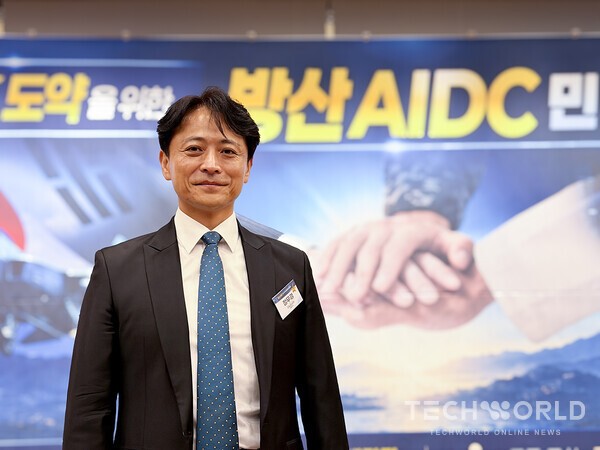
DinoTisia CEO Jung Moo-kyung: Defense AIDC Needs Sovereign LLM, Infrastructure, and Security Standards
TECHWORLD ·
✦ AI Summary
As AI becomes more important in the defense sector, building sovereign AI infrastructure that can safely use confidential data from domestic defense companies has emerged as a challenge.
DinoTisia plans to supply domestically produced AI storage and search-specialized semiconductors to defense AIDCs and has also joined the defense AIDC council.
CEO Jung Moo-kyung said sovereign LLMs, sovereign infrastructure, and security standards are all needed, and that he will push ahead with the 100MW Changwon defense-focused AIDC as a standard infrastructure model.
As AI becomes increasingly important in the defense sector, building sovereign AI infrastructure that can safely use confidential data from domestic defense companies has emerged as a key challenge. While AI is becoming a decisive factor in competitiveness in the defense industry, domestic defense companies are reportedly unable to fully use the latest AI due to security concerns.
DinoTisia plans to supply domestically produced AI storage and search-specialized semiconductors to defense AI data centers (AIDCs) to support defense companies' use of data. The plan was presented alongside discussions related to the launch of the defense AIDC council.
In an interview with TechWorld on the 21st, DinoTisia CEO Jung Moo-kyung said, in connection with the launch of the defense AIDC council, that AI is a decisive factor in competitiveness in the defense industry, but domestic defense companies are effectively unable to use the latest AI because of security issues. He added that solving this problem requires sovereign LLMs, infrastructure, and security standards to be put in place at the same time.
Jung pointed out that the pace of AI adoption in South Korea's defense sector differs from that in overseas markets. In particular, he cited examples showing that AI adoption is spreading rapidly in the U.S. defense sector.
The U.S. Department of Defense increased the contract ceiling for Palantir's AI-based battlefield command system, 'Maven,' from USD 480 million to USD 1.3 billion within a year. Jung also said the defense department's dedicated generative AI platform, 'GenAI.mil,' which launched last December, was used by 1.7 million of its 3 million personnel within 9 months.
By contrast, in domestic defense companies, design drawings, technical documents, and test data are considered sensitive assets. That makes it difficult to use external cloud services and commercial AI services.
Jung said that building each company's own GPU infrastructure, AI models, and systems is effectively impossible for small and midsize suppliers. Under these conditions, DinoTisia signed an investment agreement with South Gyeongsang Province and Changwon Special City last July and pushed ahead with a defense-focused AIDC in Changwon.
DinoTisia participated in the defense AIDC council. Jung said that while pushing ahead with the Changwon defense-focused AIDC, he confirmed that security standards, institutions, demand, and manpower all need to be addressed together for an AIDC that defense companies can actually use to take shape, and he said that this confirmed need for simultaneous solutions across security standards, institutions, demand, and manpower was the background for joining the council.
The defense AIDC council operates through five subcommittees: institutions, talent development, defense demand, technology, infrastructure, and security.
DinoTisia is serving as the technology provider for the technology and infrastructure subcommittee. Its supply targets include products based on domestic AI semiconductors and AI solutions.
Jung identified storage as one of the core infrastructure components of a defense AIDC. He explained that storage is where the defense AIDC's confidential data is actually stored.
Jung said DinoTisia is the only company in South Korea developing an AI storage system and the only company in the world directly developing everything from the semiconductors to the software for AI storage. DinoTisia plans to provide performance, AI memory, and data security to defense AIDCs through its AI storage.
Jung explained that training defense-specific models requires continuously supplying large volumes of data such as drawings, images, and sensor data to GPUs, while intermediate training results must also be stored at high speed. He added that if storage is slow, GPUs sit idle and the AIDC's most expensive resource is wasted.
Jung stressed that data retrieval is important in AI inference if trustworthy answers are to be secured. He explained that for reliable answers at the inference stage, AI must accurately search decades of accumulated drawings, standards documents, and maintenance records for the needed information based on semantic criteria.
For this, Jung highlighted three in-house components developed by DinoTisia: Seahorse, a GS-certified grade 1 vector database; VDPU, the world's first search-specialized accelerator chip; and agent memory software for accumulating AI work context. He added that these three components have been integrated into a single system.
Jung also emphasized that data security is a core element. He said the company plans to strengthen data isolation, encryption, and access log management for each company, and added that these security functions will be offered as storage-level hardening solutions.
Regarding the role of domestic AI semiconductors, Jung emphasized the search area. He also noted that VDPU and Seahorse handle the storage and retrieval of defense confidential data, and said that DinoTisia's VDPU and Seahorse AI storage handle the storage and retrieval of confidential data in defense AIDCs.
VDPU is a dedicated search semiconductor designed to take over, from CPUs, the task of finding the information AI needs in defense companies' drawings, standards documents, and maintenance records. The method AI uses to find needed information is vector search, and CPUs previously handled this vector search.
Last week, DinoTisia also cited a case from the U.S. 'AI Infrastructure Summit.' In that case, a server equipped with 4 VDPU cards achieved search throughput up to 5.77 times that of a CPU-only server, while host CPU usage fell by 92% and memory usage by 73%.
DinoTisia said these improvements in search performance lead to better AI answer quality and greater computational efficiency. The company explained that improving search speed and accuracy raises AI answer quality and reduces wasted GPU recomputation caused by retrieving the wrong material.
DinoTisia highlighted its in-house technology coverage from semiconductors to system software as a strength in the defense sector. Jung said DinoTisia directly designs the semiconductors, firmware, database, and system software for VDPU and Seahorse AI storage in South Korea, which makes it possible to conduct national security verification on design materials and source code and to directly reflect the security functions required by defense into chips and systems.
Jung identified sovereign LLMs, sovereign infrastructure, and security standards as the items that domestic industry must address first in order to build a defense-specific AI data center. In this regard, he emphasized that the long-term sustainability of technical support and functional improvements in South Korea should be independent of international developments.
As the backdrop to these challenges, Jung said the world is shifting from an era of free trade to one of bloc formation. He pointed to the U.S. export controls on advanced AI semiconductors and China's export controls on rare earth elements.
Jung said such international developments could sever supply chains and value chains. He added that the defense industry should not depend on these external changes.
He said securing in-house technology for core defense AI technologies is the biggest challenge. In that context, he identified sovereign LLMs as the first task.
Jung explained that many of the latest overseas models are service-based and route through external servers. He also said the latest overseas models are difficult to bring into closed networks.
He said access could also be restricted depending on the provider's policies or decisions by the government of that country. Accordingly, he stressed the need for domestic models that can operate inside defense AIDCs and domestic models that can be further trained on defense data.
Jung presented sovereign infrastructure as his second topic. He referred to semiconductors, storage, and cloud as model- and data-based elements, and explained that securing domestic technology for semiconductors, storage, and cloud is necessary.
Along those lines, DinoTisia said it is directly developing AI storage and also directly developing search semiconductors. Jung explained that the reason for this in-house development is to secure sovereign infrastructure.
Jung's final emphasis was on establishing security standards. He noted that the current defense security system assumes data is processed within a company's own internal network. He then raised the need for rules governing security requirements if AI using confidential data is to be used in a defense AIDC, and also for decisions on the certifying body and supervising body regarding the use of confidential data in defense AIDCs.
The biggest expected outcome from launching DinoTisia's council was presented as building a defense-focused AIDC in Changwon. Jung said the first expected outcome is the substantive construction of the Changwon defense-focused AIDC, explaining that the project will be pursued at the 100MW level in the Changwon National Industrial Complex.
He also said the council's discussion topics include institutions and security standards. The Changwon defense-focused AIDC aims to be the first application case of the institutions and security standards to be discussed by the council, and Jung said he intends to push ahead with the 100MW Changwon AIDC as a standard infrastructure model for defense AI.
Jung said the goal is to establish a standard infrastructure model that can use AI in the defense sector while maintaining confidentiality. He then said the business goal is to build the defense AIDC data infrastructure with DinoTisia's AI storage.
Jung said he intends to pursue a business that safely stores confidential data from defense companies and provides AI training and utilization infrastructure based on that data. He also said he plans to advance products tailored to the defense environment.
He said he would take into account the characteristics of defense data as large-scale multimodal data combining drawings, images, and sensor data. He also said he will reflect in the product the conditions of the defense environment, where both training and inference must be handled in closed networks and high search accuracy and high security levels are required.
Source: TECHWORLD · Park Gyu-chan
Original: https://www.epnc.co.kr/news/articleView.html?idxno=407275
References
This article was produced with the help of an automated content generation algorithm.
Source: TECHWORLD
View originalThis article was summarized and organized by BizCrush based on the original article from TECHWORLD. For exact quotations and full details, please refer to the original article.