AWS: South Korean Companies’ AI Utilization Rate Stands at 58%... The Next Challenge Is Moving Beyond Adoption to Expansion
IT DAILY ·
✦ AI Summary
AWS held a press briefing at Centerfield in Gangnam-gu, Seoul, on the 11th to unveil its report, "Realizing Korea’s AI Potential in 2026," and disclosed survey findings on the current state of AI use and related challenges in South Korea.
The survey covered 1,000 business leaders in South Korea and 1,000 members of the general public, and the AI utilization rate among South Korean companies rose from 48% last year to 58% this year.
Among companies that adopted AI, 81% reported improved productivity, while companies that have expanded AI across the enterprise remain limited, and only 18% have launched AI-based products or services.
AWS held a press briefing at Centerfield in Gangnam-gu, Seoul, on the 11th to unveil its report, "Realizing Korea’s AI Potential in 2026," and disclosed survey findings on the current state of AI use and related challenges in South Korea. The research was commissioned by AWS and conducted by Strand Partners. The survey covered 1,000 business leaders in South Korea and 1,000 members of the general public.
According to the survey results released by AWS, the AI utilization rate among South Korean companies stood at 58%. As a result, more than half of domestic companies are using AI, indicating that AI adoption is becoming common in actual business settings.
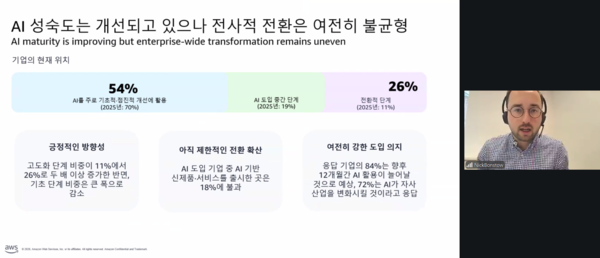
Against this backdrop, the next task was identified as expanding AI beyond adoption across organizations and linking it to tangible business outcomes. On the day, Nick Bonstow, a partner at Strand Partners, presented on the maturity of AI among South Korean companies and the status of enterprise-wide transformation. Photo credit: AWS.
The survey showed that AI adoption and use among South Korean companies expanded overall. The AI utilization rate among domestic companies rose from 48% last year to 58% this year, and the number of companies newly adopting AI over the past year was estimated at about 624,000. Nick Bonstow, a partner at Strand Partners, described the 10 percentage point increase from 48% as significant acceleration and said the pace of AI adoption is fast.
A majority of companies that have adopted AI reported feeling productivity gains and time savings. Among companies that adopted AI, 81% said productivity improved, and the average time saved through AI was 14 hours per week. Nick Bonstow, a partner at Strand Partners, said adopting companies are experiencing measurable value in concrete terms.
However, relatively few companies have connected usage levels to enterprise-wide expansion or commercialization results. Companies at the stage of enterprise-wide AI expansion were still limited. The share of companies using AI at an advanced level rose from 11% last year to 26% this year, but only 18% launched AI-based products or services.
Even so, a majority of respondent companies expected AI use to increase further over the next year. 84% of respondent companies said they expect AI use to rise over the next 12 months.
Companies’ interest in adopting AI is broadening beyond generative AI to physical AI and agentic AI. In the case of physical AI, 6% of companies had fully adopted it, 22% were conducting proofs of concept or pilots, and 39% said they plan to adopt it in the future.
Physical AI was seen as a new opportunity because it aligns closely with sectors where South Korea has strengths, such as manufacturing, robotics, and semiconductors. Bonstow said physical AI offers the biggest opportunity for South Korea. He also said it is necessary to clearly identify and select specific use cases, and that a system is needed to measure the ROI that can be achieved when it is actually deployed.
By contrast, agentic AI is still in its early stages. Among the surveyed companies, 37% were aware of agentic AI, and among those aware of it, 8% had fully adopted it and 29% were conducting proofs of concept or pilots. As for the effects of adopting agentic AI, 54% cited faster decision-making and execution, while 51% cited improved operational efficiency or productivity.
Although agentic AI is still at an early stage, companies that have adopted it are already feeling tangible effects, according to the assessment. Bonstow said that while agentic AI is still in its early stage, practical effects are already appearing among adopting companies.
O Sun-young, AWS principal solutions architect, also described a similar trend at the press briefing for "Realizing Korea’s AI Potential in 2026." He said companies’ use of AI is moving from a simple demo stage to a stage where actual operations and economic feasibility are being reviewed.
O explained that the focus of generative AI is on question-and-answer functions and document generation. By contrast, AI agents take in goals, make plans, use tools, check results, and then carry out actions, he said.
He stressed that the criteria for evaluating AI are also changing. O said the importance of execution cost and repeatability is growing beyond the possible scope of AI.
Accordingly, O said that when judging the performance of AI agents, they should be evaluated based on economic feasibility rather than the number of agents. As examples of indicators for determining economic feasibility, he pointed to processing time, error rates, and conversion rates.
The architect said the criteria for evaluating agentic AI are shifting from the number of agents toward proving economic feasibility through processing time, error rates, conversion rates, and similar metrics. He said this stage marks a transition from experimentation to operation.
Amazon also introduced internal examples of applying agentic AI to work. In the case of rebuilding the Amazon Bedrock inference engine, it was initially expected to require 30 developers and 12 to 18 months, but in practice it was completed by 6 engineers in 76 days.
At Amazon Store, pilots were conducted for about 50 teams using new AI tools and work methods. Of those, 25 pilot teams saw deployment speed improve by an average of 4.5 times, and some teams improved deployment speed by more than 10 times.
O said the role of people remains important even in the process of spreading agents. He explained that in an agent economy, people's role shifts from execution to judgment and responsibility, and emphasized that purpose, authority, and responsibility are the factors driving the new economic order in the era of autonomous AI.
Source: IT DAILY · Yang Seung-gap
Original: https://www.itdaily.kr/news/articleView.html?idxno=241565
References
This article was produced with the help of an automated content generation algorithm.
Source: IT DAILY
View originalThis article was summarized and organized by BizCrush based on the original article from IT DAILY. For exact quotations and full details, please refer to the original article.