AI With Personal Context, a Foldable iPhone: The 'Reason to Use It' Apple Must Answer
IT DAILY ·
✦ AI Summary
Apple used its new-product event on the 9th to reframe the meaning of the iPhone instead of unveiling a new device and introduced the concept of the 'Intelligent Personal Hub.'
CEO John Ternus said the iPhone is well suited to understanding personal context such as schedules, relationships, routines, photos, and messages, and to recognizing surroundings through the camera and microphone.
Through the iPhone 18 Pro, iPhone Duo, Apple Watch Series 12, AirPods 5, new Siri AI, and A20 Pro, Apple laid out an AI connectivity vision centered on the iPhone.
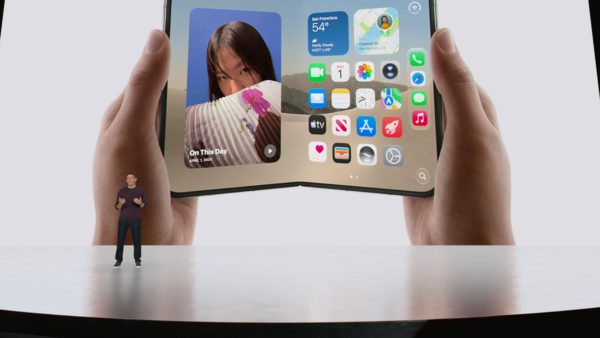
As market forecasts suggest the arrival of new devices that could replace smartphones may come sooner amid the spread of AI, Apple used its new-product launch event on the 9th at Apple Park in Cupertino, California, to reframe the meaning of the iPhone instead of unveiling a new device. According to IT Daily, Apple CEO John Ternus took the stage for his first new-product presentation since taking office and introduced the user experience of the 'iPhone Duo.' The photo is a screenshot from Apple's YouTube account.
CEO John Ternus said he believed the role of the iPhone would expand as AI advances deepen. As the basis for that view, he pointed to the fact that the iPhone has a strong understanding of users' daily lives and is a device that is always at hand, and he introduced the concept of the 'Intelligent Personal Hub.' The concept includes understanding schedules, relationships, routines, photos, and messages, recognizing surroundings through the camera and microphone, and processing computation on-device and in the cloud.
At this event, CEO John Ternus said that there was no product better suited than the iPhone to serve as the 'Intelligent Personal Hub.' In other words, Apple's answer on this stage was not a new device but a renewed emphasis on the iPhone. In discussions surrounding AI based on personal context, a foldable iPhone, and Apple's challenge of proving the 'reason to use it,' Apple positioned the iPhone as the product best suited for that role.
He laid out the conditions needed for a personal AI device in detail. He cited always-on portability, deep understanding of the user, a processor capable of running on-device models, a network connection to the cloud, a large display for showing content, a camera for sensing the surroundings, a microphone for sensing the surroundings, all-day battery life, ease of use, and integrated connectivity with other devices, applications, and services as the conditions for an ideal personal AI device. Ternus said that if these conditions are applied one by one, the conclusion is the iPhone.
The outline of the vision becomes clearer when the products announced this time are viewed together. The A20 Pro in the iPhone 18 Pro, the new Siri AI, the first foldable phone, the 'iPhone Duo,' the Apple Watch Series 12, and AirPods 5 are all different products, but the role of these product lines is to connect personal information and the surrounding environment to AI centered on the iPhone. Compared with the renewed spread of new AI-specific devices, this is a practical approach that combines computing power and personal context with existing portable devices.
The key to the iPhone Duo's success or failure is whether users actually feel its usefulness. The iPhone Duo starts at USD 1,999, and the challenge for this product is how much the larger screen changes the AI experience. In the end, the first test is whether Ternus's proposition that 'the iPhone remains central even in the AI era' can lead to changes in everyday usage habits.
Ternus used the word 'hub' on his first stage. The choice of 'hub' is regarded as a noteworthy point in Apple's history.
Apple cofounder Steve Jobs once defined the next role of the PC in 2001 as a 'digital hub.' At the time, the concept was for the Mac to become the center that managed content created across multiple devices such as digital cameras, music players, and camcorders. Twenty-five years later, the center shifted from the Mac to the iPhone, and the connected targets expanded from digital devices and content to users' personal data and AI.
Ternus mentioned understanding schedules, messages, photos, relationships, and routines as personal hub functions. The personal hub receives Apple Watch health data and Apple Watch activity data, and accepts voice input from AirPods. The camera recognizes the surrounding environment, and Siri connects that information with the user's context. This contrasts with Jobs's digital hub strategy, which was a concept for gathering scattered devices and content, whereas Ternus's vision is a structure that organizes scattered personal information around the iPhone into a state usable by AI.
That said, it is too early to define the Ternus era as a fully formed management philosophy. Ternus took office as CEO this month, and many of the products unveiled this time were developed during former CEO Tim Cook's tenure. The current focus of change that can be confirmed lies less in the products themselves than in how the new CEO describes existing assets.
Ternus's first keynote placed weight on avoiding competition over model size and benchmark scores in AI. Instead, he discussed the processor, display, camera, microphone, battery, and OS, and said AI connects hardware with user context. This way of explaining things also ties in with his long history of leading hardware engineering.
Ternus sees the iPhone as having an advantage in understanding personal context because, unlike new AI-specific devices, it already contains a user's life information and usage traces. He cited the iPhone's existing user touchpoints as the basis for the persuasiveness of that claim.
For new AI-specific devices, the challenge is said to be the need to initially accumulate data and usage habits to understand a user's daily life. By contrast, the iPhone already contains a user's daily life through contacts, schedules, messages, email, photos, and a wide range of app-based activities.
Ternus said the iPhone's range of understanding extends to schedules, relationships, daily habits, and the most private details. He made remarks to the effect that the iPhone can do much more in this respect.
Apple has begun redesigning the Siri interface to connect this information with AI. In iOS 27, this will be offered in a Siri AI beta format. This Siri AI can understand personal context in messages, emails, and photos, comprehend the content currently on the screen to carry out related tasks, and answer queries related to what the camera is seeing.
An AI that sufficiently understands personal context can infer the background of questions related to messages, emails, and schedules based on existing information, reducing the need to repeatedly explain personal situations. This stands in contrast to using a general AI chatbot, where asking about flights or appointments requires entering the necessary information directly or connecting to related services. It is presented as a competitive edge that is difficult to secure through model performance alone.
Apple paired this advantage in contextual understanding with privacy protection. It said AI computations that can be handled are performed on the device, while tasks requiring a larger model are sent to 'Private Cloud Compute (PCC).' Ternus pointed out that other companies tend to view data as something to collect and store, and he said trust has limits if data is outside a user's control. Without naming competitors, Apple highlighted its privacy-centered differentiation in AI competition.
Privacy protection and AI usefulness are separate issues. The use of personal context is only satisfied when it produces answers aligned with the user's intent and delivers real time savings compared with directly launching apps. However, early usage reports exposed a gap in utility.
The new Siri has been praised for improved ability to use personal information and for stability. However, some reports also showed that usage declined over time after initial interaction with the new Siri. As a result, a separate challenge remains for the new Siri: whether it can create the need to change existing smartphone usage habits and existing AI chatbot habits.
Ternus's vision assumes it cannot be realized through software alone. This round of new products is aimed at placing AI-capable hardware across the product line.
The iPhone 18 Pro and iPhone Duo will be equipped with the A20 Pro. The A20 Pro is manufactured using a 2-nanometer process and consists of a dual 16-core Neural Engine. Its on-device AI computing performance is twice that of the A19 Pro. The iPhone Duo uses a design that directly connects the A20 Pro with a custom vapor chamber, with the aim of maintaining sustained performance when multiple apps and AI are used simultaneously on the larger screen.
Apple is pursuing a strategy of linking AI functions across devices and OS. In this regard, the iPhone takes on the central role for personal data and computation, the Watch handles sensing the body and the surrounding environment, AirPods handle voice input, and Siri handles app and service connections for each piece of information. In this division of labor, the Apple Watch Series 12 is equipped with a new health sensing system and the S11 chip, and it collects body data such as heart rate and heart rate variability (HRV), combining it with activity and sleep information.
AirPods have the character of a voice interface. Through real-time translation and Siri AI features, AirPods enable access to AI without directly operating the iPhone screen. Accordingly, a structure is presented in which the Watch senses body and environmental information around the iPhone, while AirPods and Siri handle voice-based access and connectivity.
This kind of division of labor is tied to Apple's strength in directly controlling its own chip, OS, smartphone, wearable, earphone, and app ecosystem. With that strength, Apple can design a single experience. This approach also extends to major Apple device product lines such as Apple Vision Pro, MacBook, iPad, iPhone, and Apple Watch.
The iPhone Duo is being cited as the product that most directly embodies Ternus's vision. One of the personal AI device conditions Ternus presented is a large and beautiful display. One solution for balancing portability with screen expansion is a folding design. The Duo has a 5.4-inch external display when folded and a 7.6-inch display when unfolded.
That screen expansion also aligns with features supported in iOS 27. iOS 27 supports running 2 apps side by side and displaying 2 windows of the same app simultaneously. An example use case for the Duo is watching content on one side while talking with Siri AI on the other. On existing iPhones, AI occupies one chat window, but on the Duo, there is screen space to place AI and the task target at the same time.
At the same time, the role of AI is shifting from question-and-answer to practical work assistance. As AI's role expands, the usefulness of a large screen is likely to grow.
The iPhone Duo's first hurdle is price. The iPhone Duo's U.S. launch price is USD 1,999 for the 256GB model, which is USD 100 higher than the Galaxy Z Fold8. That said, it is difficult to conclude that Apple's premium is excessive based solely on the price gap for the first foldable. The foldable market remains closer to a high-end niche, and market researchers expect Apple to take a considerable share from its first year of release. Still, global foldable shipments remain only a portion of the overall smartphone market.
Some analysis says the benchmark for Apple's foldable success lies not in converting existing foldable users, but in moving iPhone users who had not chosen foldables. To justify USD 1,999, the Duo needs a unique way of using it that goes beyond simply moving existing iPhone tasks to a larger screen. Another view is that what matters most is the experience after unfolding, not the folding performance.
Apple is a latecomer to the foldable market. Samsung Electronics launched the first Galaxy Fold in 2019 and has since improved the screen, hinge, thickness, and weight from generation to generation. Chinese manufacturers such as Huawei and Xiaomi have also expanded their foldable product lines.
As a late entrant, Apple has the advantage of being able to observe the trial and error and consumer pain points of existing products before release. It is in the position of following the improvement cases accumulated by competitors, but that also means there is room to raise product completeness by reflecting trial and error and inconveniences.
The Duo uses a hinge with more than 100 parts, and it also applies an internal display support structure and a nano-texture finish. Early reviews said the crease in the folding section of the Duo is less noticeable than on existing foldables.
Apple says the Duo does not eliminate the crease, but reduces its visibility through nano-texture. This is an approach focused on reducing the discomfort users feel rather than removing the physical limitations of foldables. Even so, hardware compromises remain.
Specifically, the Duo weighs 254g, making it heavier than the Galaxy Z Fold8. For biometrics, it does not include Face ID and instead adopts side Touch ID. In the camera system, it excludes a separate telephoto camera, and some Pro model functions are also missing.
By contrast, early hands-on reviews cited the iOS screen transition as a strength, and app optimization was also evaluated positively. Overall completeness also received favorable reviews. This showed that Apple used its latecomer advantage to improve usability.
Even so, the limitations of cost, weight, and structural compromise have not been resolved. Separate from the gains in usability refinement, the fundamental constraints inherent to foldables remain. In that sense, it is hard to view the Duo as a foldable perfected after 7 years of waiting.
In this situation, Samsung Electronics emphasized that it had led and developed the market first before Apple's entry. Samsung used the slogan 'Welcome to Foldables' in its advertising. Its social media messages also showed a pattern aimed at Apple's late entry.
Samsung has the asset of having sold several generations of products as the first mover. It has also accumulated experience in hinges, durability, multitasking, distribution systems, and repair systems. By contrast, Apple's foldable ecosystem is not independent, and the supplier of the foldable panel for the Duo is Samsung Display. As a result, Apple's market entry has a dual effect: it acts as competition for Samsung Electronics while creating new demand for Samsung Display.
The focus of foldable competition is changing as the phase centered on first-mover advantage passes. Early competition centered on whether the screen could fold and how solid the hinge was. Later competition shifted to thickness, weight, crease, camera, and battery, and narrowing the gap with conventional smartphones became important.
The key question now is why foldables are needed. Samsung is pursuing an answer through multitasking and Galaxy AI. Apple is trying to persuade users of the need for foldables by combining iOS, Siri AI, and its vast iPhone app ecosystem with a larger screen.
If Apple succeeds, it could expand the standard of foldable competition from hardware completeness to software and AI usage experience even as a latecomer. Conversely, if the iPhone Duo remains a niche product priced at around USD 2,000, it would mean Apple has not broken through the barrier to foldable mainstream adoption that existing manufacturers also failed to clear.
In that sense, some interpret Ternus's strategy as being tested more fundamentally by AI than by foldables. The question is increasingly centered on whether AI itself can become the core of the actual user experience, rather than on form-factor change alone.
The new Siri's features include understanding user context, recognizing the screen, and interacting with apps. In addition, the new Siri sets itself apart by emphasizing privacy protection based on on-device computation and PCC integration.
However, whether a function exists and whether users use it in daily life are separate matters. The standard for judging the value of an AI product is not how many features it has, but how much it changes existing behavior, and for usage habits to change, delegating tasks to Siri has to be faster and more accurate than searching messages and launching apps directly.
Apple has a vast installed base as an advantage. iPhone users can use Siri without buying a separate AI device and without installing a new service. Siri being built in by default is also an advantage for Apple. On top of that, the personal data and cross-device integration Apple already has are conditions that new AI companies would struggle to secure in the short term.
However, the iPhone's high familiarity is also a burden for Apple. Users are accustomed to existing methods for browsing messages, searching, and opening photos. For that reason, if AI convenience is not clearly greater than the existing way of doing things, it is difficult to change habits. Early usage reviews also showed that, aside from feature improvements, Siri usage declined over time.
The Apple Watch Series 12 includes the 'Readiness' feature. 'Readiness' is a function that synthesizes health and activity data such as heart rate, heart rate variability (HRV), and sleep to display the user's physical condition as a numerical value. The photo source is Apple.
Ternus's first keynote took on the character of a stage that reassembled Apple's existing assets in the language of the AI era. Apple has built hardware-software integration since the Jobs era, and under the Cook era it has accumulated its own semiconductors, services, wearables, and a vast installed base. On his first stage, Ternus presented the vision of integrating these existing assets into the 'Intelligent Personal Hub.'
This strategic assessment is realistic. The direction of the strategy is to choose to make the user's existing iPhone smarter rather than wait for a new AI device after smartphones. The advantage of iPhone intelligence lies in distribution and usability. In addition, Apple has the strength to connect personal data, its own chips, OS, apps, Watch, and AirPods.
On the other hand, the flip side of realism also points to possible weaknesses. Because the place of change is inside the familiar iPhone, there is a risk that the scale of innovation will be seen as small if it fails to clearly present an experience different from before. The Duo offers a new screen, but its starting conditions come with the burden of price, weight, and functional compromise.
In the end, Siri AI is being asked to do more than just understand personal context. What Siri AI must prove is how much daily behavior it can actually replace. If it fails to show this sufficiently, the innovation may be perceived as weak.
On his first stage, Ternus presented the proposition that the core personal computer in the AI era is the iPhone, rather than a finished answer. This was also a way of first recalling that 25 years ago, the reason Jobs's digital hub succeeded was not the name 'hub' itself, but the fact that the Mac, iPod, and iTunes actually simplified fragmented digital experiences.
The criteria for evaluating Ternus's Intelligent Personal Hub were the same. The iPhone's task is not to understand more user information, but to make users do less work, and from that perspective Ternus's side presented the view that the most important personal computer in the AI era is the iPhone.
Source: IT DAILY · Kim Byung-ju
Original: https://www.itdaily.kr/news/articleView.html?idxno=241545
References
This article was produced with the help of an automated content generation algorithm.
Source: IT DAILY
View originalThis article was summarized and organized by BizCrush based on the original article from IT DAILY. For exact quotations and full details, please refer to the original article.