National AI Strategy Committee Marks 1 Year, Says It Will Focus on Its Role as a Mediator and Deliver Results the Public Can Feel
IT DAILY ·
✦ AI Summary
The National AI Strategy Committee disclosed its achievements and future action plan at its 1st anniversary report meeting.
In February, the committee announced the "Republic of Korea Artificial Intelligence Action Plan," and finalized 3 major policy pillars and 12 strategic areas, along with 99 action tasks and 326 policy recommendations.
Ha Jung-woo, standing vice chair, emphasized the committee’s role as an inter-ministerial mediator and result-oriented operation, saying he would focus on coordination through the AI competition golden time through 2030.
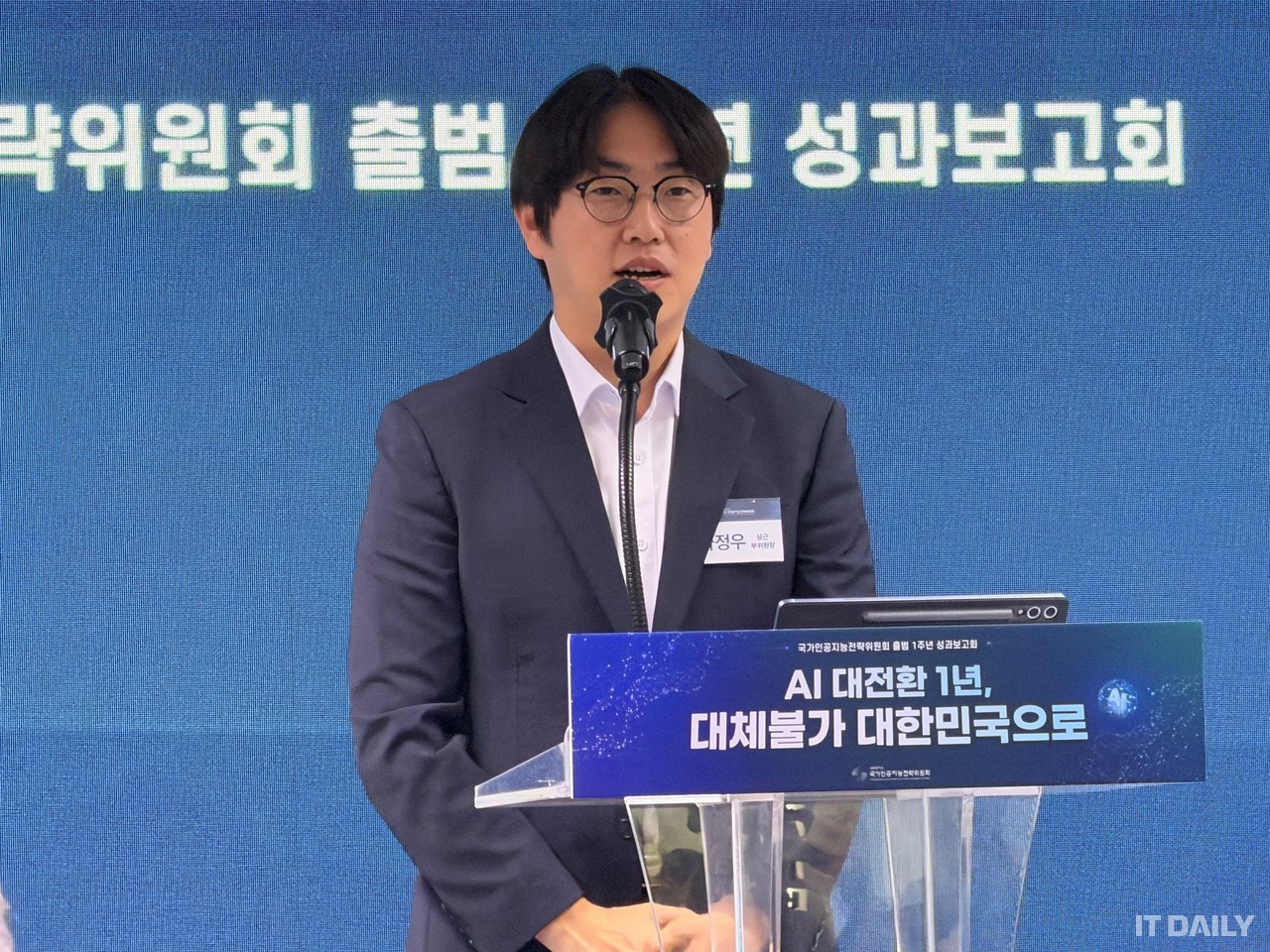
The National AI Strategy Committee marked its first anniversary and disclosed its achievements and future operating direction. The committee serves as the government-wide control tower for AI policy coordination. On the 8th, Ha Jung-woo presented the committee’s accomplishments and future action plan at the "1st Anniversary Achievement Report" held at Seoul Square.
The National AI Strategy Committee consists of 10 subcommittees, 2 special committees and 1 task force (TF). In February, the committee announced the "Republic of Korea Artificial Intelligence Action Plan." The plan includes 3 major policy pillars and 12 strategic areas, with 99 action tasks and 326 policy recommendations finalized.
Ha Jung-woo, standing vice chair of the National AI Strategy Committee, said he would strengthen the committee’s role as an inter-ministerial "mediator." He also outlined a direction to support the organic promotion of 3 major mega-projects and 7 SEED projects.
Ha Jung-woo said the committee will be operated with a stronger focus on project results going forward. He also set the goal of producing outcomes that the public can directly feel.
Assessing the country’s AI capabilities, Ha said South Korea ranks in the top 3 on many global AI ranking indexes. He also said the country has its own cloud companies, data center operation capabilities, AI technology capabilities and AI application capabilities.
He added that South Korea is one of the few countries with AI capabilities across nearly all sectors. However, he pointed out that AI transformation across industry remains an unresolved task.
Ha said the gap in industrial AI transformation compared with the U.S. and China is significant. He also said AI gaps between companies and between regions remain unresolved, explaining that the gap between large corporations and small and medium-sized enterprises is wide, as is the gap between the Seoul metropolitan area and non-capital regions.
He also assessed that while support for startups at the founding stage is diverse, difficulties in the growth and scale-up process continue. His point was that structural problems persist in the growth stage after founding.
Ha said the National AI Strategy Committee needs to serve as the country’s AI control tower. He stressed that the committee must play a role in addressing these gaps and challenges.
The committee reviewed future roadmaps for key subcommittees and presented tasks to be pursued, divided by subcommittee.
The technology innovation and infrastructure subcommittee plans to establish a review-and-decision system for AI data centers and conduct simulations before the AI Data Center Special Act takes effect in March next year. It also plans to upgrade the management system for computing resources such as graphics processing units (GPU).
The science subcommittee will support follow-up measures for K-Moonshot and the Research Data Act. It will also continue to monitor the development and use of specialized AI foundation models in fields such as bio, materials and healthcare. The industrial AX and ecosystem subcommittee will review implementation progress in manufacturing, autonomous driving and humanoids, among other key strategic areas, and support the formulation of the "2030 Global AI Decacorn Fostering Plan" and the "Autonomous Driving-Centered Transportation and Logistics AI Transformation Plan."
The public AX subcommittee will establish a rapid development system for public AX and create guidelines. In addition, it will push ahead with API, MCP and data standardization to advance the public sector’s AI transformation acceleration plan.
The data subcommittee has been assigned the role of supporting the revitalization of "data assetization" based on data valuation and linkage with finance and accounting. It plans to flesh out measures to link national-level AI, data and technology policies.
The security special committee will push for full-scale AI security coverage across the entire process of AI model development, procurement and operation. It also plans to establish a K-AI cybersecurity framework.
At the event, Ha Jung-woo and the subcommittee chairs posed for a commemorative photo. Ha said that the period through 2030 is the golden time for AI competition, adding that he would focus on coordination among ministries.
A Q&A session followed, with questions directed to Ha Jung-woo and the subcommittee chairs. The questions focused on assessing the organization’s size and complexity, as well as ways to improve it.
Ha acknowledged that the National AI Strategy Committee is large. He said he understands that the organization must become bigger because AI influences all sectors.
Ha said the work of each subcommittee is currently divided by area. However, he explained that projects overlapping multiple areas need to be jointly promoted by more than one subcommittee.
Ha said he will push ahead with a plan to design the committee’s operation around results in order to deliver outcomes the public can feel. He also said discussions are under way on how to operate the current organizational structure more efficiently.
In response to a question about the need for continuity in the leadership of the committee to carry out its mediator role, and the minimum term needed for that purpose, the speaker said the minimum deadline for ensuring policy continuity is considered to be through 2030.
The speaker explained that, given the direction of AI technology development and the intensifying global AI competition, time is needed for coordination and for producing results. He also said the chair does not make every decision alone.
The speaker added that future decisions will take into account the pace of technological development and the international competitive landscape.
Regarding questions about a desirable competition system after controversy over the first and second rounds of the independent AI foundation model development project (Dopfamo), the speaker said shortcomings were identified in the first and second review processes. He said the key task is to strengthen frontier AI capabilities and that the evaluation methods, evaluation criteria and execution system will be reviewed. He also said the plan is to keep improving the direction in consultation with experts.
The government recently selected an organization to carry out a cyber security-specialized foundation model project, and it is separately pushing ahead with a cyber security-specialized model initiative. This is connected to the background for separately promoting a cyber security-specialized model without using Dopfamo.
The reason for the separate initiative lies in Dopfamo’s focus on commercial services. Since it will take time to apply Dopfamo to security, short-term response is needed, and that is why an immediately deployable cyber security-specialized model is necessary. The model will be trained on malware and cyber threat intelligence, and its purpose is security preparedness.
This approach is linked to a policy structure that runs short-term and mid- to long-term policies in parallel. The speaker also said the point is that an immediately deployable cyber security-specialized model is needed separately from Dopfamo.
It was also noted that the government’s role is not to directly build frontier models. The speaker explained that frontier model competition is driven by capital and corporate competitiveness, and that the leading players in the U.S. and China are also companies. The U.S. government encourages frontier competition through legal and institutional mechanisms, while the Chinese government plays a role by driving it from the top down. Given South Korea’s competitive conditions, a one-team approach rather than government action alone is needed, and the gist was that securing domestic AI competitiveness depends more on combining company-led competition with government support than on direct government development.
The conditions for long-term self-reliance were presented as being selected by the global market and reducing dependence on government support. Accordingly, it is necessary to expand the global usability of participants in the Dopfamo project, and a call was made to strengthen diffusion and design for that purpose. "AI for All" was presented in that context as the starting point for a data flywheel, that is, a virtuous cycle, and it was summarized as having the status of the first starting point for independence in the long term.
There was also recognition that simply launching services is not enough. A large number of users must use AI assistants and agents, and in that process users enter data and generate outputs. Those outputs take on the character of high-quality data, and that high-quality data is then fed back into retraining. Ultimately, the desired structure is a virtuous cycle in which outputs are used again for training.
Source: IT DAILY · Seong Won-young
Original: https://www.itdaily.kr/news/articleView.html?idxno=241485
References
This article was produced with the help of an automated content generation algorithm.
Source: IT DAILY
View originalThis article was summarized and organized by BizCrush based on the original article from IT DAILY. For exact quotations and full details, please refer to the original article.