[K-FDE②] Building a System to Spread Manufacturing Tacit Knowledge... Government to Support Data, Training, and Talent
IT DAILY ·
✦ AI Summary
Discussion over institutionalizing K-FDE has begun in earnest at a National Assembly roundtable, where the Ministry of Trade, Industry and Energy, the Ministry of Employment and Labor, and the Ministry of SMEs and Startups introduced related programs and support plans.
The Ministry of Trade, Industry and Energy said it will push ahead from next year with projects to convert skilled workers' tacit knowledge into data and apply it to AI, robots, and manufacturing equipment, while reflecting about KRW 290 billion in next year's government budget proposal and reviewing about 90 projects.
The Ministry of SMEs and Startups and the Ministry of Employment and Labor said they will work together on field retention and supplier-company development through measures such as training manufacturing AI fellows, linking AI coaches, and operating more than 30 AI training and support hubs nationwide.
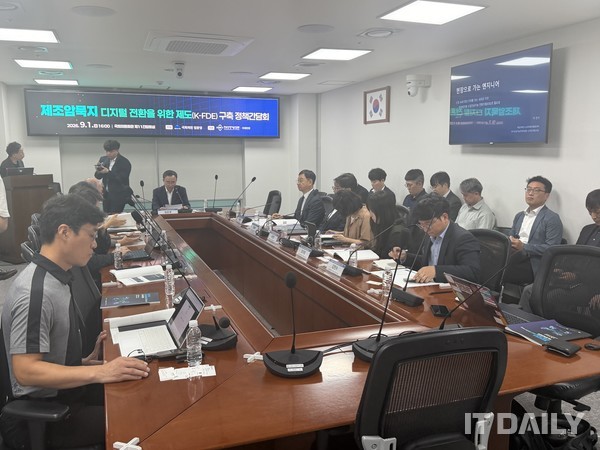
Discussion over institutionalizing the 'Korean-style field-deployed engineer (K-FDE)' system, aimed at turning skilled workers' experience and know-how into assets in the AI era, is gathering pace, and the government's moves to turn policy and programs into practice are also taking shape. On the 1st, a policy roundtable titled 'Policy Discussion on Building a K-FDE System for the Digital Transformation of Manufacturing Tacit Knowledge' was held at the National Assembly Members' Office Building in Yeouido, hosted by Rep. Lim Moon-young.
At the roundtable, experts from academia and industry agreed that K-FDE should not be limited to simple workforce training and field placement. They suggested that a career path linking education and field experience is needed, and that a system to accumulate skilled workers' tacit knowledge as data, as well as regional hub infrastructure connecting universities and companies, is also necessary.
The roundtable was arranged to discuss concrete institutionalization measures for the revision of the 'Act on Promoting Industrial Digital Transformation and the Use of AI,' jointly proposed by Rep. Lim Moon-young. The revision bill, drawing on Palantir's FDE model, includes support for placing young specialists at small and midsize companies and mid-sized companies, and for helping them identify and solve real manufacturing-site problems alongside skilled workers.
On the 1st, the 'Policy Discussion on Building a K-FDE System for the Digital Transformation of Manufacturing Tacit Knowledge' hosted by Rep. Lim Moon-young was held. Photo caption: Yang Seung-gap. The discussion also covered the Ministry of Trade, Industry and Energy's plan to invest KRW 290 billion in manufacturing AI transformation.
At the roundtable, ministries including the Ministry of Trade, Industry and Energy, the Ministry of Employment and Labor, and the Ministry of SMEs and Startups introduced their related programs and support plans. They also presented ways to link those measures with K-FDE.
Kwon Soon-mok, director of the Industrial AI Policy Division at the Ministry of Trade, Industry and Energy, said the ministry plans to push ahead with a project starting next year to convert skilled workers' tacit knowledge into data and apply it to AI solutions, robots, and manufacturing equipment. The ministry's envisioned project begins by collecting and digitizing video and motion information that contains skilled workers' experience and intuition.
This will include collecting and digitizing equipment logs, reports, research notes, and unstructured data such as professional books and training materials. The data gathered in this way will then be refined through standardized methods.
The refined data will be converted into data for AI training, and based on that, the idea is to lead to the development and spread of related solutions such as manufacturing AI and robots centered on AI startups. At the roundtable, the ministries explained their respective programs and support plans, and also presented ways to connect this flow with K-FDE.
Regarding the direction of expanding AI support for small and midsize companies, Kwon said the government has reflected about KRW 290 billion in related programs in next year's government budget proposal. He added that if the budget is finalized after parliamentary review, about 90 projects could be pushed ahead with.
Project identification is being considered with a focus on core manufacturing processes, he said. The reason is the high risk of losing skilled know-how.
The government is also reviewing a plan to conduct midterm evaluations and concentrate support on outstanding projects. The direction is to improve the efficiency of support by differentiating it through evaluations.
At the same time, the Ministry of Trade, Industry and Energy plans to focus on talent development. It plans to designate regional hub universities and train master's- and doctoral-level personnel who will be responsible for developing AI models based on tacit knowledge. It also plans to pursue on-site demonstrations and workforce training linking universities, industrial complexes, and regionally specialized industries.
Kwon said the ministry intends to intensively support talent that combines AI knowledge and domain expertise. Lee Young-jin, head of the Corporate Training Support Division at the Ministry of Employment and Labor, stressed that securing personnel for on-site use and sustained operation is as important as building AI solutions.
Many small and midsize companies have not made sufficient use of AI and digital solutions after introducing them. Lee said there are cases where MES and AI solutions were built but not used well, and cases where operational errors occurred. He added that there are also cases where companies returned to their previous methods due to poor use and operational errors.
Lee also said there are cases where equipment is built but cannot be utilized. In response, the Ministry of Employment and Labor is operating more than 30 AI training and support hubs nationwide to ease difficulties in on-site use.
The AI diffusion centers support diagnosing on-site problems through direct visits by AI experts to small and midsize companies, and they also provide problem-solving support through project-based learning (PBL). Lee explained that the support is designed to make on-site training reusable.
In addition, the ministry will identify training demand among about 7,300 small and midsize companies that have adopted related solutions through support programs from other ministries, and will link AI coaches to about 7,300 small and midsize companies. Next year, it plans to deploy about 300 additional young AI coaches.
The article's title is the Ministry of SMEs and Startups' support for FDE growth paths. Lee mentioned a method in which senior-level private-sector AI coaches and young coaches visit companies and stay on-site for a set period to solve problems. He also said that the FDE-related bill could provide institutional support for corporate AX support.
Lee also said that, on the premise of inter-ministerial cooperation, the Ministry of Employment and Labor could play a role in vocational training. His point was that the FDE-related bill and cooperation among ministries could institutionally support AX assistance and the role of vocational training.
Oh Ji-young, head of the Workforce Policy Division at the Ministry of SMEs and Startups, identified systematic training of advanced talent and their sustained retention in small manufacturing companies as key tasks in the institutionalization of K-FDE. Oh said she sees this as a core task in institutionalizing K-FDE.
To that end, the ministry plans to launch a 'Manufacturing AI Fellow Training Program' starting next year. Oh Ji-young explained that the ministry plans to develop curricula in manufacturing and AI with the four science and technology institutes and train about 500 people. The status of the program is in the concretization stage.
Oh said that, to remove bottlenecks in talent development, it is necessary to flesh out plans linking smart factories and the Ministry of Trade, Industry and Energy's projects, as well as plans connecting skilled workers and young people. She added that the Ministry of SMEs and Startups will also actively work to remove bottlenecks in talent development based on feedback from the field and experts.
There was also a call to foster supplier companies as the foundation for FDE activities. Kim Min-soo, director of the Manufacturing Innovation Division at the Ministry of SMEs and Startups, suggested that, alongside FDE talent, specialized supplier companies that these workers belong to and that support small and midsize companies' AX should be nurtured at the same time.
The ministry said it is pursuing support for supplier-company specialization and growth. It said the current supplier pool is about 2,700 companies, and that it is in the process of selecting companies with the necessary capabilities as specialized companies.
Kim Min-soo said that if more specialized supplier companies are created, the talent training and field placement pipeline can be solidified. He added that, for good companies to attract, retain, and grow good talent, it is important to create a stable growth path for supplier companies alongside talent development.
In his closing remarks, Rep. Lim Moon-young emphasized the need for education, industry, and employment-related systems to change together, and said that a perspective that sees the whole as a connected concept is necessary. He then underscored that an overall shift in systems and policies is needed.
Regarding policy evaluation and design, Rep. Lim Moon-young said it is necessary to move away from output-focused measures such as the number of items distributed and the number of people trained, and to shift toward outcome-focused policies that value actual changes in the field. He also said that bold improvements to existing methods are needed, and that channels leading to genuine AX must be continuously considered.
Source: IT DAILY · Yang Seung-gap
Original: https://www.itdaily.kr/news/articleView.html?idxno=241366
References
This article was produced with the help of an automated content generation algorithm.
Source: IT DAILY
View originalThis article was summarized and organized by BizCrush based on the original article from IT DAILY. For exact quotations and full details, please refer to the original article.