Soaring Memory Prices Push Kakao Enterprise to Share Open-Source Storage Optimization Case
IT DAILY ·
✦ AI Summary
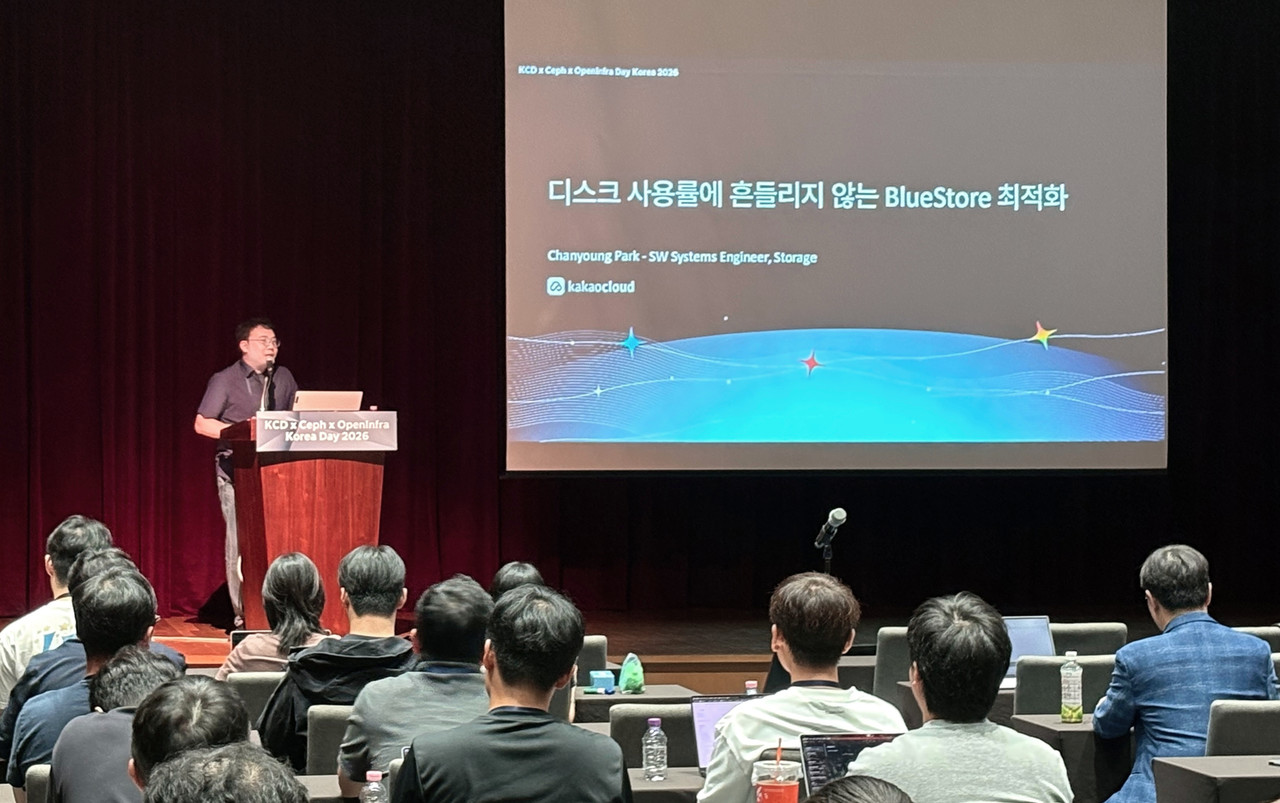
Kakao Enterprise said on the 2nd that it shared a storage optimization case at OpenInfra Day Korea (KCD x Ceph x OpenInfra Day Korea 2026) held in Yongsan District, Seoul.
Park Chan-young, manager of Kakao Enterprise's IAM/Storage Development Team, gave a presentation on the 1st on "BlueStore optimization that is not swayed by disk utilization."
KakaoCloud said it applied partitioning to a single SSD to operate Allocators separately and separated the original data area from the metadata area.
Kakao Enterprise said on the 2nd that it shared its storage optimization know-how at the OpenInfra Day Korea (KCD x Ceph x OpenInfra Day Korea 2026) held in Yongsan District, Seoul. Park Chan-young, manager of Kakao Enterprise's IAM/Storage Development Team, took the stage to present at the event on the 1st.
Park's presentation was titled "BlueStore optimization that is not swayed by disk utilization." Kakao Enterprise also unveiled its own storage optimization case at the event.
OpenInfra Day Korea was co-hosted by the three communities of "Kubernetes," "Ceph," and OpenInfra. "Kubernetes" is a standard for cloud-native technology, "Ceph" is an open-source distributed storage platform, and OpenInfra leads open infrastructure technology. Domestic and international experts took part in the presentation sessions to share open-source cloud technologies and field experience.
Park Chan-young, manager of Kakao Enterprise's IAM/Storage Development Team, gave a presentation on BlueStore optimization that is not swayed by disk utilization. He explained that as the prices of NAND flash memory and SSDs have risen sharply recently, companies are focusing on using memory and disk resources more efficiently. He added that the need to operate cloud services in a resource-constrained environment is also expanding.
He pointed out, however, that there is a limit: as disk utilization rises, disk fragmentation increases Latency. He explained that disk fragmentation means related data and free space are not stored contiguously but are distributed across multiple locations on the disk, which in turn slows response times due to data dispersion.
KakaoCloud said it is using Ceph and BlueStore to address disk fragmentation. The method applies partitioning to a single SSD and then sets up an Allocator for each area before operating the Allocators separately. As a result, it said it achieved both higher disk utilization and lower Latency, while also improving the user experience.
Park said that, based on the fact that KakaoCloud's block storage service frequently records and modifies metadata, it applied a partitioning technique similar to separating the metadata area onto a separate SSD to a single SSD. Accordingly, he said the original data area and the metadata area were separated.
Kakao Enterprise is participating in several global open-source conferences to unveil and demonstrate its technical capabilities. The events it takes part in are OpenInfra Day Korea and OpenInfra Summit, with OpenInfra Summit being an event that cloud developers and engineers from around the world attend.
Source: IT DAILY · Kim Ho-jun
Original: https://www.itdaily.kr/news/articleView.html?idxno=241343
References
This article was produced with the help of an automated content generation algorithm.
Source: IT DAILY
View originalThis article was summarized and organized by BizCrush based on the original article from IT DAILY. For exact quotations and full details, please refer to the original article.