Dell Technologies Targets Enterprise AI PC Market With a Deskside Strategy
IT DAILY ·
✦ AI Summary
Dell Technologies has launched a full-scale push into the enterprise AI PC market and presented a deskside strategy that shifts AI processing from the data center to individual employee devices.
With cost control and data security as its goals, the company introduced its 'Dell Pro' AI PC portfolio and a hybrid AI deployment strategy.
At 'Dell Technologies Forum 2026,' Dell Technologies Korea unveiled the strategy along with related new products and security configurations.
Dell Technologies has begun a full-scale push into the enterprise AI PC market. The company has made it a strategic pillar to distribute AI processing away from the data center and to individual employee devices. Spreading data center-centric AI workloads to employees' desks is at the core of this strategy.
The goal of this deskside strategy is to control costs and maximize data security. As a way to win in the market, Dell Technologies presented its 'Dell Pro' AI PC portfolio. Along with that lineup, the company laid out plans to expand in the enterprise market.
Dell Technologies Korea held 'Dell Technologies Forum 2026' on the 25th and announced its business strategy at a media briefing for new commercial client products. At the event, Kim Sang-mo, president of Dell Technologies Korea, delivered welcoming remarks.
Kim Sang-mo, president of Dell Technologies Korea, said the market's questions are moving away from AI use cases and performance itself. He explained that Dell's support spans the data center, servers, workstations and AI PC. He also said the company helps enterprise customers address token costs and security issues in an economical and optimized way.
Kim Sang-mo, president of Dell Technologies Korea, was photographed speaking at the event. The photo was taken by reporter Kwon Young-seok.
The main session at the event was presented by Jeong Jae-wook, director at Dell Technologies Korea, and the topic was how workload handling locations are changing with the rise of agentic AI. The presentation explained that as agentic AI spreads, inference needs to happen more often and closer to the workplace.
Director Jeong described agent capabilities as an autonomous loop of reasoning, planning, tool calling and review. He said that, because of these characteristics, continuous inference occurs within everyday workflows, and the need for immediate inference processing on the deskside, where data is generated, is expanding.
From an 'AI Tokenomics' perspective, Jeong pointed to the limits of cloud dependence. He said that while token unit prices continue to fall, total token consumption is surging as AI agents make several thousand background calls, causing actual enterprise billing amounts to rise exponentially.
Jeong said this creates a 'meter dilemma' for companies, referring to the cost problem they have to bear. He then said this problem can be solved through the deskside.
Dell proposed a 'hybrid AI deployment strategy' that combines the cloud, on-premises data centers and deskside environments rather than concentrating AI tasks in one place, with the mix determined by workload characteristics. In this model, the cloud handles large-scale training and the use of the latest frontier models, while the data center handles areas that require internal core data governance.
Repetitive inference tasks and sensitive data processing are intended to be handled locally on deskside workstations. The purpose of this local-processing concept is to maximize cost efficiency based on a predictable fixed-cost structure.
Dell also unveiled high-performance deskside hardware to support this strategy. The 'Dell Pro Max with GB10/GB300' is equipped with an NVIDIA Grace Blackwell superchip. The tower workstation 'Dell Pro Precision 9' series (T2, T4, T6) was also unveiled, and the series is equipped with Intel Xeon 600 processors and NVIDIA RTX Pro Blackwell GPUs to support high-performance computing and graphics work.
Dell presented a configuration that combines NVIDIA NeMo, OpenCL, Agent Toolkit and the CrowdStrike security framework to provide a secure deskside environment for developing and operating agents without external data leakage. It said seamless scaling is also possible when needed through Dell PowerEdge servers.
Director Jeong Jae-wook of Dell Technologies Korea presented this information at the event. The photo was taken by reporter Kwon Young-seok.
Dell then fully introduced the standard AI PC lineup 'Dell Pro' for AI-native organizational transformation. The target is everyday AI use across all members of the enterprise.
The lineup has been organized into 3, 5, 7 and Premium. The installed processors are the latest Intel Core Ultra Series 3 and AMD Ryzen AI 400 Series, and the AMD Ryzen AI 400 Series was presented as improving local AI processing performance by strengthening NPU performance.
On the product side, Dell said it reduced the thickness of its flagship 'Dell Pro 5' laptop by 12% and strengthened durability and design by using aluminum. The 'Dell Pro 5 Micro' mini PC has an ultra-compact form factor and can support 100W power delivery (PD) and display output at the same time through a single USB-C cable. Dell also positioned the 'Dell Pro 5 Micro' as suitable for financial-sector network separation environments, suitable for multi-monitor setups and offering space efficiency.
At the same time, Dell said it sees the attack surface expanding as AI spreads to endpoints, and it presented a hardware-based layered security system as a core countermeasure capability. Dell said it applies supply chain security from the product design and manufacturing stages and applies vulnerability checks below the OS with 'SafeBIOS' by default. It also presented default off-host integrity verification and the default application of post-quantum cryptography (PQC) to prepare for attacks by quantum computers.
Dell said 61% of enterprise breaches in 2026 are related to direct device compromise, linking that to the need for these default security measures. Through this, Dell presented hardware-based layered defense extending from supply chain security to BIOS, integrity verification and PQC, along with assurances of device integrity.
Director Jeong Jae-wook said the company will actively support enterprise customers' safe and forward-looking AI transformation. He presented three support pillars for this effort: deskside infrastructure based on AI Tokenomics, Dell Pro AI PC for AI-native organizations and hardware-based layered endpoint security.
Jeong said the goal is to support AI transformation without cost burdens or security risks. He also said the company will support enterprise customers in a way that reduces cost and security burdens during the AI transformation process.
A summary of the main Q&A from the briefing followed. The Q&A topics were Dell Technologies' domestic and overseas commercial client results and market positioning.
At the session, it was noted that Dell Technologies posted USD 13 billion in global commercial client revenue in the first quarter (February to April) and achieved meaningful results, including 18% growth from the same period a year earlier. For the domestic market, the benchmark was IDC's second quarter.
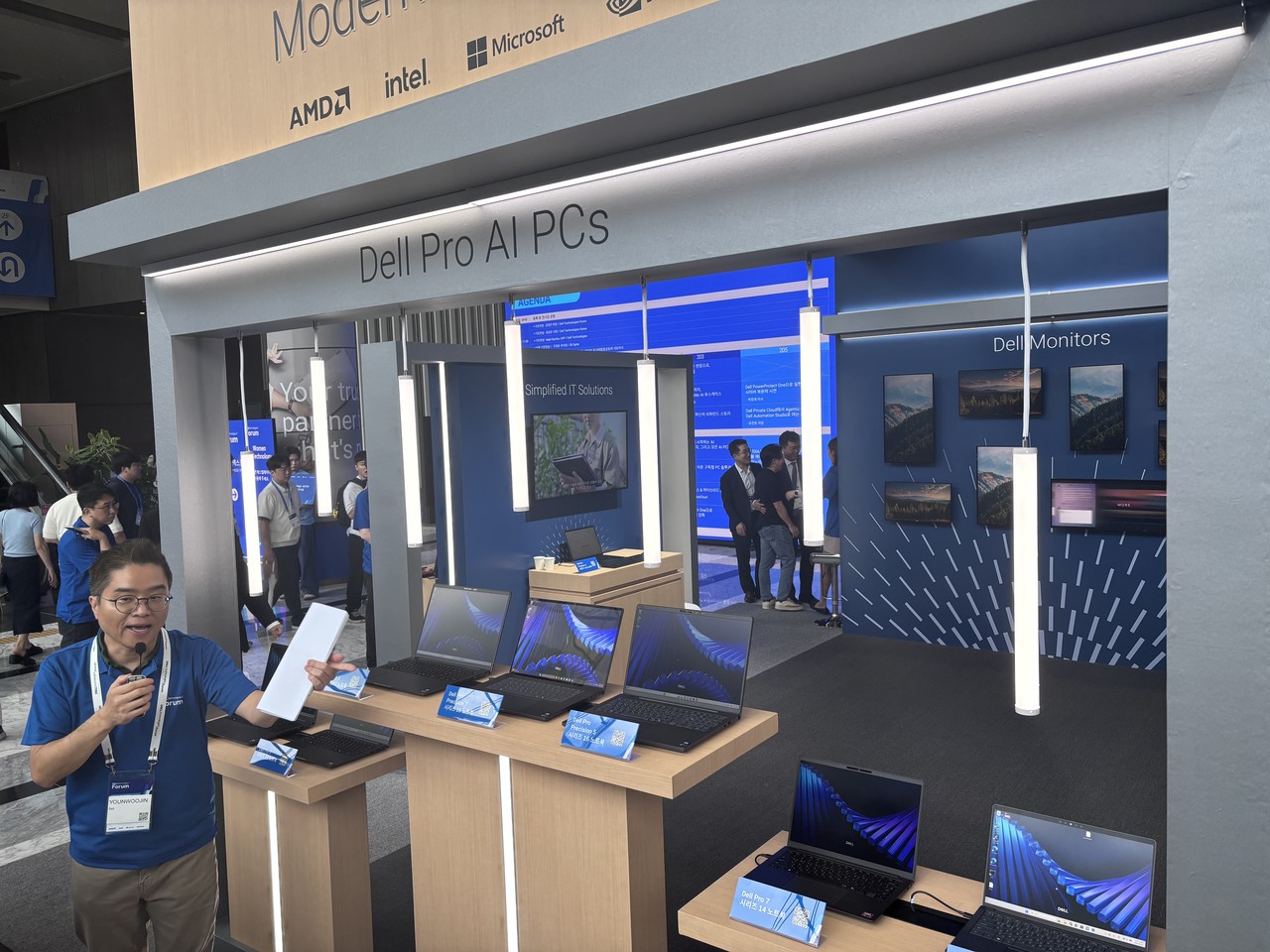
In the domestic overall commercial PC market, Dell ranked second among the three foreign brands, and in the domestic 'enterprise commercial desktop' segment it was presented as the No. 1 market share holder among all domestic and foreign vendors. The article also included an on-site photo of the 'Dell Technologies Forum 2026' booth, credited to reporter Kwon Young-seok.
Some view the ongoing rise in memory component prices as a reason cloud dependence will continue. However, the current shift in the AI paradigm is moving from simple Q&A-centered use cases to 'agentic AI' centered on autonomous background operation.
If agent use increases, the burden of cloud token costs will grow exponentially, and the need for long-term cost control and data protection will also increase. Against this backdrop, acceleration toward deskside AI and on-premises infrastructure is seen as inevitable.
Source: IT DAILY · Kwon Young-seok
Original: https://www.itdaily.kr/news/articleView.html?idxno=241195
References
This article was produced with the help of an automated content generation algorithm.
Source: IT DAILY
View originalThis article was summarized and organized by BizCrush based on the original article from IT DAILY. For exact quotations and full details, please refer to the original article.