Government to Track Illegal Filming Sites That Change Domains Using AI
IT DAILY ·
✦ AI Summary
The government is promoting the establishment of an AI tracking and analysis response system to counter illegal filming sites that repeatedly distribute content while changing domains.
The Ministry of Gender Equality and Family, the Korea Communications Commission, and the National Police Agency finalized and announced an integrated response plan for illegal sites at an interagency digital sex crime response consultative body.
The government is reviewing a single response system that includes stronger responsibility for platforms, hosting, CDN, and ISP, legal and institutional reforms, and links between investigations and blocking measures.
The government is promoting the establishment of an AI-based tracking and analysis response system to counter illegal filming sites that repeatedly distribute content while changing domains, and it is also reviewing measures to strengthen responsibility at each stage of illegal content distribution for platforms, hosting, CDN, and ISP.
On the 20th, the Ministry of Gender Equality and Family, the Korea Communications Commission, and the National Police Agency finalized and announced the "Integrated Response Plan for Illegal Site Response Through In-Depth Analysis of Illegal Filming Content Distribution Sites" through the pan-government consultative body on digital sex crime response.
The government analyzed investigative materials on 34,628 illegal sites secured by the Central Digital Sex Crime Victim Support Center during its deletion support process from May 2018 to this May, as well as 27 cases involving illegal site operators arrested by police over the past 5 years.
As a result, 6,683 of the sites analyzed, or 19.3%, were accessible, and 3,832 of those were confirmed to be accessible from domestic commercial networks without any separate bypass.
The government identified 1,316 accessible sites that operate in Korean or have Korea-related categories, and it estimated that those sites carried about 2.15 million videos related to Koreans.
Some videos were found to include personal information that could identify victims. The personal information items included names, occupations, regions of residence, contact information, and SNS accounts.
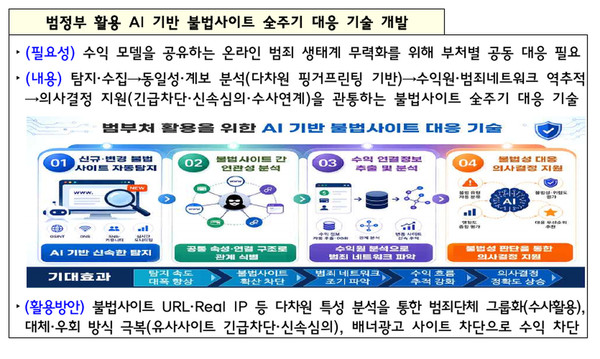
To respond to "domain shuttling," in which sites continue operating by repeatedly changing domains after being blocked, the government is pushing the development of AI-based full-cycle response technology and system construction for illegal sites. This process includes automatic domain change detection.
The AI-based response system is being developed to include automatic detection of illegal sites, analysis of the same operator, tracking of criminal networks, and support for linking blocking and investigations. In addition, the government is pushing AI-based tracking of operating networks and revenue sources.
The government is pursuing a plan to turn its response to illegal sites into a single system that runs from detection to analysis, blocking, and linkage to investigations, rather than treating each measure separately. For automatic illegal site detection, it proposed analyzing and predicting domain change methods and analyzing site similarity and illegality. It also includes a plan to systematize the process into a single chain covering detection and collection, identity and genealogy analysis, backtracking of revenue sources and criminal networks, and emergency blocking, expedited review, and investigative linkage.
For this purpose, the government is pushing the development of technologies that analyze multiple characteristics such as URL and actual IP, identify sites operated by the same criminal group, and detect substitute and bypass sites. In the government's fact-finding survey, technical traces such as web structure, domain, and content were tracked, and 385 groups suspected of operating multiple sites by the same operator were identified. Some of these groups were found to be operating more than 20 sites simultaneously.
The government is also reviewing blocking technologies to respond to the spread of encrypted communications. Along with the review of blocking technologies to respond to the spread of encrypted communications, it is reviewing the introduction of blocking technologies to address QUIC and ECH (Encrypted Client Hello). In addition, it is pushing the development of technology to analyze the characteristics of encrypted traffic without decrypting the contents of communications.
The government will strengthen its response to illegal sites based on the sharing and blocking use of information on illegal and harmful sites collected by the Korea Internet & Security Agency (KISA). At the same time, it is moving to establish a spam-text keyword filtering system and is also pushing preventive measures such as blocking the sending stage of information on illegal sites and suspending the use of the relevant phone numbers.
As for preventing the distribution of illegal filming content, the government is reviewing a plan to expand the scope of responsibility to the internet service sector as a whole. Going beyond the current distribution prevention measures centered on value-added telecommunications operators, it is reviewing a requirement for platform operators to report suspicious content such as illegal filming content found within their own services, including user ID and IP address.
In addition, it is reviewing measures to strengthen responsibility at each stage of distribution for platforms, hosting, CDN, and ISP. This is tied to the review of expanding responsibility for preventing the distribution of illegal filming content across the internet service sector and broadens the response across the entire distribution route.
The government is also pushing to block major revenue sources of illegal sites. A review of 1,674 sites that could be accessed from domestic networks and carried banner ads found 40,686 banner ads for gambling, prostitution, and other content on those sites, and analysis of investigative materials from 27 cases and 126 sites arrested by police since 2021 identified about KRW 30.4 billion in criminal proceeds generated through banner ads.
The government is pushing legal and institutional reforms in line with a policy of simultaneously cutting off revenue sources and operating foundations by targeting advertisements, accounts, and overseas infrastructure used by sites distributing illegal filming content. To that end, it is pushing revisions to the law to ban the placement of ads on sites distributing illegal filming content, and it is also pushing institutional reforms so that sanctions can be imposed for violations of the ad ban. It is also pushing to freeze account transactions used in operating illegal sites and has prepared a policy for joint service suspension requests by relevant ministries targeting overseas hosting and CDN providers.
At the same time, the government is reviewing the introduction of an "active defense" system for these purposes, including consideration of allowing investigative agencies to directly access illegal sites, allowing them to collect investigative leads, and allowing them to delete original data. The government plans to refer to related systems in Australia and the UK, and based on that, will review whether to introduce such a system domestically.
In addition, considering the current absence of direct punishment provisions for opening and operating illegal sites and the fact that such acts are currently punished as aiding and abetting the production and distribution of sexual exploitation materials, the government is reviewing a legal revision to separately criminalize the act of opening illegal sites as a measure to close this punishment gap. The police have drawn up plans to establish a "Special Investigation Team on Illegal Sites," and the team plans to focus its investigative power on arresting operators and deleting originals.
The government is pushing to introduce the right to demand emergency blocking for sites that repeatedly ignore deletion requests, and to allow the Minister of Gender Equality and Family to directly request blocking from telecommunication service providers. In addition, the Korea Communications Standards Commission is pushing to treat sites identical or similar to those already under review as covered by existing review, while also pushing for swift blocking of identical or similar sites.
In response, Kim Jong-cheol, head of the Korea Communications Commission, said that, based on cooperation among relevant agencies, the government would respond without gaps at every stage, from victim support and distribution prevention to deletion, blocking, and investigation. He also expressed his determination to create a digital environment where the public can feel secure.
Source: IT DAILY · Kim Byeong-ju
Original: https://www.itdaily.kr/news/articleView.html?idxno=241114
References
This article was produced with the help of an automated content generation algorithm.
Source: IT DAILY
View originalThis article was summarized and organized by BizCrush based on the original article from IT DAILY. For exact quotations and full details, please refer to the original article.