DigiKey TechForum: Multiphase Boost Converters Reduce Input and Output Capacitor Requirements
TECHWORLD ·
✦ AI Summary
The output capacitor C2 averages the inductor-derived pulse current to keep the output voltage stable.
Because of this role, the output capacitor requires high capacitance and low ESR and low ESL, and as a result large and expensive capacitors are often needed.
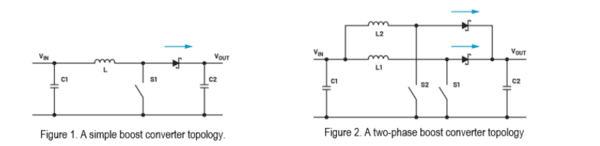
A multiphase boost converter has two boost regulators operating in parallel and sharing one output capacitor, and the two channels are driven with a 180° phase difference to reduce the required capacitance of C2.
In a typical boost converter topology, the output capacitor C2 serves to keep the output voltage stable. The output side has the characteristic of carrying pulse current derived from the inductor.
Accordingly, C2 averages the pulse current and maintains a constant output voltage. It is presented as a key function for keeping the voltage stable at the output stage of a boost converter.
To perform this role, the output capacitor needs high capacitance and low ESR and low ESL. The purpose of these characteristics is to reduce voltage ripple and keep the output voltage stable.
As a result, there are many cases in which large and expensive capacitors are required. This in turn makes the overall design larger and raises costs.
One way to ease this output capacitor burden is to use a multiphase boost converter. A multiphase boost converter has two boost regulators operating in parallel and sharing a single output capacitor.
According to DigiKey's TechForum/Article, the two channels are driven with a 180° phase difference. As a result, C2 receives energy twice per cycle.
The energy source for C2 is each inductor, L1 and L2, and each inductor supplies energy once each. Because energy is supplied alternately from the two inductors, output voltage ripple is reduced.
With this operating characteristic, compared with a single-phase design, C2 can achieve the same performance with roughly half the required capacitance. This applies when the advantages of a multiphase boost regulator appear in the output capacitor.
The advantages of a multiphase boost regulator also apply to the input capacitor. The two inductors on the input side have a phase difference with respect to each other.
The effect of the two phase-shifted inductors reduces input current variation. The input current characteristic of a boost converter is already somewhat stabilized because it passes through the inductor, but the multiphase structure provides an additional reduction in input current variation.
As a result, the size of the input capacitor C1 can be reduced. This makes it possible to shrink the power supply, improve economy, and improve efficiency.
Source: TECHWORLD · Lee Gwang-jae
Original: https://www.epnc.co.kr/news/articleView.html?idxno=407347
References
This article was produced with the help of an automated content generation algorithm.
Source: TECHWORLD
View originalThis article was summarized and organized by BizCrush based on the original article from TECHWORLD. For exact quotations and full details, please refer to the original article.