UVC Unveils 'OCTOPUS Agentic AI' at Korea Graphics 2026
TECHWORLD ·
✦ AI Summary
UVC CEO Cho Gyu-jong unveiled "OCTOPUS Agentic AI" at the online "Korea Graphics 2026" on September 10.
UVC said that AI adoption among domestic small and midsize manufacturing companies stands at 0.1%, and that 75% of companies that have introduced smart factories are still at the basic stage.
UVC said it implemented OCTOPUS Agentic AI through ontology-based digital twins and agent orchestration, and that application at an injection-molding assembly site in South Korea confirmed a 42% reduction in defect rates and a 20% increase in productivity.
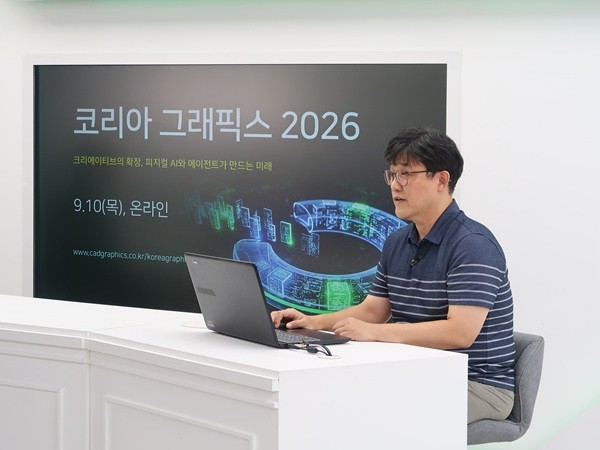
UVC CEO Cho Gyu-jong unveiled "OCTOPUS Agentic AI" during a presentation at "Korea Graphics 2026," held online on September 10. The subtitle of the event was "Expanding Creativity, the Future Created by Physical AI and Agents," and UVC's presentation topic was "The Premise of the Future Shaped by Dark Factory: Ontology-Based Digital Twins and Agent Orchestration."
In the presentation, UVC said that AI adoption on manufacturing floors is spreading. However, UVC cited figures showing that AI adoption among domestic small and midsize manufacturing companies stands at just 0.1%, and that 75% of companies that have introduced smart factories remain at the basic stage.
UVC proposed "OCTOPUS Agentic AI" as a way to address problems in the use of AI on manufacturing floors. UVC explained that Agentic AI is not limited to providing answers, but instead makes goal-based autonomous judgments and is capable of carrying out real actions.
There are two ways to implement OCTOPUS Agentic AI. One is an ontology-based digital twin, which gives meaning to equipment, process, and quality data and turns the 3D factory into a space where AI can recognize data and simulate. The other is agent orchestration, which is described as a way to operate AI in that space according to a set procedure.
UVC applied and verified this structure at an injection-molding assembly site in South Korea. In the process, it rebuilt the system so that production data for each product could be tracked in real time, and set it up so that when Agentic AI detects a defect, it analyzes the cause and then adjusts equipment conditions. It linked defect detection, root-cause analysis, and adjustment into a single flow, and expert approval is required for equipment control. UVC said the application results showed a 42% reduction in defect rates and a 20% improvement in productivity.
UVC CEO Cho said that the starting condition for autonomous manufacturing is not AI advancement itself, but AI controllability. He also said the company plans to expand cooperation with the graphics and simulation industries to build a 3D world where AI can learn and act.
Source: TECHWORLD · Kim Gyeong-ju
Original: https://www.epnc.co.kr/news/articleView.html?idxno=407428
References
This article was produced with the help of an automated content generation algorithm.
Source: TECHWORLD
View originalThis article was summarized and organized by BizCrush based on the original article from TECHWORLD. For exact quotations and full details, please refer to the original article.