Machina Rocks Applies AI Operating Environment to Military Warfighting Network... First Demonstration at UFS
TECHWORLD ·
✦ AI Summary
Machina Rocks applied its AI operating system, Runway 2.0, to KJCCS together with the Joint Chiefs of Staff.
The project, titled "Demonstration of Generative AI-Enabled KJCCS Information Retrieval and Operation Technology," was carried out during the 2026 UFS exercise period.
The demonstration checked the operational viability of GeDAI J and the information search function in the warfighting network's closed-network environment.
Machina Rocks said on the 28th that it had applied its AI operating system, Runway 2.0, to the Korean Joint Command and Control System (KJCCS) together with the Joint Chiefs of Staff, and conducted a demonstration during the 2026 UFS exercise period. The demonstration was jointly carried out by Machina Rocks and the Joint Chiefs of Staff, under the project titled "Demonstration of Generative AI-Enabled KJCCS Information Retrieval and Operation Technology."
Through the "2026 Ulchi Freedom Shield (UFS)" exercise, Machina Rocks verified the system's usability in an actual military operating environment. KJCCS is a key command and control system used by the South Korean military for joint operations support.
The warfighting network on which KJCCS operates is a closed network subject to stricter security controls than the defense network. The defense network handles general administrative, logistics, and personnel tasks, and introducing new IT technologies such as generative AI into the warfighting network requires meeting even stricter technical and security requirements.
For this project, Machina Rocks supplied the AI model, service development, and operations infrastructure inside KJCCS. This enabled the management of models, data, and development tools in an environment separated from the external internet, and established a closed-network AI operating environment based on Runway 2.0.
The operational targets in this build-out included the military's in-house AI service, GeDAI J, and commercial AI models. The goal was to establish a foundation that would allow multiple AI models and services to be applied as needed, without dependence on any specific model.
This pilot project focused less on individually building AI services inside the warfighting network and more on establishing a common foundation for the continuous development, deployment, and operation of multiple models and services. The operating environment was set up so that military-owned data and models could be managed internally and additional AI functions could be added as needed.
A natural-language search function targeting accumulated KJCCS materials was also applied. Machina Rocks developed a feature that searches for relevant information when a user enters a question and provides answers based on sources.
These AI infrastructure and services were verified in an actual military operating environment during the Korea-U.S. joint exercise 2026 UFS. During the exercise, the military used GeDAI J and the information search function at the training site to check whether generative AI could be operated in a closed-network environment.
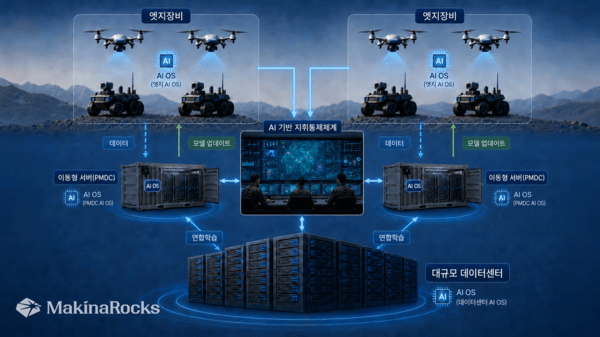
For future expansion, the company proposed a distributed architecture linking the central data center AI environment with mobile servers and edge equipment at operational sites. This structure would include reusing field-generated data for model development and enhancement, then deploying the improved models to each operating environment.
Through this concept, Machina Rocks said it plans to establish an AI model development and operation system based on military-owned data and to create a foundation for deploying AI services from central data centers to field equipment. Going forward, it also plans to continue expanding AI operating environments that can be applied to the defense closed network, based on the results of this pilot deployment, and to keep advancing AI adoption in the defense sector.
Along with this direction, Machina Rocks had previously applied an AI assistant for ship equipment operation support to the Navy's 1st Fleet Command before the KJCCS project. The company is also continuing to develop generative AI infrastructure and services tailored to military systems.
Machina Rocks CEO Yoon Sung-ho said the warfighting network is a challenging area for AI deployment because it requires a high level of security and an independent operating environment. He added that this pilot deployment laid the groundwork for operating military-developed AI models in KJCCS and verified their usability in the actual military environment during UFS.
Yoon said defense AI competitiveness depends not on a single model but on the ability to continuously introduce new models and services and secure a foundation for safe operations. He added that the company will push to expand environments for applying various AI technologies within the defense closed network, centered on Runway.
Source: TECHWORLD · Kim Seung-gi
Original: https://www.epnc.co.kr/news/articleView.html?idxno=407424
References
This article was produced with the help of an automated content generation algorithm.
Source: TECHWORLD
View originalThis article was summarized and organized by BizCrush based on the original article from TECHWORLD. For exact quotations and full details, please refer to the original article.