Interior Ministry Unveils Comprehensive Disaster Safety AX Plan, to Invest KRW 940 Billion by 2030
IT DAILY ·
✦ AI Summary
The government has launched a full-scale government-wide AX initiative across disaster and safety operations.
The Ministry of the Interior and Safety announced the "Government-Wide Disaster Safety AX Comprehensive Plan" and decided to invest in 50 projects and about KRW 940 billion by 2030.
The plan includes integrating and analyzing disaster data, establishing an AI-based preemptive response system, and creating an "AI-friendly web environment" for public websites.
The government is launching a full-scale government-wide AX initiative across disaster and safety operations. The Ministry of the Interior and Safety announced on the 28th that it had drawn up and released the "Government-Wide Disaster Safety AX Comprehensive Plan." The government has prepared a comprehensive plan to apply AI across the entire disaster and safety sector.
To this end, the government plans to promote 50 projects through 2030 and allocate about KRW 940 billion in total. The initiatives include integrating and analyzing disaster data and establishing an AI-based preemptive response system. The goal is to create safer daily lives that people can feel in their everyday experiences.
The plan was drawn up based on recommendations from the National AI Strategy Committee earlier this year. While the existing disaster management system was centered on response, the new plan was presented as aiming to shift toward a system that uses AI for advance preparedness.
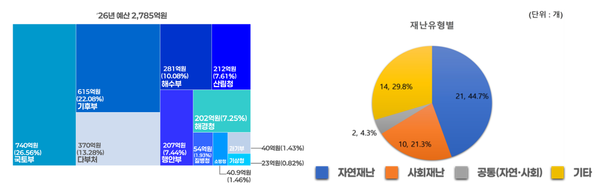
The Ministry of the Interior and Safety also attached materials showing the 2026 ministry-by-ministry budget and disaster-type project distribution for the government-wide disaster safety AX initiative. The source of the materials is the Ministry of the Interior and Safety.
The Ministry of the Interior and Safety and the National Information Society Agency will promote the "Disaster Safety AI Data Build Project." The goal of the project is to convert accumulated disaster safety data into a format that generative AI can immediately use. The target includes large volumes of unstructured documents produced daily, such as the "Daily Safety Management Situation Report" and "Situation Notification Message," which will be converted into AI-specific structured data.
To this end, the government will establish a foundation for integrated analysis of satellite data and materials on disaster-vulnerable areas, and create a structure that interlinks disaster data dispersed across agencies on an incident-by-incident basis. Examples of disaster-vulnerable area materials include natural disaster risk improvement districts and landslide-prone areas. In the event of heavy rainfall, AI will integrate and analyze flood extent and damage data from the Ministry of the Interior and Safety, weather conditions from the Korea Meteorological Administration, river water levels from the Ministry of Climate, Energy and Environment, and 119 emergency call information from the National Fire Agency to autonomously judge hazardous situations.
The Ministry of the Interior and Safety and the National Information Society Agency also plan to support public institutions and private companies in developing services that use disaster safety data. To that end, they plan to define the procedure for surveying data demand and also define the data provision process.
As generative AI-based information searches increase, concerns are emerging that the structure of public websites could affect the accuracy of AI information gathering. Existing websites have multi-step access paths and complex information display structures, and this structure has raised concerns that AI may collect misinformation.
In response, the government is promoting improvements to the accessibility of public websites. For supplemental purposes, when new public websites are built or revamped, it will create an "AI-friendly web environment" and strengthen cooperation among related agencies for that purpose.
At the same time, the government has launched full-scale work on the "AI-based Heavy Rain and Typhoon Response Service Build Project," a key implementation task in the comprehensive plan. The three local governments selected this year through the public contest are Busan Metropolitan City, Yeongcheon in North Gyeongsang Province, and Inje County in Gangwon Province, and the related systems for these three local governments will be built as pilot projects. The system will have functions for real-time analysis of weather information by AI during typhoons and heavy rain, analysis of risk factors such as underground spaces and low-lying areas, analysis of past damage cases, and presentation of evacuation and blockade measures.
The Ministry of the Interior and Safety held a kickoff briefing on the project on the 8th and plans to work with local governments. The ministry plans to verify the effectiveness of the AI decision-support service as a test target by early next year.
Interior and Safety Minister Yoon Ho-jung said he would push ahead with quickly converting and integrating the disaster management data accumulated so far into a form that AI can understand. He added that he would continue pushing ahead with the goal of completing disaster safety AX that provides practical help to frontline public officials.
Source: IT DAILY · Yang Seung-gap
Original: https://www.itdaily.kr/news/articleView.html?idxno=241852
References
This article was produced with the help of an automated content generation algorithm.
Source: IT DAILY
View originalThis article was summarized and organized by BizCrush based on the original article from IT DAILY. For exact quotations and full details, please refer to the original article.