[DigiKey Tech Forum] What Is the Difference Between a Multiphase Boost Converter and a Conventional Boost Converter?
TECHWORLD ·
✦ AI Summary
A boost converter converts a low voltage into a higher voltage.
The single-phase boost converter is simple and effective in structure, but it has limitations in high-power ranges.
A phase-shifted multiphase boost converter improves efficiency under high-load conditions and lowers input and output capacitor requirements.
A boost converter is generally used when converting a low voltage into a much higher voltage. A boost-mode switching power supply performs the function of converting a low voltage into a higher voltage.
The mainstream approach has been the single-phase boost converter. This method has the advantages of a simple structure and effectiveness.
However, the single-phase boost converter has limitations, especially in high-power ranges. As an alternative, a phase-shifted multiphase boost converter has been proposed.
A phase-shifted multiphase boost converter improves efficiency under high-load conditions. It also reduces input and output capacitor requirements.
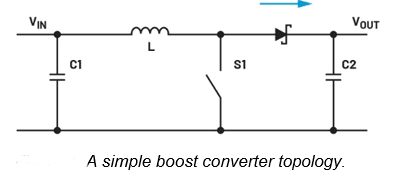
A conventional boost topology operates on the principle of applying pulsed current to an inductor. As a result, the output voltage rises.
The load requires a stable output voltage.
Accordingly, the output capacitor (C2) serves to average the pulses and maintain a constant DC voltage.
For the output capacitor in a boost converter to perform this role reliably, a considerably large capacitance is required.
In addition, the output capacitor is required to have high capacitance and low ESR and low ESL.
One way to ease this burden on the output capacitor is a phase-shifted multiphase boost converter design.
This structure has the characteristic that two or more boost regulators operate in parallel while sharing a single output capacitor, and each channel operates with a 180° phase difference. In a conventional topology, energy is supplied once per cycle, but in the output capacitor of a phase-shifted multiphase structure, energy is supplied multiple times within one cycle.
As a result, power is distributed across multiple paths, reducing the peak current of each component and improving efficiency.
A multiphase boost converter distributes current across multiple paths. By distributing current through multiple paths in a multiphase boost converter, the burden on each component can be reduced.
This structure can reduce input ripple current. Output ripple current can also be reduced.
As ripple current is reduced, the required capacitor size can be reduced. Smaller passive components can be used. More cost-effective passive components can also be used.
It can also improve thermal distribution. These characteristics make it possible to miniaturize power supply designs.
It also makes efficiency improvements possible. Reliability improvements are also possible.
Source: TECHWORLD · Lee Gwang-jae
Original: https://www.epnc.co.kr/news/articleView.html?idxno=407344
References
This article was produced with the help of an automated content generation algorithm.
Source: TECHWORLD
View originalThis article was summarized and organized by BizCrush based on the original article from TECHWORLD. For exact quotations and full details, please refer to the original article.