Surfshark: 6 in 10 AI Bot Comments on SNS Go Unrecognized as Human, and 'Friendly Bots' Are Harder to Spot
TECHWORLD ·
✦ AI Summary
According to an analysis by Surfshark of 1,722 participants worldwide, the rate at which people identified comments written by bots on SNS was 40%.
Bots with a positive, friendly, and logical tone were harder to identify, while angry trolls were generally easy to spot.
In the Korea Press Foundation's "Digital News Report 2026," 59% of respondents in Korea said they were concerned about online misinformation, up 4 percentage points from the previous year.
According to an analysis by Surfshark of 1,722 participants worldwide, the rate at which people identified comments written by bots on SNS was 40%. That means people failed to spot about 6 out of every 10 SNS bot comments.
According to Surfshark, bots with a positive, friendly, and logical tone were the hardest type to identify. Luis Costa, head of research and insights at Surfshark, said positive SNS bots can evade real users' suspicion and could be exploited for social engineering attacks.
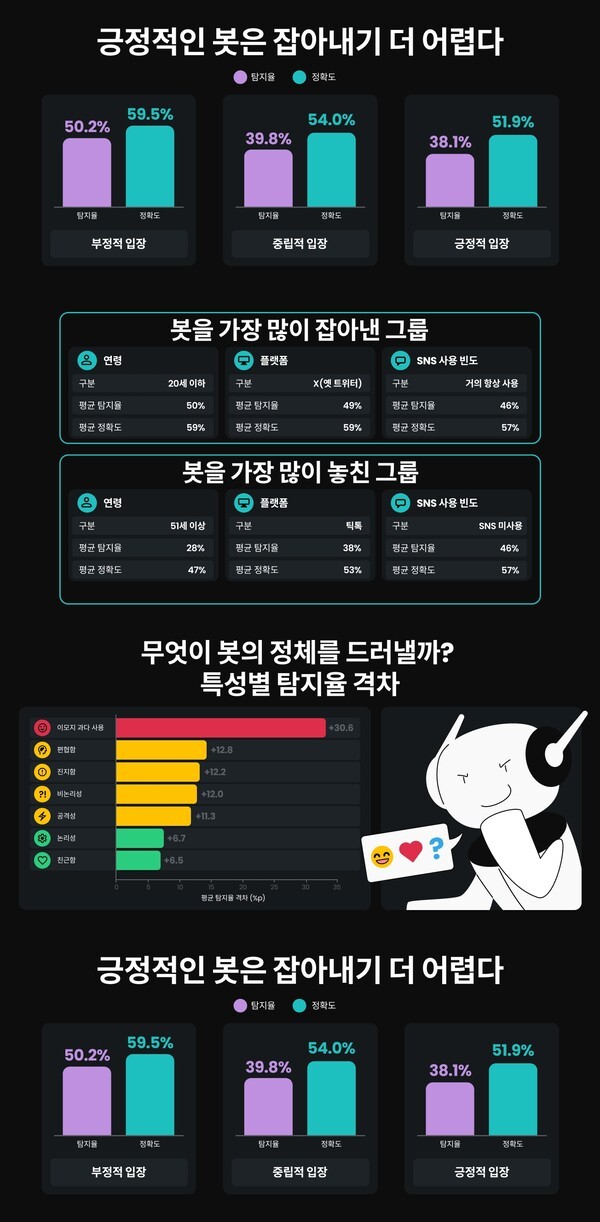
By contrast, Luis Costa explained that angry trolls on SNS are generally easy to identify. He said trolls are also the type most often exposed, and the identification rate for negative AI bots among participants in the virtual SNS environment stood at 50.2%. That means roughly half of the negative AI bots were spotted.
The report also included results from the Korea Press Foundation's "Digital News Report 2026." In Korea, 59% of respondents said they were concerned about online misinformation, up 4 percentage points from the previous year.
The experiment found that people's ability to identify bots varied depending on the tone they adopted. When bots disguised themselves as positive and friendly, the detection rate among participants was 38%. The detection-rate gap was 12 percentage points.
The simulation is currently available online. Anyone can test their ability to tell bots apart.
Costa said AI-based accounts used in sophisticated manipulation campaigns often readily agree with opposing views or blend in by appearing logical and ordinary. He said such accounts can amplify real users' opinions and increase the number of comments, making minority views look like the majority.
Costa also said few people report such accounts. Surfshark warned that on SNS, positive and friendly AI bots are more dangerous than bots that pick fights and irritate others.
Surfshark said bots avoid users' suspicion by appearing friendly and logical. It added that this increases the chances that users will move the conversation to DM, share personal information, click on links posted by bots, or trust the bots' "logical" misinformation.
When AI bots spread misinformation while hiding their identity, they may be able to change political and social views before the other party realizes they are talking to AI. This highlights the risk that users may be influenced before they even notice a bot's identity.
In the simulation, emoji use was identified as a major clue to a bot's identity. Bots that used many emojis had a detection rate of more than 60%, while bots that used very few emojis had a detection rate of 35%. The detection-rate gap was 0.6 percentage points.
However, 3Surfshark said that identifying bots based only on whether they use emojis makes it difficult to protect oneself on SNS. 3Surfshark explained that if scammers simply reduce their habit of overusing emojis, the difficulty of detection rises by about two times.
By platform, users of text-centered platforms had the advantage in the simulation. X, formerly Twitter, users had the highest bot-detection rate at 49% and were judged the best "bot hunters," while TikTok users recorded 38% and Facebook users 39%. X, formerly Twitter, users had higher detection rates than users of image- and video-centered platforms such as TikTok and Facebook, which was interpreted as meaning that AI bots have greater potential to manipulate real users on TikTok and Facebook.
AI-generated content is difficult to identify even with automatic detection tools, and even sophisticated AI content and human-made content are almost impossible to distinguish by eye. In this context, Costa offered advice on how to protect yourself on SNS, recommending that users look at the account rather than the content when deciding. He pointed to the account creation date, profile photo, and bio as items to check.
He also listed signs that strongly suggest a fake account, including newly created accounts, generic photos, vague bios, and a history of repeatedly posting the same message. Costa warned that the more heated SNS arguments become, the more emotions take over, making it easier to miss fake accounts and mistake real people for bots. He also said users should not assume someone is real simply because they agree with or support their opinions, adding that formulaic support concentrated over a short period is the kind of reaction bots can easily produce.
Source: TECHWORLD · Lee Gwang-jae
Original: https://www.epnc.co.kr/news/articleView.html?idxno=407396
References
This article was produced with the help of an automated content generation algorithm.
Source: TECHWORLD
View originalThis article was summarized and organized by BizCrush based on the original article from TECHWORLD. For exact quotations and full details, please refer to the original article.